OBUASI SHTS SCANDAL BLOWS OPEN WIDER SCHOOL SAFETY CRISIS AS EDUWATCH DEMANDS NATIONWIDE AUDIT OF SEXUAL MISCONDUCT CASES
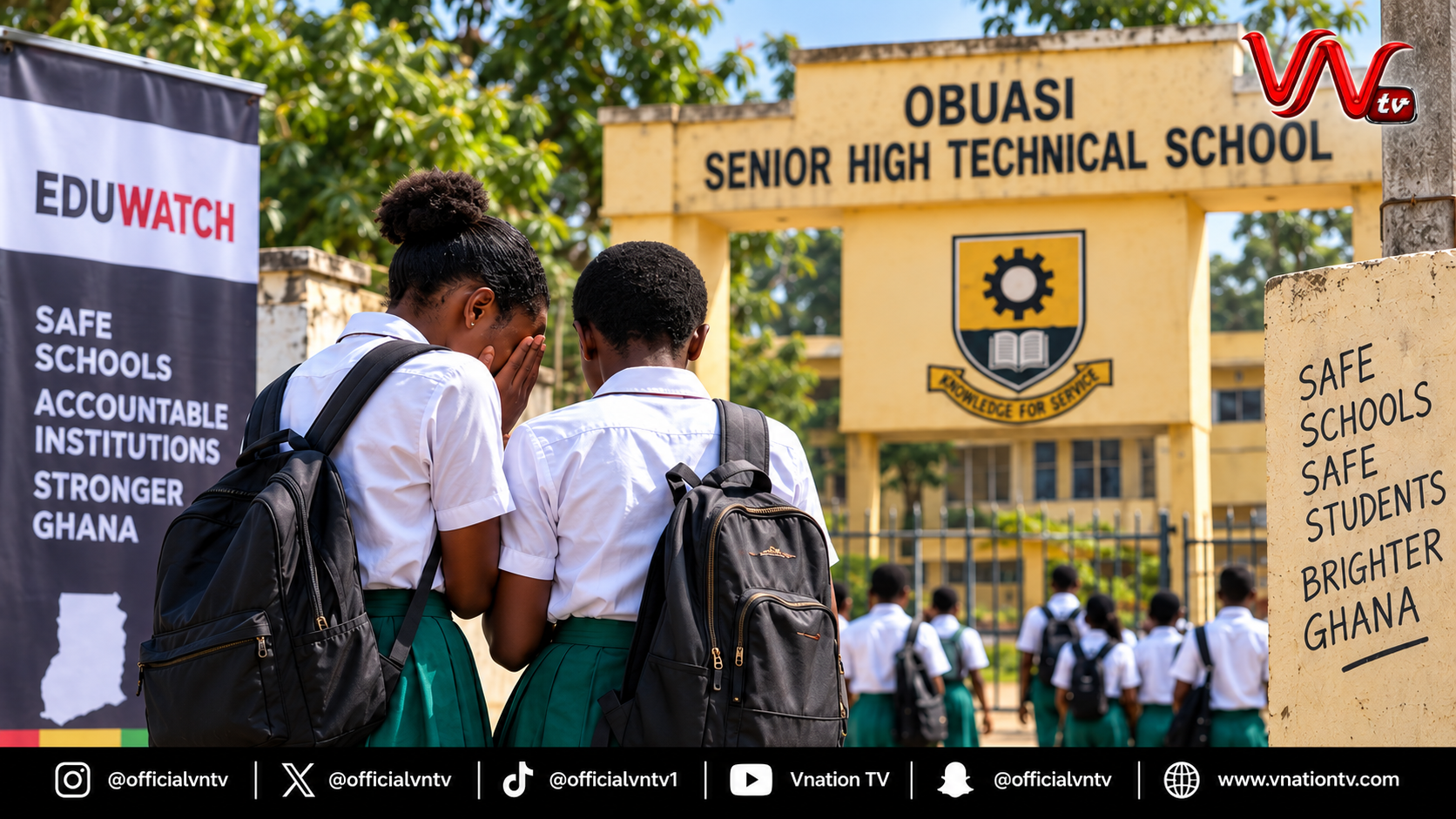
Africa Education Watch has called for an independent nationwide audit of sexual misconduct and safeguarding systems in Ghana’s secondary schools following the growing Obuasi Senior High Technical School scandal. Eduwatch says the review should examine both reported and unreported cases, how complaints are handled and whether school, district and regional officials follow proper safeguarding procedures. The organisation says the Obuasi allegations involving interdicted headmaster Zakaria Abdulai reveal possible failures across the education system, with complaints reportedly reaching officials months before national action was taken. Investigative reporting says the number of female students alleging abuse has risen to 16, while the allegations remain under investigation.
Africa Education Watch is demanding an independent nationwide audit of sexual misconduct and safeguarding systems across Ghana’s secondary schools after disturbing allegations at Obuasi Senior High Technical School raised fresh questions about how schools, district education offices and the Ghana Education Service respond when students report abuse. The education policy advocacy organisation says the Obuasi case should not be treated as an isolated scandal involving one headmaster, arguing instead that the allegations expose wider weaknesses in prevention, reporting, investigation, accountability and the protection of students who come forward. Eduwatch wants the Ministry of Education to commission an external review led by competent investigative and child protection institutions outside the Ghana Education Service and the TVET Service, with the aim of establishing how widespread reported and unreported sexual misconduct may be, identifying institutional risk factors and determining whether existing complaint and referral systems are actually working.
The call follows ongoing revelations surrounding the interdicted headmaster of Obuasi Senior High Technical School, Zakaria Abdulai, who is facing multiple allegations of sexual misconduct involving female students. The allegations remain under investigation and have not been proven in court, but the scale of the claims and the length of time some complaints were allegedly known to school and education authorities have triggered national concern. Investigative journalist Manasseh Azure Awuni initially reported allegations involving 14 female students, before saying the number of students who had come forward increased to 16 as his investigation progressed. He said the first information he received concerned five students, but further accounts emerged when he travelled to Obuasi and began speaking with people connected to the school.
What has made the scandal especially damaging is not only the number of allegations but the suggestion that warning signs and complaints had reached responsible officials months before decisive national action was taken. Eduwatch says the school’s Girl Child Coordinator, who also served as a safeguarding officer, petitioned school management in February 2026. Five students then reportedly approached the Municipal Education Directorate in March with allegations that they had been sexually assaulted by the headmaster. Further incidents were allegedly reported in June and July. According to Eduwatch, that timeline raises serious questions about whether mandatory safeguarding procedures were followed and whether officials at school, municipal and regional levels responded with the urgency required when allegations involve students under the care of the state.
The concerns became even more serious after the Obuasi East Municipal Education Director, Kwabena Owusu Nketia, provided details of an earlier committee process that reportedly invited dozens of witnesses to give evidence. According to local reporting, 49 people were invited to participate in that inquiry, including 26 students, but only nine of the 26 students ultimately appeared before the committee. The director said some parents would not allow their children to attend and that some students had also been discouraged by teachers. Those figures have raised difficult questions about whether students felt safe enough to participate in official processes, whether families feared consequences, and whether adults within the education system may have influenced the ability of complainants to tell their stories freely.
The Education Director’s earlier account also indicated that five female students had approached the Municipal Education Directorate in March 2026 with allegations against the headmaster. He reportedly explained that he became ill around the same period and that the investigation did not move forward as expected. Manasseh Azure Awuni later questioned why a matter involving allegations from several students could stall because one official was unavailable and why there was not a stronger institutional mechanism capable of taking over immediately. That issue goes to the heart of Eduwatch’s argument: a safeguarding system cannot depend entirely on the availability, discretion or personal initiative of a single school or district official when serious allegations involving students arise.
Eduwatch says the pattern suggests that Ghana needs to move away from a largely reactive approach in which serious action tends to come only after media investigations, public outrage or violent incidents. The organisation welcomed the interdiction of Abdulai and the decision to involve the police, but said suspending the headmaster alone would not be enough. It wants investigators to examine the actions and omissions of every official who received complaints, became aware of allegations or had responsibility for student safeguarding before the case exploded into national attention. Where officials are found to have suppressed complaints, discouraged students from reporting or compromised safeguarding processes, Eduwatch says disciplinary action should follow, subject to proper investigation and due process.
The Ghana Education Service formally interdicted Abdulai on October 14 and ordered him to hand over management of the school to the Ashanti Regional Director of Education while a full investigation proceeds. GES said the decision followed allegations of sexual misconduct involving students and confirmed that a complaint had also been lodged with the police. Education Minister Haruna Iddrisu separately directed that the headmaster be suspended and requested that the Criminal Investigations Department headquarters of the Ghana Police Service investigate the matter. Those actions represent the strongest official response so far, but they came after months of alleged complaints and after the controversy had already contributed to serious unrest at the school.
The case has also moved into the criminal justice system. The Domestic Violence and Victim Support Unit of the Ashanti South Regional Police Command has forwarded a docket involving one of the rape allegations to the Attorney General’s Office for study and advice. According to police, a 20 year old Form Two student, accompanied by her father, lodged a complaint in August alleging that the headmaster forcibly had sexual intercourse with her at his official residence on the school campus on July 25. The allegation remains subject to legal review and Abdulai has not been convicted of the offence. The forwarding of the docket is significant because it means at least one allegation has moved beyond internal education procedures into a formal criminal process.
The controversy has meanwhile affected the entire school community. Obuasi SHTS was temporarily closed following a student rampage linked to anger over the allegations, with property damaged during the disturbances. First year students posted to the school were left waiting to begin classes while authorities assessed whether the campus was safe to reopen. GES has said the closure was based on security concerns and that reopening would depend on assurances from police that the environment was conducive for academic work. Traditional leaders and local stakeholders have also been involved in discussions over how and when the school should resume normal operations.
For Eduwatch, however, the central danger is that national attention could remain fixed on Obuasi while similar cases elsewhere disappear inside poorly functioning administrative systems. The organisation cited a review documenting 44 reported cases involving teachers and school heads accused of sexually abusing students between January 2015 and October 2026. More than half of those cases had no publicly reported final verdict or sanction. Eduwatch is careful to say that those figures do not establish the national prevalence of sexual abuse in schools. They do, however, indicate persistent weaknesses in how allegations are tracked, investigated and concluded. In many cases, the public hears about an accusation and an interdiction but never learns whether the allegation was substantiated, dismissed or resulted in a disciplinary or criminal sanction.
That lack of closure creates problems in both directions. Students who report genuine abuse may conclude that nothing happens after they come forward, while teachers falsely accused of misconduct can remain under suspicion indefinitely if investigations are never properly concluded and communicated. Eduwatch therefore argues that standardised safeguarding procedures are necessary not only to protect students but also to guarantee fairness and due process for accused staff. Kofi Asare, the organisation’s Executive Director, has said the absence of clear standard operating procedures creates inconsistent responses across schools, allowing one allegation to trigger immediate interdiction while another may remain unresolved for months.
Asare has also called for the creation of a sex offenders register and mandatory criminal background checks for teachers as part of broader reforms. His argument is that education authorities should have access to reliable information about individuals with established histories of sexual offending or serious safeguarding violations before those individuals are placed in positions involving students. He has pointed to practices in other jurisdictions where background checks are routine in professions involving children and has argued that Ghana’s education sector needs stronger preventive mechanisms rather than relying almost entirely on complaints after harm may already have occurred.
A nationwide audit, as proposed by Eduwatch, would go further than examining individual teachers. It would assess the systems schools use to prevent abuse and what happens after a complaint is made. That could include whether students know who to report concerns to, whether girl child coordinators and guidance officers are properly trained, whether complaints are documented, whether parents are informed, whether cases involving possible crimes are referred to police, whether accused staff are temporarily removed from positions where they could interfere with witnesses, and whether victims receive medical, psychological and legal support.
The organisation also wants investigators to examine institutional and behavioural risk factors. In boarding schools, headteachers and senior staff often exercise significant authority over students’ movements, accommodation, discipline and access to privileges. That imbalance of power can make it difficult for students to challenge inappropriate behaviour, particularly when they fear punishment, academic consequences or disbelief from adults. The problem can become even worse where a school culture treats complaints against senior officials as threats to the institution’s reputation rather than as safeguarding matters that require independent investigation.
Fear of retaliation is already part of the Obuasi controversy. A father of one student has publicly alleged that some parents were being threatened or pressured to abandon complaints. That claim has not been independently proven, but it reinforces Eduwatch’s demand that victims and families receive protection from intimidation and victim blaming. The organisation says confidential medical, psychosocial, legal and educational support should be made available to affected students and that any nationwide audit must create channels through which students can speak safely without fearing consequences from teachers, administrators, classmates or community figures.
This issue is especially important because sexual misconduct cases in schools can be underreported. A student who believes school authorities will protect a teacher may decide silence is safer than making a complaint. A child may also fear being blamed, ridiculed or exposed publicly. Families sometimes worry about the effect of a scandal on their child’s education or future marriage prospects. In smaller communities, parents may also fear confrontation with influential teachers or local officials. Those pressures mean official case numbers may capture only a portion of actual misconduct, which is one reason Eduwatch says a national audit should investigate both reported and unreported patterns.
The Obuasi SHTS allegations have also reignited debate about the difference between consensual adult relationships and teacher student relationships involving young people who are subject to institutional authority. Even where a student has reached the legal age of consent, an education system still has to consider professional ethics, power imbalance and the duty of care teachers owe students. School staff control academic assessments, discipline, recommendations and access to institutional opportunities, making sexual relationships with students professionally dangerous even before questions of criminal law arise.
Where students are minors, the safeguarding responsibilities become even more serious. Teachers and school leaders occupy positions of trust and are expected to protect students rather than exploit access to them. That is why Eduwatch argues that Ghana needs a national system capable of identifying risk before abuse occurs and responding immediately when allegations are raised.
The organisation is also concerned about the independence of the current investigation. Its October 16 statement said the alleged failures stretch from the school level through the education administration, creating legitimate questions about whether the same institutions accused of failing to respond should be solely responsible for investigating what went wrong. Eduwatch therefore wants external investigative and child protection bodies involved in reviewing the Obuasi case and the wider national system.
That recommendation could require coordination among the Ministry of Education, Ghana Police Service, Department of Social Welfare, child protection specialists and possibly independent civil society organisations. A truly national audit would also have to cover both GES and TVET institutions because students in technical and vocational schools face many of the same safeguarding risks as those in traditional senior high schools.
The scope would be enormous. Ghana has hundreds of secondary schools spread across every region, each with different leadership structures, boarding arrangements and local reporting cultures. A meaningful audit could not simply ask headteachers whether their schools have received complaints. Investigators would need to examine records, interview safeguarding officers, review disciplinary processes and create confidential ways for students and former students to disclose experiences without passing through the same officials they may fear.
Such an exercise would also need strict safeguards against false allegations and reputational harm. Anonymous reporting can help victims speak, but allegations cannot automatically be treated as proven. Investigators would need clear procedures for preserving evidence, protecting identities and giving accused persons an opportunity to respond. Eduwatch’s broader argument is that strong safeguarding and due process are not opposing goals. A well designed system should be capable of protecting students while ensuring investigations are fair.
The current crisis suggests Ghana does not yet have that consistency. Eduwatch says different schools respond differently to similar allegations, and Kofi Asare has pointed to previous cases in which headteachers were interdicted over misconduct claims but later not found culpable. In his view, this inconsistency is precisely why standard procedures are necessary. The system should not depend on how powerful an accused teacher is, how vocal parents become, whether students riot or whether an investigative journalist takes interest.
The role of media in the Obuasi case has itself become uncomfortable for the education establishment. The strongest national action came after the findings of Manasseh Azure Awuni’s investigation became public. Eduwatch has questioned why safeguards meant to protect children appeared unable to produce an equivalent response earlier, when complaints had allegedly already reached education officials. If investigative journalism becomes the mechanism required to force action, the organisation argues, then the formal safeguarding chain is not functioning as it should.
That does not mean every allegation reported to a school must lead immediately to dismissal. It means there should be a predictable and documented process. Serious allegations should be recorded, the safety of complainants assessed, possible criminal conduct referred to the appropriate authorities, conflicts of interest managed, and investigations completed within reasonable timelines. Students should also know what is happening rather than watching a complaint disappear into administrative silence.
The revelations about the earlier Obuasi committee have strengthened that concern. If 26 students were invited but only nine appeared, investigators need to understand why the majority stayed away. If parents blocked participation because they feared the process, that is a safeguarding problem. If teachers discouraged students from attending, that could be even more serious. If some students simply chose not to participate for personal reasons, that too should be understood rather than assumed. A national audit could help establish whether similar barriers exist in other schools.
The debate also places pressure on the Ministry of Education to determine whether the response should be limited to investigating one headmaster or expanded into a systemic review. Minister Haruna Iddrisu has already ordered the suspension and police investigation, signalling that the government considers the Obuasi allegations serious. Eduwatch now wants the ministry to take the next step by examining the national system that allowed complaints in this case to remain unresolved for so long.
GES has publicly reiterated its commitment to student safety and professional conduct. The real test will be whether that commitment produces structural reforms after the immediate scandal subsides. Public institutions often respond strongly when a case dominates national headlines, only for attention to fade once the news cycle moves on. Eduwatch is attempting to prevent that by framing Obuasi as evidence of a wider governance problem rather than a single disciplinary case.
The proposed nationwide review could also reveal schools that are handling allegations well, allowing the Ministry to identify practices that could be standardised nationally. Some institutions may already have strong reporting systems, active guidance units and leadership that responds quickly. Understanding why those schools perform better could be as important as identifying failures.
There is also a training issue. Headteachers and teachers are educators, not investigators, yet they are often the first people to receive allegations. Without clear training, staff may inadvertently compromise evidence, confront accused persons too early, expose complainants or treat potential crimes as internal disciplinary matters. Safeguarding officers need to know when their responsibility is to support a student and when the matter must be referred immediately to police or child protection authorities.
Parents require similar education. Families should know that they do not have to rely exclusively on school authorities when a child alleges sexual abuse. They can report directly to police, DOVVSU, social welfare authorities or other appropriate agencies. Making that information widely available could reduce the power any single school administrator has to suppress a complaint.
The Obuasi case has become a painful example of what can happen when confidence in internal systems collapses. Students allegedly believed serious accusations had not been addressed, anger built within the school, violence eventually erupted and the institution closed. That outcome harmed students who had nothing to do with the allegations, including newly admitted pupils who could not begin classes. A functioning safeguarding system should protect victims while also preventing unresolved accusations from destabilising entire schools.
Eduwatch’s intervention therefore goes beyond calling for punishment. Its central argument is that Ghana needs a system in which prevention, reporting, investigation and accountability operate before a crisis reaches the point of school riots, national media exposés and ministerial intervention.
For the students at the centre of the Obuasi allegations, however, institutional reform will not replace the need for justice in the current case. Police and the Attorney General must determine what can be proven under criminal law. Education authorities must establish whether professional misconduct occurred. Officials who received complaints must explain what action they took and why. Students who came forward must receive support and protection.
The headmaster is entitled to due process and remains accused rather than convicted. The same principle applies to any education official whose handling of the complaints is now being questioned. A credible investigation must distinguish between administrative failure, negligence, deliberate suppression and circumstances where officials acted reasonably based on the information available to them.
But the number of questions now surrounding the case makes a narrow inquiry increasingly difficult to justify. Sixteen students have reportedly made allegations during the wider investigation. Five girls allegedly approached the Municipal Education Directorate months before the scandal became national. A previous committee reportedly struggled to hear from most students it invited. One criminal docket has reached the Attorney General. Parents have alleged intimidation. The headmaster has been interdicted. The school was closed following unrest.
Taken together, those developments are why Eduwatch says Ghana should stop asking only what happened at Obuasi SHTS and begin asking how many other schools may have safeguarding systems with similar weaknesses.
The organisation wants an independent national answer.
If the Ministry of Education accepts that challenge, the result could become one of the most extensive reviews of student protection in Ghana’s secondary education system in years. It could also expose uncomfortable truths about how schools have historically handled sexual misconduct, how often complaints disappear without resolution and how much confidence students actually have in the adults responsible for protecting them.
For now, Eduwatch’s message to government is straightforward. Obuasi should not end with the suspension of one headmaster. The scandal should become the starting point for a nationwide examination of whether Ghanaian schools are genuinely safe places for the young people entrusted to them.