RAMAPHOSA REINSTATES SOUTH AFRICA POLICE CHIEF FANNIE MASEMOLA AFTER CHARGES WITHDRAWN
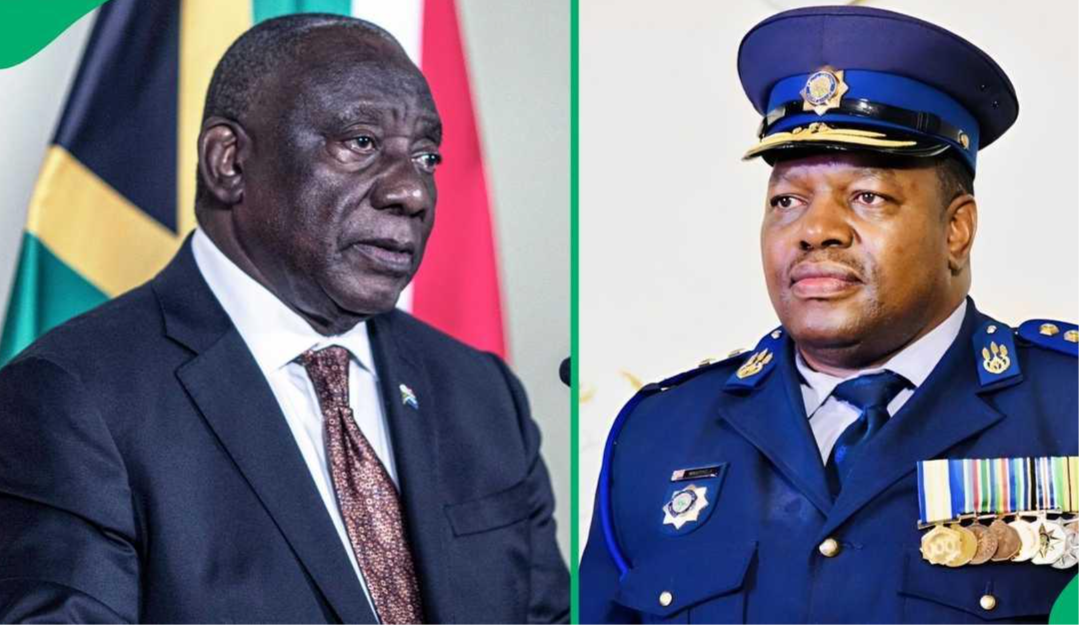
President Cyril Ramaphosa has lifted the precautionary suspension of South Africa’s National Police Commissioner General Fannie Masemola, who will resume full duties on Monday, October 19. Masemola had been suspended in April after being charged with alleged breaches of the Public Finance Management Act linked to a controversial SAPS healthcare tender. Prosecutors ordered the charges withdrawn on September 15, and the Pretoria Magistrate’s Court formally withdrew them on September 22.
South African President Cyril Ramaphosa has lifted the precautionary suspension of National Police Commissioner General Fannie Masemola, clearing the way for the country’s top police officer to return to full duty on Monday, October 19, after prosecutors withdrew the criminal charges that led to his suspension six months ago.
The Presidency announced the decision on Friday, October 16, saying Masemola would resume leadership of the South African Police Service after the National Prosecuting Authority concluded that the case against him should not proceed. Ramaphosa also thanked Lieutenant-General Puleng Dimpane, who served as Acting National Police Commissioner during Masemola’s absence and managed the organization through a turbulent period of institutional scrutiny, criminal investigations and public concern over alleged corruption within parts of the policing system.
Masemola was placed on precautionary suspension in April 2026 after appearing in the Pretoria Magistrate’s Court to face charges of contravening the Public Finance Management Act. The charges were linked to a controversial South African Police Service healthcare tender awarded to Medicare24, a company associated with businessman Vusimuzi “Cat” Matlala, who has been described in court and media reporting as an alleged criminal figure. The case became one of several high-profile matters intensifying scrutiny of the relationship between senior police officials, procurement systems and private contractors.
The exact value attached to the tender has varied across public reporting because different parts of the broader procurement arrangement have been described separately, but authorities have consistently linked the case to a multimillion-rand police health-services contract. The allegations against Masemola centered on whether he had failed to comply with public finance and procurement rules rather than on a final judicial finding that he personally benefited from the contract.
Masemola denied wrongdoing, and his suspension was precautionary rather than punitive. That distinction became more important after prosecutors reviewed the case and decided not to continue with the charges. On September 15, the National Director of Public Prosecutions instructed that the charges against Masemola be withdrawn, and the Pretoria Magistrate’s Court formally removed them on September 22. The Presidency’s decision to reinstate him follows that sequence of events rather than a separate political settlement.
The withdrawal of charges does not erase the wider controversy surrounding the tender, however. The procurement arrangement has featured in the Madlanga Commission of Inquiry, which is examining allegations that criminal syndicates and politically connected actors have penetrated parts of South Africa’s law-enforcement and criminal justice structures. The commission has become one of the most significant institutional investigations into police integrity in recent years and continues to examine claims involving procurement, interference in investigations and relationships between police officials and alleged criminal networks.
Masemola’s reinstatement therefore comes at a particularly sensitive time for the SAPS. The organization faces pressure not only to respond to South Africa’s high levels of violent crime but also to restore public confidence in the integrity of senior police leadership. Acting Police Minister Firoz Cachalia said the return of the national commissioner provides an opportunity to maintain focus on operational priorities and continue the Police Reset Agenda, which is intended to strengthen professionalism, accountability and institutional capacity across the service.
The minister’s statement makes clear that government wants the transition back to Masemola’s leadership to be framed around operational continuity rather than the political controversy surrounding his suspension. Cachalia praised Lieutenant-General Dimpane for her leadership during the interim period and said the ministry remained focused on building a capable and trusted police service.
The timing of Masemola’s return is also significant because the SAPS has experienced other senior-level disruptions in recent months. Former Deputy National Police Commissioner Shadrack Sibiya resigned this week after being suspended and facing separate serious criminal allegations, including rape, sexual grooming and links to alleged criminal networks. Sibiya denies the allegations, and his case is separate from Masemola’s. His resignation nevertheless adds to the sense of upheaval within the upper ranks of the police service.
Against that background, Ramaphosa’s decision restores a measure of continuity at the top of the organization. Masemola had been serving as national commissioner before his suspension and returns with the formal backing of the Presidency after the criminal case against him was withdrawn.
The Presidency’s statement was concise and avoided language suggesting that the earlier allegations had been proven false in every respect. It focused specifically on the legal development that the charges had been withdrawn and on Masemola’s resumption of duties. That distinction is important because the end of a prosecution does not necessarily resolve every administrative, institutional or factual question raised by the underlying procurement process.
The government has not announced that all reviews connected to the tender have ended. The wider procurement controversy remains part of ongoing institutional scrutiny, and the Madlanga Commission continues its examination of allegations involving corruption and criminal influence within the justice system.
Masemola’s return may therefore place him back at the center of questions about how the SAPS intends to respond to the findings and evidence emerging from those processes. As national commissioner, he will again carry responsibility for operational leadership of an organization confronting both external security threats and internal credibility problems.
South Africa continues to struggle with serious violent crime, including murder, armed robbery, extortion, organized crime and politically linked killings in some provinces. The police service is under sustained pressure to improve detective work, intelligence coordination, visible policing and case preparation while also dealing with shortages of personnel and equipment in parts of the country.
The country has also seen repeated public concern over the ability of organized criminal groups to influence state institutions. Allegations that criminal syndicates have cultivated relationships inside law enforcement have made internal discipline and anti-corruption measures central to the government’s policing agenda.
The Madlanga Commission was established specifically against that backdrop. Its work has drawn attention to claims that some police officials, prosecutors and politically connected individuals may have interfered with investigations or enabled criminal networks to operate with protection.
Masemola’s reinstatement does not automatically resolve those structural concerns. It instead restores him to a leadership role in which he will be expected to respond to them.
His return may also help clarify lines of authority within the SAPS after months in which Dimpane served in an acting capacity. Acting appointments can preserve continuity, but they often come with uncertainty over long-term strategy, senior appointments and institutional reform. A permanent national commissioner has greater authority to implement sustained operational decisions and hold senior commanders accountable.
The police ministry has emphasized that the service must remain focused on its constitutional mandate to protect the public and enforce the law. That message reflects concern that controversies involving senior officials can distract from day-to-day policing and deepen public distrust.
Masemola will therefore return to a role that is both operational and symbolic. His leadership will be judged not only by crime statistics but by how effectively the organization responds to allegations of corruption within its own ranks.
The withdrawn case will also remain politically relevant. Opposition parties and civil society organizations are likely to continue asking how the original prosecution was initiated, why it was ultimately abandoned and whether procurement weaknesses exposed by the controversy have been corrected.
Supporters of Masemola’s reinstatement have argued that once the charges were withdrawn, there was no longer a sufficient basis to keep him suspended. Before Ramaphosa’s announcement, political groups and labor organizations including the South African Police Union had publicly called for his return, arguing that continued suspension after the prosecution ended was unfair and potentially damaging to the institution.
Critics, however, may continue to argue that the broader procurement controversy requires further institutional scrutiny even if the criminal case against Masemola has ended. Those are separate questions. A person may no longer face prosecution while administrative or governance concerns connected to the same events remain under examination.
That distinction will be important in the months ahead because South Africa is attempting to rebuild trust in criminal justice institutions at a time when public confidence has been weakened by repeated allegations against senior figures.
Masemola’s reinstatement also puts renewed focus on Ramaphosa’s handling of senior police leadership. The president has previously presented institutional reform and anti-corruption measures as central to his administration, making personnel decisions involving law-enforcement leadership politically sensitive.
By lifting the suspension after prosecutors abandoned the case, Ramaphosa is signaling that Masemola can return to office while the government continues dealing separately with broader corruption concerns.
The immediate administrative transition is expected to be straightforward. Masemola will resume full duties on Monday, October 19, while Dimpane returns from the acting national commissioner role after six months leading the service.
The Presidency thanked Dimpane publicly, saying she served with distinction during the interim period. That acknowledgment suggests government wants to avoid any perception of instability or conflict surrounding the leadership handover.
For Masemola, the priority will be reasserting command over a police service facing multiple operational challenges. Crime prevention, organized crime investigations, extortion, firearms trafficking, political violence and corruption within the police itself remain major areas of concern.
The service is also under pressure to improve internal discipline. Allegations involving senior officers have damaged public confidence and strengthened calls for more aggressive vetting, lifestyle audits and independent investigation of police misconduct.
Masemola’s own experience with suspension may influence how closely his leadership is scrutinized on these issues. Any perception that senior officers are treated differently from rank-and-file personnel could become politically damaging, particularly if future allegations emerge.
The commissioner will also need to work closely with Acting Police Minister Cachalia, whose ministry has been promoting the Police Reset Agenda. The initiative is intended to improve professionalism and strengthen operational effectiveness across the SAPS.
That agenda will likely include closer attention to command structures, procurement controls and accountability mechanisms. The controversial healthcare tender that led to Masemola’s prosecution exposed the reputational risks created when procurement decisions become entangled with alleged criminal figures.
Even though the charges against Masemola were withdrawn, the government will face pressure to demonstrate that safeguards around police procurement are strong enough to prevent similar controversies.
The broader criminal justice system is facing similar scrutiny. Prosecutors, investigators and intelligence structures have all been drawn into debates over institutional independence and the influence of criminal networks.
The Madlanga Commission’s continuing work means new evidence or testimony could still generate further controversy around current or former officials. Masemola will therefore return to office in an environment where senior police leadership is likely to remain under intense public and judicial examination.
His reinstatement may nevertheless provide some institutional stability. A prolonged vacancy or acting leadership arrangement could have made it harder to implement long-term reforms while the organization dealt with continuing investigations and public pressure.
The president’s decision also reflects the legal principle that precautionary suspension is not equivalent to guilt. Masemola was removed temporarily while facing criminal charges, and once those charges were formally withdrawn, the rationale for keeping him out of office became significantly weaker.
That does not mean the original concerns were imaginary or that every issue surrounding the tender has been settled. It means the criminal case against the commissioner did not proceed and the government has decided he should resume his constitutional and operational responsibilities.
South Africa’s wider policing crisis will remain unresolved regardless of who occupies the top post. High violent-crime levels, organized criminal networks, police corruption and uneven service delivery continue to challenge the SAPS.
Masemola’s effectiveness will therefore be measured by whether he can strengthen investigations, improve accountability and restore confidence in an institution facing substantial pressure.
The return also comes as South Africa approaches a period of heightened political activity, with local government elections increasing demands on policing, public-order management and intelligence coordination. Ensuring election security while avoiding political interference will be another key responsibility for the commissioner and senior command.
Police leadership will also have to deal with politically motivated violence in some parts of the country. Recent killings linked to local political disputes have reinforced concerns about intimidation and organized violence around public office and party structures.
In that environment, institutional credibility becomes especially important. Political parties must have confidence that the police are acting impartially, while communities need assurance that criminal investigations are not being influenced by political or private interests.
Masemola’s return will therefore be watched closely not simply because of his personal legal history but because of the broader moment confronting South African policing.
The withdrawal of charges has removed the immediate legal barrier to his leadership, but it has not removed the political and institutional expectations surrounding the office.
The next stage will be defined by how the commissioner responds to the issues that developed during his absence. He returns to a police service under heavier scrutiny than when he left it in April, with ongoing inquiries raising fundamental questions about procurement, integrity and criminal infiltration.
Ramaphosa’s decision gives Masemola the opportunity to lead the institutional response to those challenges. It also means that responsibility for the SAPS’s direction will once again rest clearly with a permanent national commissioner rather than an acting appointment.
For the government, the reinstatement closes one personnel dispute but does not close the wider debate about policing reform. The criminal justice system remains under investigation, allegations against other senior figures continue to move through legal processes and organized crime remains a serious national concern.
The immediate development is nevertheless clear. Fannie Masemola will return to his post on Monday after six months away, following the withdrawal of the charges that triggered his precautionary suspension.
The longer-term significance will depend on whether his return strengthens stability and accountability inside the police service or simply marks another transition in an institution still grappling with deep structural challenges.
Ramaphosa has restored his police commissioner to office. The next test will be whether Masemola can use that restored authority to confront the operational and integrity problems that continue to shape public confidence in South African law enforcement.