SAUDI ARABIA INTERCEPTS TWO BALLISTIC MISSILES AND THREE DRONES AS RIYADH, ABHA AND KHAMIS MUSHAIT RECEIVE FRESH SECURITY ALERTS
Saudi Arabia says its air defenses intercepted and destroyed two ballistic missiles and three drones launched by Yemen’s Houthi movement early on October 18. The coalition said both missiles were heading toward Khamis Mushait, while two drones were intercepted over the Riyadh region and another over the Eastern Province. Saudi Civil Defense temporarily issued danger warnings in Riyadh, Abha and Khamis Mushait before announcing that the immediate threat had passed. The incident followed another series of drone interceptions on Saturday and coalition strikes that Saudi officials say destroyed two Houthi ballistic missile launchers in Yemen’s Saada governorate. No casualties or major damage were reported from the latest interceptions.
Saudi Arabia says its air defense systems intercepted and destroyed two ballistic missiles and three drones launched by Yemen’s Houthi movement in a fresh overnight attack that triggered temporary danger alerts across Riyadh and parts of the kingdom’s south before authorities announced that the immediate threat had passed. The Saudi-led Coalition to Support Legitimacy in Yemen said early Sunday, October 18, that two ballistic missiles were heading toward Khamis Mushait in southern Saudi Arabia, while two drones were intercepted over the Riyadh region and a third was destroyed over the Eastern Province. The latest interceptions add to a rapidly intensifying cycle of cross-border missile and drone attacks that has again placed Saudi cities, airports, energy infrastructure and strategic installations under heightened security pressure.
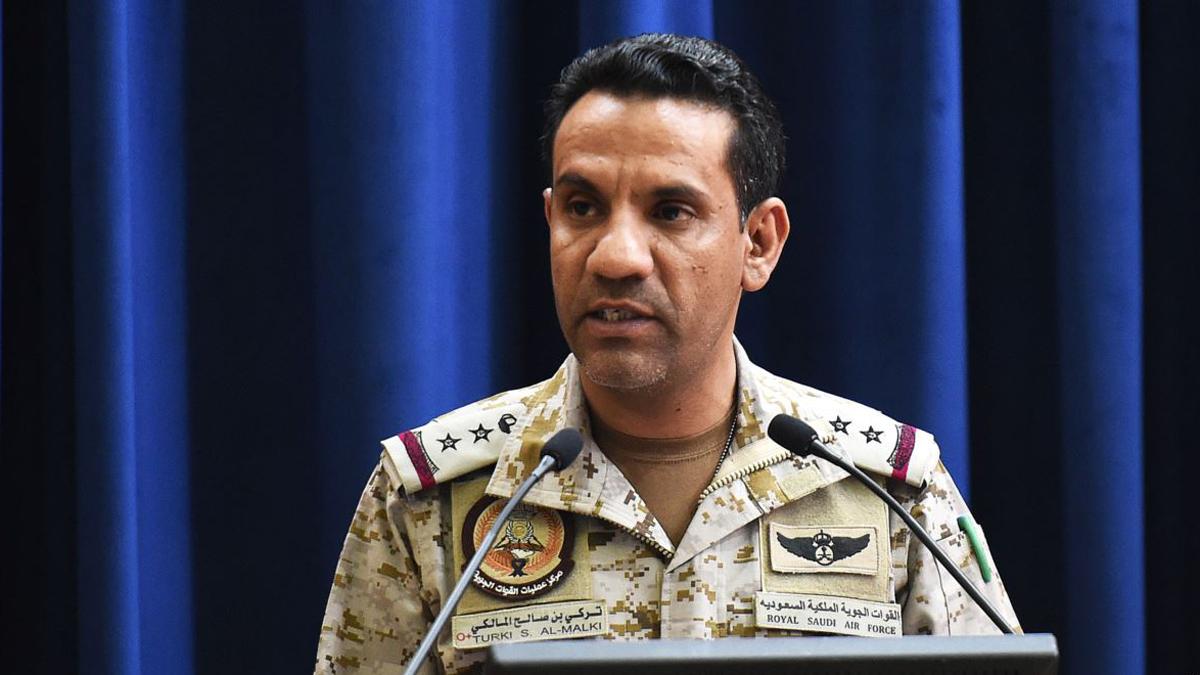
Coalition spokesperson Major General Turki al-Maliki said the two ballistic missiles were launched by the Houthis toward Khamis Mushait, an important city in Asir Province close to major Saudi military facilities. Saudi authorities said the missiles were intercepted before reaching their intended destination. The coalition also reported that two unmanned aerial vehicles were destroyed over the Riyadh region and another over the Eastern Province, expanding the geographical spread of the overnight threat well beyond areas immediately adjacent to Yemen.
Saudi Civil Defense activated the kingdom’s public early warning system as the threat developed, sending alerts to residents in Riyadh, Abha and Khamis Mushait warning of possible hostile aerial activity. The alerts were later lifted after authorities said the danger had passed. The renewed use of public warnings is significant because Saudi Arabia has faced growing scrutiny over the effectiveness and consistency of its civilian alert system during the current escalation, particularly following deadly attacks on aviation infrastructure earlier in October.
The overnight interceptions followed another series of military incidents on Saturday. The Saudi-led coalition said it had intercepted four drones over several hours across the Riyadh region, the Eastern Province and southern Saudi Arabia. Al-Maliki also announced that coalition forces had destroyed two ballistic missile launchers in Yemen’s northern Saada governorate, a Houthi stronghold near the Saudi border. The coalition released footage that it said showed the launchers being struck after they had been used to fire missiles toward Saudi territory.
Saudi Arabia’s latest announcement comes amid a renewed escalation in the Yemen conflict after several years in which large-scale direct attacks on the kingdom had significantly decreased. The internationally recognized Yemeni government and the Houthis remain divided over control of the country, and the resurgence of missile and drone attacks has again brought the conflict directly into Saudi territory. Riyadh intervened militarily in Yemen in 2015 after the Houthis seized the capital Sanaa and expanded across large parts of northern and western Yemen.
The recent attacks have demonstrated that the Houthis retain a substantial arsenal of ballistic missiles, cruise missiles and unmanned aircraft capable of striking targets hundreds of kilometers from Yemen. The group has repeatedly targeted Saudi airports, energy facilities and other infrastructure during different stages of the war. The current escalation has renewed concern over the ability of Saudi air defenses to protect a country whose strategic infrastructure is spread across an enormous geographical area.
Khamis Mushait has been one of the locations most frequently targeted during years of cross-border hostilities because of its military importance and proximity to Yemen. The city lies near King Khalid Air Base, making the area strategically significant to Saudi military operations. Previous Houthi missile and drone attacks have repeatedly been directed toward the region, forcing Saudi air defenses to maintain a high level of readiness.
What makes the latest incident particularly notable is the simultaneous threat to several parts of the kingdom. While ballistic missiles were directed toward the south, drones were intercepted over the Riyadh region and Eastern Province. That geographic spread requires Saudi Arabia to defend multiple population and infrastructure centers at the same time rather than concentrating defensive assets only along its southern border.
Riyadh has become an increasingly important target during the latest confrontation. The capital is home not only to millions of residents but also to government institutions, diplomatic facilities, international businesses and King Khalid International Airport. Attacks reaching Riyadh carry both strategic and psychological significance because they demonstrate the ability of hostile weapons to penetrate deep into Saudi airspace even when they are ultimately intercepted.
Saudi Arabia has experienced a series of serious incidents involving its aviation infrastructure in recent weeks. King Khalid International Airport was struck earlier in October in attacks that caused deaths, injuries and extensive disruption to flight operations. Another projectile hit Terminal 4 during a subsequent attack, prompting additional concern about the security of civilian aviation. Those incidents led several foreign governments and airlines to review travel arrangements and security advice for citizens travelling through the kingdom.
The airport attacks were particularly damaging because Saudi Arabia is attempting to transform itself into a major international aviation, tourism and commercial hub under its Vision 2030 economic programmed. Riyadh is investing heavily in airports, airlines, tourism attractions, sporting events and business infrastructure designed to increase the number of foreign visitors and investors. Persistent missile and drone attacks therefore create risks that extend beyond physical damage because repeated security incidents can affect international confidence and travel planning.
Saudi energy infrastructure is another major source of concern. The kingdom remains one of the world’s largest oil exporters, and its refineries, processing facilities, pipelines and export terminals are critical not only to Saudi Arabia but to global energy markets. Houthi forces have previously attacked Saudi oil installations, including the dramatic 2019 attacks on facilities at Abqaiq and Khurais that temporarily disrupted a significant share of global oil production.
The latest wave of hostilities has again included threats against Saudi Aramco infrastructure. Recent attacks have targeted areas around major oil facilities and administrative buildings, increasing concerns that continued escalation could disrupt energy production or exports. Even when facilities are not significantly damaged, the threat itself can affect oil markets by increasing the geopolitical risk attached to supplies from the Gulf.
Saudi Arabia’s air defense network includes American supplied Patriot missile systems and other sophisticated platforms designed to detect and intercept ballistic missiles, cruise missiles and drones. The kingdom has also worked with international partners to strengthen air defense cooperation. However, the economics of missile defense create an important challenge because relatively inexpensive drones can sometimes require interception using missiles that cost far more than the incoming weapon.
That imbalance becomes particularly important during prolonged campaigns involving repeated drone attacks. An adversary does not necessarily need every drone or missile to reach its target in order to create strategic pressure. Launching large numbers of relatively inexpensive weapons can force defenders to expend costly interceptor missiles, maintain aircraft on high alert and repeatedly activate civil defense measures.
The Houthis have spent years expanding their missile and drone capabilities despite extensive military pressure. United Nations investigators and other international experts have previously documented weapons and components linked to Iranian designs, while Saudi Arabia and the United States accuse Tehran of providing assistance to the group. Iran has repeatedly denied supplying weapons in violation of international restrictions and says it supports a political settlement to the Yemen conflict.
The Houthis have also demonstrated an ability to manufacture or assemble significant portions of their weapons inside Yemen using imported components and local facilities. That has made efforts to eliminate the arsenal through airstrikes extremely difficult. Missile launchers can be moved, hidden or dispersed across Yemen’s rugged terrain, while underground facilities can provide additional protection.
Saada governorate is particularly important in that context because it is the historic heartland of the Houthi movement. The coalition’s announcement that two ballistic missile launchers were destroyed there on Saturday indicates that Saudi forces are increasingly attempting to strike weapons before they can be launched rather than relying exclusively on defensive interception after missiles are already airborne.
Such pre-emptive strikes nevertheless carry their own risks. Air operations inside Yemen can cause civilian casualties and infrastructure damage if intelligence is inaccurate or targets are located near populated areas. Saudi-led airstrikes during earlier stages of the war were repeatedly criticized by the United Nations and international human rights organizations following attacks that killed civilians.
The humanitarian consequences of the Yemen conflict remain enormous. Years of warfare have damaged hospitals, schools, roads and basic services while leaving millions dependent on humanitarian assistance. Any renewed phase of large-scale conflict risks deepening those problems at a time when international aid organizations are already struggling with funding shortages.
Saudi officials argue that the kingdom has a right to defend itself against missile and drone attacks originating from Houthi-controlled territory. The Houthis say their attacks are responses to Saudi military operations and restrictions connected to the war. Those competing narratives have remained largely unchanged even as the intensity of hostilities has risen and fallen over the years.
A United Nations brokered truce that began in 2022 significantly reduced cross-border attacks for an extended period even though a comprehensive peace agreement was never reached. The relative calm created hope that Saudi Arabia might eventually remove itself from direct involvement in the Yemen war through negotiations. The renewed attacks since July 2026 have damaged that expectation and returned the conflict to a more dangerous phase.
The growing ability of the Houthis to strike Saudi territory also reflects broader technological changes in warfare. Drones have become one of the most influential weapons in modern conflicts because they can travel long distances, remain difficult to detect and be produced more cheaply than traditional combat aircraft. Ballistic and cruise missiles provide additional options for penetrating air defense systems through speed, maneuverability or coordinated attacks.
Saudi Arabia therefore faces a defense problem involving quantity as well as technology. Even a sophisticated air defense network can be placed under pressure when several threats approach from different directions or when drones and missiles are launched together. Protecting an individual military installation is considerably easier than protecting every airport, city, refinery and energy facility across the kingdom.
The Eastern Province is particularly important because much of Saudi Arabia’s oil production and processing infrastructure is concentrated there. The interception of a drone over the province during the latest attack therefore carries strategic importance even though Saudi authorities did not publicly identify the intended target. The region contains major Saudi Aramco installations as well as important cities including Dammam and Dhahran.
The coalition’s announcement did not report casualties or significant damage resulting from the October 18 interceptions. That distinguishes the overnight incident from previous attacks in which missile or drone debris fell into populated areas after interception. Successful interception does not always eliminate danger because fragments can still fall from the sky and damage homes, vehicles or other property.
Saudi authorities frequently advise residents to remain indoors and avoid gathering around debris following aerial attacks. Civil Defense alerts are designed to give people enough time to move away from windows, seek shelter and avoid outdoor areas until the danger has passed. The warnings issued in Riyadh, Abha and Khamis Mushait demonstrate that authorities considered the overnight threat serious enough to activate those procedures.
The alerts also reflect lessons from earlier October attacks. Saudi Arabia faced criticism after its public warning system reportedly failed to activate before some deadly strikes on Riyadh airport. Reuters reported that public alerts had stopped being issued for a period even as hostile aerial activity continued, raising questions about whether residents were receiving sufficient warning. The renewed activation of alerts suggests that authorities are again using the system during incoming threats.
Public confidence in those warnings is important because citizens and foreign residents need to know what actions to take when an alert appears on their phones. Too many warnings can create fatigue, but failing to issue them before a genuine attack can have far more serious consequences. Saudi authorities are therefore trying to balance operational security with the public’s need for immediate information.
The current escalation is also affecting education and business life. Schools in some areas have moved temporarily to remote learning during periods of heightened threat, while international organizations and foreign embassies have issued security advice to personnel. Airlines have had to monitor Saudi airspace closely because unexpected missile launches can create serious risks for civilian aircraft even when airports themselves are not directly targeted.
Commercial aviation is particularly vulnerable during regional missile conflicts because aircraft may be operating within the same airspace where military interceptors are being launched. Airlines can therefore suspend flights even when an airport remains physically operational. The result can be widespread disruption far beyond the immediate area of an attack.
Saudi Arabia’s expanding tourism sector faces similar concerns. The kingdom has spent billions promoting itself as an international destination and hosting major sporting, entertainment and business events. Persistent security incidents could complicate those efforts if travelers begin perceiving the country as vulnerable to unpredictable missile attacks.
At the same time, Saudi officials have attempted to project normality and resilience. Major conferences and public events have continued despite recent attacks, reflecting the government’s determination not to allow the Houthis to disrupt the kingdom’s economic agenda. Maintaining that approach becomes more difficult, however, if attacks continue reaching sensitive civilian infrastructure.
Regional governments are also watching the escalation closely. Egypt has publicly expressed its willingness to support Saudi Arabia’s defense if requested, while other Gulf and Arab states have condemned attacks on the kingdom. Saudi Arabia’s strategic relationships with Pakistan, Turkey and Western partners could also become increasingly important if the conflict intensifies.
The United Arab Emirates remains particularly important because it was a major participant in the Saudi-led Yemen coalition before reducing its direct military role. Relations between Saudi Arabia and the UAE have experienced periods of disagreement over Yemen’s political future and the role of southern separatist forces. Any renewed coordination between the two Gulf powers could significantly affect the balance of the conflict.
Iran remains the larger regional factor in the background. Saudi officials accuse Tehran of encouraging Houthi escalation, while Iranian officials deny directing the group and have offered to support negotiations. The Houthis maintain their own political and military leadership and are not simply an extension of Iran, but their access to technology resembling Iranian missile and drone systems has repeatedly drawn international scrutiny.
Diplomatic efforts remain difficult because the basic demands of the parties are far apart. The Houthis have sought major changes to the restrictions imposed around Yemen and stronger recognition of their authority, while Saudi Arabia wants security guarantees preventing Yemen from becoming a permanent platform for missile and drone attacks against the kingdom.
The internationally recognized Yemeni government also has its own interests and does not want any settlement that legitimizes Houthi territorial control without significant concessions. Southern separatist movements create another layer of complexity because they have different objectives from both the Houthis and the government.
That fragmentation means the conflict cannot easily be reduced to a simple Saudi-Houthi confrontation. Yemen contains multiple armed and political factions with different territorial ambitions and foreign supporters. Even if Riyadh and the Houthis reached an understanding, unresolved divisions inside Yemen could continue producing instability.
The latest Saudi interceptions therefore represent only one episode in a much broader security crisis. They demonstrate that the Houthis remain capable of launching multiple long-range weapons toward several regions of Saudi Arabia in the same period and that Saudi air defenses remain engaged in near-continuous efforts to identify and neutralize those threats.
The destruction of two launchers in Saada also indicates that the Saudi-led coalition is attempting to shift some of the fight back into Houthi-held territory. If those operations expand, the risk of retaliation could increase, creating a cycle in which Saudi strikes on launch infrastructure are followed by additional missile and drone attacks on the kingdom.
Such cycles have characterized much of the Yemen war. Military pressure has sometimes reduced the tempo of attacks, but it has not eliminated the Houthi movement or removed its ability to threaten Saudi territory. The group has survived years of airstrikes, economic pressure and internal conflict while expanding aspects of its military capability.
Saudi Arabia must therefore confront both an immediate defensive challenge and a longer-term political one. Air defense systems can stop many missiles and drones, but they cannot by themselves produce a durable end to cross-border attacks. A sustainable solution would require either a major change in the military balance inside Yemen or a political settlement capable of addressing the security concerns of Saudi Arabia and the demands of Yemeni factions.
For residents of Riyadh, Abha, Khamis Mushait and other affected cities, those strategic questions are experienced through emergency alerts, explosions in the sky and uncertainty over whether an intercepted missile will still send debris toward populated areas. The latest overnight warnings may have been lifted within a relatively short period, but they demonstrate how quickly normal life can be interrupted by a threat originating hundreds of kilometers away.
The absence of reported casualties from the October 18 interceptions is significant, particularly after the deadly attacks experienced earlier in the month. It shows that Saudi defenses successfully prevented the reported incoming weapons from reaching their intended targets. It does not, however, remove the larger security problem represented by repeated launches.
The more frequently the Houthis are able to launch missiles and drones toward major Saudi regions, the greater the pressure on the kingdom’s defense systems, civilian warning infrastructure and economy. Every successful interception protects lives and infrastructure, but every launch also forces Saudi Arabia to expend military resources and reminds residents and investors that the threat remains active.
The Saudi-led coalition has made clear that it intends to continue striking launchers and other military infrastructure it says are being used to attack the kingdom. The Houthis have shown little indication that they are prepared to abandon missile and drone operations while the broader conflict remains unresolved.
That leaves Saudi Arabia facing a difficult security equation. It must continue intercepting incoming weapons, protect a vast network of civilian and strategic infrastructure and decide how aggressively to strike inside Yemen without triggering an even more dangerous escalation.
The events of October 18 underline that dilemma. Two ballistic missiles were destroyed while heading toward Khamis Mushait. Two drones were intercepted over the Riyadh region. Another drone was destroyed over the Eastern Province. Residents in several cities received temporary danger warnings before authorities declared the immediate threat over.
For Saudi Arabia, the overnight danger may have passed, but the security crisis surrounding the kingdom is far from finished. The latest interceptions show that the confrontation with the Houthis has again moved beyond Yemen’s borders and directly into Saudi airspace, where every new launch carries the possibility that the next missile or drone may not be stopped in time.