ACCRA–TEMA MOTORWAY PROJECT REACHES 53% COMPLETION
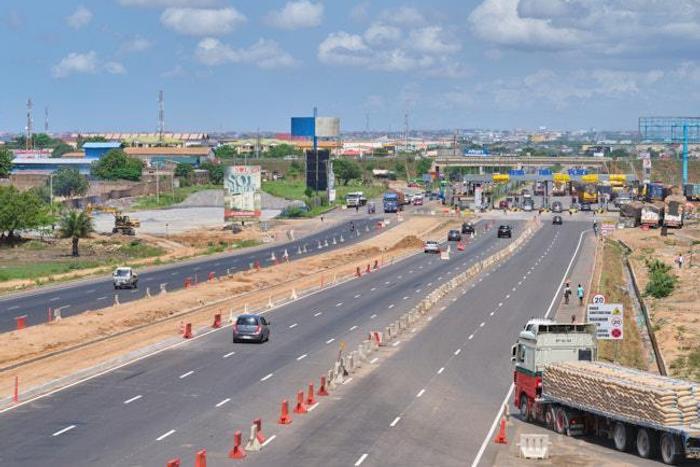
Construction of Section One of the Accra–Tema Motorway and Extensions Project has reached 53% completion. Chief Resident Engineer Kwabena Bempong says work is slightly behind schedule because of challenges including the relocation of pipelines and fibre-optic infrastructure, but contractors are still targeting completion in August 2027. The 19.5-kilometre first phase has a construction contract value of approximately US$339 million and will ultimately create a 10-lane corridor between Tetteh Quarshie and Tema.
Construction of the Accra–Tema Motorway expansion has reached 53% physical completion, with project officials maintaining that the US$339 million first phase remains on course for completion in August 2027 despite delays caused partly by the relocation of pipelines, electricity infrastructure and fibre-optic cables along one of Ghana’s busiest transport corridors.
Chief Resident Engineer Kwabena Bempong disclosed the latest progress on Wednesday, October 28, during a media engagement marking the official launch of the A.T. Expressway Limited project website. He said work had advanced across road pavement, drainage systems, bridges, interchanges and pedestrian facilities, although construction remained slightly behind the programme originally set for this stage of the project.
Bempong said the contractor, Maripoma Enterprise Limited, was expected to increase the pace of construction over the coming months to recover lost time and preserve the August 2027 completion target. The project’s official schedule gives August 2, 2027, as the completion date for Section One, the 19.5-kilometre stretch currently under active construction between the Tetteh Quarshie Interchange and Tema.
The project is one of Ghana’s largest ongoing road infrastructure developments and is intended to transform the existing motorway into a significantly wider and more modern transport corridor. When completed, Section One will provide 10 lanes in total, combining four lanes of access-controlled reinforced-concrete freeway with six lanes of urban highway running alongside the main motorway.
The wider Accra–Tema Motorway and Extensions Project covers approximately 27.7 kilometres across three connected sections. The first and currently active section covers the 19.5-kilometre Accra–Tema Motorway from Tetteh Quarshie to Tema. A second section covers approximately 5.7 kilometres of the George Bush Highway between Tetteh Quarshie and Apenkwa, while a third section covers approximately 2.5 kilometres of the Nsawam Road corridor toward the Neoplan and Achimota areas.
Project officials say Section One is the immediate focus of construction, while preparatory and procurement work continues for subsequent sections. The development is being implemented under a long-term public-private partnership arrangement involving the Ministry of Roads and Highways, the Ghana Highway Authority and A.T. Expressway Limited, with the Ghana Infrastructure Investment Fund playing a major financing role.
The construction contract for the first phase is valued at approximately US$338.9 million before taxes. A.T. Expressway Limited states that no approved variation had been added to the contract price as of September 2026, making cost control an important part of the project’s current implementation strategy.
At Wednesday’s engagement, Bempong said progress had reached the 53% mark after more than two years of construction activity, although utility relocation remained one of the most persistent challenges facing contractors. Major road projects through densely developed urban and industrial areas often require the movement of water pipelines, electricity lines, telecommunications infrastructure and fibre-optic cables before permanent road structures can be completed.
Those challenges are particularly significant along the Accra–Tema corridor because the motorway runs through heavily developed communities, industrial areas and commercial zones containing extensive underground and overhead infrastructure. Moving utilities without interrupting services to households and businesses requires coordination between contractors, state agencies, telecommunications companies, water providers and power distributors.
Bempong nevertheless expressed confidence that the contractor could recover delays through accelerated construction and improved coordination. He said the target remained August 2027 and that work would continue simultaneously across multiple sections of the corridor.
The latest official progress report shows major differences in the level of completion across individual interchanges. The reconstruction and improvement works around Tetteh Quarshie Interchange were reported at approximately 95%, while Teshie Link Interchange was around 92% complete. Community 18 Interchange was approximately 93% complete, while Lashibi Interchange, one of the more complex sections still under development, was reported at approximately 40%.
Those structures form a major part of the redesign because the expanded motorway is intended to separate long-distance express traffic from local urban traffic while improving access to communities on both sides of the corridor. The interchanges will also reduce dangerous turning movements that currently force motorists to interact directly with high-speed motorway traffic.
The project includes improvements and reconstruction at Tetteh Quarshie as well as new or upgraded interchanges at Teshie Link, Community 18 and Lashibi. Pedestrian infrastructure is also being introduced at multiple locations to reduce the number of people attempting to cross the motorway directly at road level.
Seven pedestrian footbridges were reported to be at various stages of construction during the latest project inspection. The broader design includes 10 pedestrian crossing points across the corridor, reflecting concerns over the high number of pedestrians who regularly move between communities separated by the motorway.
Project Manager Benjamin Sackey said major concrete structures were approximately 70% complete. About four kilometres of road base had also been laid and was ready for asphalt paving, while work on bridge structures, culverts and drainage facilities was progressing at different points along the route.
Two bridges on the urban highway portion had already been completed, according to Sackey, while two of the three major new interchanges were described as substantially complete. The project also includes about 20 box culverts and three bridges, all intended to improve drainage and maintain connections across areas divided by the expanded roadway.
Drainage has become an increasingly important component of major road projects in Accra because intense rainfall frequently overwhelms existing systems and causes flooding along transport corridors. Engineers on the motorway project are therefore constructing new drains and culverts alongside the road expansion to reduce the risk of water accumulation and protect the new pavement.
The existing Accra–Tema Motorway has served Ghana for more than six decades and remains one of the country’s most economically important highways. The route links Accra with Tema, Ghana’s principal industrial and port city, and carries commuters, commercial vehicles and a significant share of cargo moving to and from the Tema Port.
A.T. Expressway Limited Chief Executive Officer Louis Harrison said at the website launch that the motorway now carries roughly 60,000 vehicles each day, far more than the volume originally anticipated when the road was constructed. The increase in traffic has contributed to congestion, pavement deterioration and pressure on adjoining intersections and communities.
The original motorway was constructed during the early post-independence period and was designed for a much smaller population, lower vehicle ownership and significantly lighter freight volumes. Decades of continuous use have resulted in visible fatigue cracking, failed pavement joints and structural deterioration that engineers say cannot be permanently addressed through resurfacing alone.
The reconstruction therefore involves rebuilding the motorway rather than simply placing new asphalt over the existing surface. Sections of the main freeway are being reconstructed with reinforced concrete intended to provide greater durability under heavy commercial traffic, while parallel urban highway lanes will carry local traffic and provide access to adjoining communities and businesses.
Under the final design, the corridor will carry 10 lanes in total. Four lanes will form the main access-controlled motorway, with two lanes in each direction, while six additional lanes will form an urban highway with three lanes in each direction. Certain sections will widen further around interchanges and merging areas to allow vehicles to move safely between the expressway and local roads.
The redesign is expected to reduce one of the major weaknesses of the current motorway: the mixing of long-distance traffic with vehicles entering and leaving nearby communities. Over decades, residential, industrial and commercial development has expanded around the motorway, creating numerous access points that were never part of its original freeway design.
Separating through traffic from local movements is intended to improve safety while reducing congestion caused by vehicles slowing down to enter businesses, communities and connecting roads.
The project is also closely connected to Ghana’s trade infrastructure because Tema Port handles a major share of the country’s international cargo. Delays along the motorway affect the movement of freight between the port, Accra and inland destinations, increasing transportation costs for businesses and logistics operators.
An improved corridor could therefore have effects beyond commuting times. Faster and more predictable freight movement could support logistics, manufacturing, retail distribution and cross-border trade, particularly for goods transported from Tema toward other parts of Ghana and neighboring landlocked countries.
The current development is being implemented through a 30-year public-private partnership toll-road concession. Under the arrangement, A.T. Expressway Limited is responsible for financing, rebuilding, expanding, operating and maintaining the motorway and its extensions in partnership with the government.
The tolling component remains one of the issues still to be finalized. Harrison said the concession agreement had received parliamentary approval but the specific toll level that motorists will pay has not yet been determined. Any proposed toll amount will require the appropriate approval process.
The company is also exploring local-currency financing from Ghanaian banks as part of efforts to reduce exposure to exchange-rate risks associated with borrowing in foreign currencies. Longer-term pension-fund financing is also being considered for later sections of the project.
The Ghana Infrastructure Investment Fund has described the project as an example of how institutional capital can be used to finance major public infrastructure without requiring the government to carry the entire initial funding burden.
The motorway project has faced several financing and procurement challenges over the years. Earlier attempts to restructure and expand the corridor encountered funding difficulties, while the suspension of road toll collection in Ghana in 2021 created uncertainty for infrastructure projects that depended partly on future toll revenue.
Project advisers later restructured the development into phases, allowing the first section to proceed while financing arrangements were developed for the remaining parts of the corridor.
The first phase has since become one of the most visible infrastructure projects in Greater Accra. Construction has required frequent diversions, lane changes and temporary traffic arrangements, creating significant congestion for motorists who use the route daily.
Project officials have repeatedly asked drivers to exercise caution around construction zones and comply with temporary signs and diversions. Heavy machinery, changing lane configurations and reduced road widths create additional risks, particularly during peak commuting periods and at night.
A.T. Expressway Limited says its newly launched website is intended partly to address public frustration and uncertainty surrounding construction. The platform provides progress updates, details on individual interchanges, project milestones, safety notices and information about the structure and financing of the development.
Officials said the decision to publish detailed progress information was intended to improve transparency and allow motorists and the wider public to monitor the project rather than relying solely on occasional site inspections or announcements.
The latest information shows that overall physical progress increased from 52% in August to 53% in September. Major recent activities included bridge beam installation, interchange construction, retaining walls, drainage works, subgrade preparation and road-foundation construction.
The project has 284 pieces of equipment recorded on site, reflecting the scale of the construction operation. The official contract period covers 1,095 days, with work continuing while the existing motorway remains open to traffic.
Maintaining traffic throughout construction is itself a major engineering and operational challenge. Unlike a new highway built on an undeveloped route, the Accra–Tema Motorway cannot simply be closed for extended periods because of its importance to commuters, Tema Port operations and businesses along the corridor.
Contractors are therefore required to build new sections while maintaining enough existing capacity to keep vehicles moving. This frequently requires temporary diversions before portions of the old road can be demolished or reconstructed.
Utility relocation has complicated that process because construction cannot always proceed until pipelines, fibre cables and electricity installations are moved away from permanent road structures. Officials have acknowledged that these difficulties account for part of the current schedule slippage.
Despite those constraints, project managers insist that August 2027 remains achievable. The coming months will be critical because substantial portions of the road pavement, Lashibi Interchange and remaining bridge and pedestrian structures must still be completed while traffic continues to use the corridor.
The government and project partners will also face pressure to minimize disruption as work intensifies. Motorists have experienced significant delays around construction areas, particularly during morning and evening rush hours, and further traffic diversions will likely be necessary before completion.
The project’s significance means that meeting the completion date will be closely watched. The Accra–Tema corridor is not simply another urban road; it is a strategic national link connecting the capital, Tema’s industrial areas and Ghana’s largest seaport.
If the current timetable holds, Section One should be completed by August 2, 2027, delivering a substantially expanded corridor after years of deterioration and congestion. Project officials will meanwhile continue monitoring progress against the construction programme and attempting to recover delays associated with utilities and other site constraints.
For now, the official physical completion level stands at 53%. The next major test will be whether contractors can accelerate the remaining works sufficiently to meet the August 2027 target without compromising construction quality, safety or the continued movement of tens of thousands of vehicles that depend on the motorway every day.