ATIKU TO CAMPAIGN IN ALL 36 STATES AS ADC CONTRASTS STRATEGY WITH TINUBU’S 12-STATE TOUR
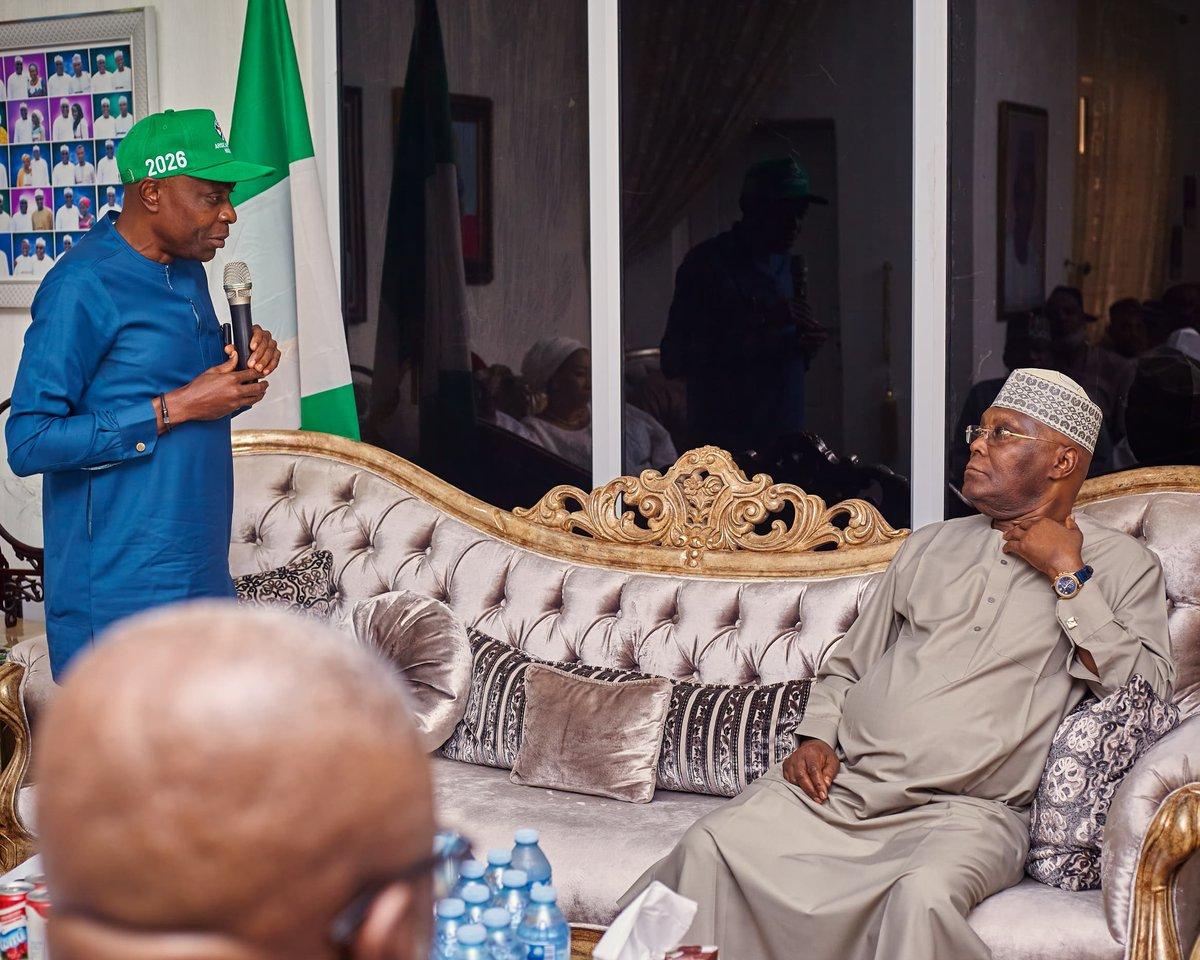
The African Democratic Congress Presidential Campaign Council says Atiku Abubakar will personally campaign across all 36 states ahead of Nigeria’s January 2027 presidential election. Phrank Shaibu told ARISE News that the campaign will go beyond large rallies to include town halls, community meetings, local-government engagements and visits to villages, while rejecting suggestions that Atiku’s electoral strategy is focused mainly on northern Nigeria. The approach contrasts with President Bola Tinubu’s plan to personally attend rallies in 12 selected states while the APC’s broader campaign organization operates nationwide.
Former Vice-President Atiku Abubakar will personally campaign across all 36 states of Nigeria ahead of the January 2027 presidential election, according to the African Democratic Congress Presidential Campaign Council, which says its candidate intends to combine conventional rallies with town hall meetings, community engagements and visits to local government areas and villages as part of an effort to build a nationwide coalition. Phrank Shaibu, Director of Strategic Communication of the ADC Presidential Campaign Council, outlined the strategy during an interview with ARISE News on Sunday, October 25, dismissing suggestions that Atiku’s campaign might concentrate primarily on northern Nigeria and insisting that no part of the federation would be excluded from the former vice-president’s direct engagement with voters.
Shaibu said the ADC campaign would release its detailed itinerary shortly and maintained that Atiku would be physically present across the country rather than limiting his electioneering to a small number of strategic battleground states. He said the campaign intended to reach voters beyond the traditional political format in which presidential candidates appear at large rallies in state capitals before moving quickly to the next destination, arguing that Atiku wanted more direct interaction with Nigerians at community level. According to Shaibu, the campaign would include town halls, community meetings, visits to local governments and, in some states, engagements in villages where the former vice-president would listen to residents and discuss the economic and security concerns shaping the election.
The announcement draws a deliberate contrast with President Bola Tinubu’s campaign strategy. The ruling All Progressives Congress has released a nationwide campaign schedule covering all 36 states and the Federal Capital Territory, but Tinubu himself is expected to appear at only 12 major rallies between October 2026 and January 2027. The president has said he does not intend to abandon the responsibilities of government in order to attend every campaign event, arguing that the APC’s broader campaign council and state structures can represent the ticket while he continues to focus on governance, economic management, investment and other presidential duties.
Under the APC’s proposed itinerary, Tinubu’s personal campaign appearances began in Kaduna on October 24 and are expected to continue through Port Harcourt in Rivers State, Jos in Plateau, Ibadan in Oyo, Maiduguri in Borno, Enugu, Bauchi, Sokoto, Asaba in Delta, Kano, Yola in Adamawa and finally Lagos on January 9, 2027. The broader APC campaign will continue in other states without the president physically attending every rally, meaning the difference between the ruling party and the ADC is not that one is campaigning nationally and the other is not, but rather that Atiku’s team says its candidate intends to make personal appearances across the entire federation while Tinubu has delegated much of his nationwide campaign activity to his party machinery.
That distinction has quickly become part of the political contest between the two campaigns. Atiku’s allies are presenting the 36-state strategy as evidence that he is prepared to face voters directly and defend his proposals in every region, while the APC has argued that a sitting president must balance political campaigning with the demands of governing Africa’s most populous country. The opposing approaches reflect two different campaign calculations: Atiku is attempting to maximize personal contact and demonstrate national reach, while Tinubu is relying heavily on incumbency, an expanded campaign council, state coordinators and a network of influential politicians to mobilize support beyond the places where he will appear personally.
Shaibu rejected suggestions that Atiku’s most realistic pathway to victory lies almost entirely in the North. He argued that the economic hardship affecting voters in Zamfara was fundamentally similar to the hardship experienced by people in Lagos and that the election would ultimately be shaped by national concerns rather than regional assumptions. The ADC strategist pointed to the cost of living, poverty and public frustration over economic conditions as issues capable of cutting across ethnic, religious and geographical boundaries, and he maintained that Atiku would take that message into both northern and southern states rather than campaign as a regional candidate.
That argument is central to Atiku’s 2027 strategy because his previous presidential campaigns have demonstrated both his strength and his limitations. In the 2023 election, Atiku performed strongly across parts of northern Nigeria and won several states, but he struggled to consolidate enough support in southern regions to overcome Tinubu nationally. Peter Obi’s strong performance in parts of the South-East, South-South and urban centers further fragmented the opposition vote, while Rabiu Musa Kwankwaso commanded substantial support in Kano. The 2027 political landscape is significantly different, but the fundamental arithmetic remains the same: Atiku cannot rely only on traditional northern support if he wants to defeat an incumbent president with extensive political structures across the federation.
The ADC therefore appears determined to present Atiku as a genuinely national candidate rather than one whose campaign is geographically concentrated. Shaibu said the campaign’s route would extend “across the length and breadth of Nigeria,” and the emphasis on villages, local governments and town halls suggests the campaign is trying to move beyond the symbolic politics of large rallies into smaller encounters where voters can question the candidate and hear his policy positions directly. Whether the strategy can be implemented effectively across a country as geographically large and logistically complex as Nigeria will become clearer when the campaign publishes its full schedule.
The decision also places significant demands on Atiku personally. Nigeria has 36 states spread across six geopolitical zones, and a genuine nationwide tour involving rallies, local meetings and community engagements would require an intense travel schedule over the remaining campaign period. Security arrangements, transportation, local party coordination and event management will all be major considerations, particularly in areas facing insurgency, banditry, kidnapping and other security risks. The ADC will therefore have to demonstrate that its promise of nationwide personal campaigning is not merely rhetorical but can be sustained operationally.
Tinubu’s strategy, by comparison, appears more selective. Of the 12 states where he is expected to campaign personally, nine are states he lost in the 2023 presidential election, suggesting the APC has deliberately prioritized places where the president either needs to recover lost ground or confront strong opposition. Kaduna, Plateau, Enugu, Bauchi, Sokoto, Delta, Kano, Adamawa and Lagos were all won by his rivals in 2023, while Rivers, Oyo and Borno are states where the APC believes reinforcing existing or cross-party support could be strategically important.
Kaduna, where the APC officially opened its campaign on October 24, illustrates that calculation. Atiku defeated Tinubu there in 2023, securing more than 550,000 votes compared with just under 400,000 for the APC candidate despite the ruling party then controlling the state government. With Atiku again seeking the presidency, Kaduna represents an important northern battleground and a logical location for Tinubu to make a direct appeal to voters.
Kano carries even greater numerical significance. Kwankwaso won the state by a wide margin in 2023, collecting close to one million votes, while Tinubu finished well behind him. The political alignments entering 2027 have changed substantially, but Kano remains one of the country’s largest electoral prizes and an area where the APC cannot afford a poor performance. Tinubu’s decision to campaign personally in the state therefore reflects its continuing importance to any national presidential strategy.
Adamawa, Atiku’s home state, is equally symbolic. Atiku defeated Tinubu there decisively in 2023, and any APC attempt to improve substantially in the state would carry political value beyond the raw vote totals. A presidential visit allows Tinubu to challenge the opposition candidate directly in his home territory while demonstrating that the ruling party intends to compete rather than concede states where Atiku is traditionally strong.
The inclusion of Lagos may be the most personally significant stop for Tinubu. Despite his long political association with the state and the political network he built there over decades, he narrowly lost Lagos to Peter Obi in 2023. The APC’s decision to conclude its campaign in Lagos therefore gives the president an opportunity to demonstrate organizational strength in the state most closely associated with his political career and to attempt to reverse one of the most symbolic defeats of the previous election.
Enugu, meanwhile, presents an entirely different challenge. Tinubu received fewer than 5,000 votes there in 2023 while Obi won overwhelmingly, highlighting the APC’s longstanding difficulties in much of the South-East. A personal appearance in Enugu appears designed to show that Tinubu is willing to directly seek support in a region where his party has historically struggled at presidential level.
The selective itinerary therefore appears to reflect strategic allocation of the president’s time rather than an absence of national campaigning by the APC. Tinubu’s campaign council includes state coordinators, regional leaders, governors, ministers and influential politicians from both within and outside the ruling party, giving the campaign a large organizational structure intended to continue mobilization even when the president is not personally present.
That expanded campaign council itself has become controversial. Tinubu’s re-election structure includes prominent politicians who remain formally affiliated with opposition parties, including Federal Capital Territory Minister Nyesom Wike of the Peoples Democratic Party, Anambra Governor Chukwuma Soludo of the All Progressives Grand Alliance and Osun Governor Ademola Adeleke, who is associated with Accord. Their inclusion reflects the cross-party coalition Tinubu is attempting to build but has also prompted criticism about party loyalty and the increasingly fluid nature of political alliances ahead of 2027.
Wike has been given responsibility for campaign coordination in Rivers State and the Federal Capital Territory, while Soludo and Adeleke have been assigned roles in Anambra and Osun respectively. Their involvement gives Tinubu access to political networks beyond the APC’s formal membership but also provides the opposition with an argument that the president is relying on political elite alliances rather than direct engagement with ordinary voters.
Atiku’s campaign has repeatedly attacked the expanded APC council on that basis. The ADC has argued that the size and composition of Tinubu’s campaign structure cannot substitute for a record of government that voters consider successful. The ruling party, meanwhile, says its broad coalition demonstrates confidence in the president’s leadership and the ability to attract support across traditional party boundaries.
The disagreement over campaign style is therefore part of a much larger argument about the 2027 election. The APC is asking voters to judge Tinubu on the record of his administration, including economic reforms, infrastructure, revenue growth and efforts to stabilize public finances. Atiku and the ADC are seeking to make the election a referendum on the cost of living, poverty, insecurity and what they describe as the social consequences of Tinubu’s economic policies.
Shaibu’s language during the ARISE interview made clear that economic hardship will be central to the ADC’s campaign message. His assertion that a hungry voter in Zamfara faces the same fundamental problem as a hungry voter in Lagos is an attempt to frame hardship as a unifying national issue capable of overcoming regional divisions. That message allows the ADC to argue that Atiku’s electoral pathway is based not on northern identity but on dissatisfaction with the incumbent government.
The APC rejects that characterization and has defended Tinubu’s economic program as necessary reform following years of structural weaknesses. The president’s administration has pointed to improved government revenues, stronger foreign reserves, adjustments to the foreign-exchange system and other macroeconomic indicators as evidence of stabilization. At the same time, Nigerians continue to face high food prices, expensive fuel, transportation costs and widespread concerns about purchasing power, creating a political contest over whether improving macroeconomic conditions are translating quickly enough into better living standards.
That economic debate is likely to dominate the campaign more than geography alone. Atiku’s strategy of visiting every state creates opportunities to tailor his message to local concerns while returning repeatedly to national themes of economic hardship and governance. In agricultural states, the discussion may focus on food production and insecurity; in commercial centers such as Lagos and Kano, it may center on business costs and employment; in oil-producing areas, resource management and environmental concerns could become more prominent.
The town hall strategy could also give the ADC an opportunity to contrast Atiku’s accessibility with Tinubu’s more selective appearances. Smaller meetings allow candidates to answer questions and respond to local grievances in ways that highly scripted rallies often do not. At the same time, such events expose candidates to greater scrutiny because voters, journalists and civil society groups can challenge policy proposals directly.
Atiku is one of Nigeria’s most experienced presidential candidates, having contested for the presidency multiple times and served as vice-president from 1999 to 2007 under President Olusegun Obasanjo. His long political career gives him widespread name recognition, but it also means voters are already familiar with his record and previous campaigns. The ADC will therefore need to convince Nigerians that the 2027 campaign represents more than another attempt by a familiar political figure to win an office he has sought repeatedly.
His move to the ADC has significantly altered the opposition landscape. After previous presidential campaigns under the Peoples Democratic Party, Atiku is now leading a different coalition as opposition figures attempt to reorganize ahead of the election. The success of that arrangement will depend partly on how effectively the ADC can build state-level structures capable of matching the APC’s organization.
Campaigning in every state could help strengthen those structures by giving local candidates and party officials direct access to Atiku. Presidential visits often energize supporters, attract media coverage and create opportunities for fundraising and recruitment. For a party attempting to expand nationally, the organizational value of a candidate’s physical presence can be significant even in states where victory may be difficult.
The strategy could be particularly important in southern Nigeria, where Shaibu’s comments suggest the campaign is determined to challenge perceptions about Atiku’s geographical appeal. The ADC will need to demonstrate credible support in the South-West, South-East and South-South if it is to build the kind of broad coalition required to win nationally.
Nigeria’s presidential election system makes that geographic spread especially important. A candidate must not only win the highest number of votes nationally but also meet constitutional requirements concerning the distribution of support across the federation. That makes campaigning nationally more than an issue of symbolism; presidential candidates must build sufficient breadth as well as total vote strength.
The APC’s strategy reflects the same constitutional reality even though Tinubu will not personally attend every rally. Its campaign operations are scheduled across all 36 states and the FCT, meaning state-level leaders will carry the president’s message into areas where he does not appear. Tinubu’s absence from some rallies should therefore not be confused with the APC abandoning those states.
The political dispute centers instead on the value of presidential presence. The ADC argues that someone asking Nigerians for their votes should personally engage them across the country. The APC argues that a sitting president must continue governing and can responsibly delegate campaign duties while appearing personally in strategically selected areas.
Both arguments are likely to resonate differently with different voters. Some may consider direct personal campaigning evidence of seriousness and accessibility, while others may see Tinubu’s decision to prioritize presidential duties as appropriate. The election will ultimately test whether physical campaign presence translates into measurable electoral gains.
The choice of campaign style may also reflect the different advantages available to an incumbent and a challenger. Tinubu already controls the presidency and receives daily national media coverage through official duties, policy announcements and government activities. Atiku does not have that institutional visibility and therefore has a stronger incentive to travel extensively in order to command attention and define the campaign narrative.
Incumbency also gives Tinubu access to an extensive network of governors, ministers, lawmakers and political allies capable of campaigning in his absence. Atiku’s coalition, while politically significant, must still demonstrate that it can build an equally disciplined national operation.
The campaign will unfold amid intense scrutiny over the distinction between official government activity and partisan electioneering. Opposition figures have already criticized the use of the Presidential Villa for campaign-related activities and warned against the misuse of public resources. The APC has rejected accusations that government institutions are being improperly used for partisan purposes.
Those arguments are likely to grow louder as the election approaches. A sitting president must continue to travel, announce policies and perform official duties during an election campaign, creating inevitable disputes about where governance ends and campaigning begins. Opposition candidates, by contrast, generally have greater freedom to devote their schedules almost entirely to political activities.
For Atiku, the promise to visit every state establishes a clear benchmark against which his own campaign can be judged. Once the schedule is released, journalists and voters will be able to determine whether the campaign fulfills its commitment and how much time the candidate spends in each region. Any significant omissions could therefore become politically damaging after Shaibu’s unequivocal declaration that no state would be left out.
The same scrutiny will apply to the APC’s proposed schedule, which remains subject to adjustment. Tinubu’s 12 personal appearances could change because of security, official travel, health, campaign considerations or evolving electoral priorities. The current itinerary should therefore be understood as the party’s proposed plan rather than an unchangeable final calendar.
The January 16, 2027 election is shaping up as a contest in which campaign organization could prove as important as messaging. Nigeria’s population, geography and regional political diversity make nationwide mobilization extremely complex, and successful candidates require both national narratives and strong local structures capable of turning supporters into actual votes.
Atiku’s decision to pursue a 36-state personal campaign is an attempt to address both dimensions simultaneously. His team wants to present him as a candidate willing to listen directly to voters while also strengthening the ADC’s presence across the country. Tinubu’s campaign is taking a different approach by concentrating the president’s personal time on selected battlegrounds while delegating much of the national mobilization to a broad political coalition.
Neither strategy guarantees victory. Large rallies do not always translate into votes, and extensive travel does not necessarily overcome weak local organization. Similarly, a sophisticated political machine can struggle if voters are dissatisfied with the candidate it represents. The effectiveness of both approaches will depend on how well they connect with public concerns and whether the campaigns can mobilize supporters on election day.
What is clear is that the contrast has already become part of the 2027 political narrative. Atiku’s campaign is saying the former vice-president will go everywhere, listen to voters and make his case directly across all six geopolitical zones. Tinubu’s team is saying the president will campaign strategically while continuing to run the country and relying on his party’s national structures elsewhere.
That debate will unfold alongside the more substantive questions facing voters: the economy, jobs, inflation, fuel prices, security, corruption, education, healthcare and the future direction of Nigeria. Shaibu is betting that economic hardship provides Atiku with a message capable of cutting across traditional regional boundaries, while the APC will seek to persuade Nigerians that Tinubu’s reforms require more time to deliver their full benefits.
The campaign schedule expected from the ADC will therefore be more than a logistical document. It will reveal where Atiku plans to spend his time, which regions his campaign considers most competitive and whether the promise of reaching local governments and villages can be translated into a realistic nationwide program.
For now, Shaibu has made the ADC’s position unambiguous: Atiku Abubakar intends to campaign in all 36 states, and his team says the former vice-president’s pathway to the presidency is not confined to northern Nigeria. The APC, meanwhile, will continue a nationwide campaign of its own but with President Bola Tinubu personally concentrating on 12 selected states while his campaign council and political allies handle much of the remaining mobilization.
The competing strategies offer voters an early glimpse of how two of the country’s principal presidential campaigns intend to fight the 2027 election. One is emphasizing personal nationwide presence; the other is emphasizing strategic appearances backed by incumbency and an expansive political organization. As the schedules become clearer and both campaigns move deeper into the country, Nigerians will begin to see whether either approach can turn political visibility into the broad coalition required to win the presidency.