
CANADA WELCOMES CLOSER EU TIES BUT ASSOCIATE MEMBERSHIP REMAINS UNDEFINED
Canadian Prime Minister Mark Carney has welcomed European Commission President Ursula von der Leyen's proposal for Canada to become the EU's first associate member. However, the status does not currently exist under EU treaties and its terms would have to be negotiated. The proposal comes as Canada seeks deeper cooperation with Europe across trade, defence, energy, critical minerals and technology.
Canadian Prime Minister Mark Carney has warmly welcomed a proposal for Canada to forge an unprecedented new relationship with the European Union, but significant political and legal questions remain over what becoming the bloc's first associate member would actually mean.
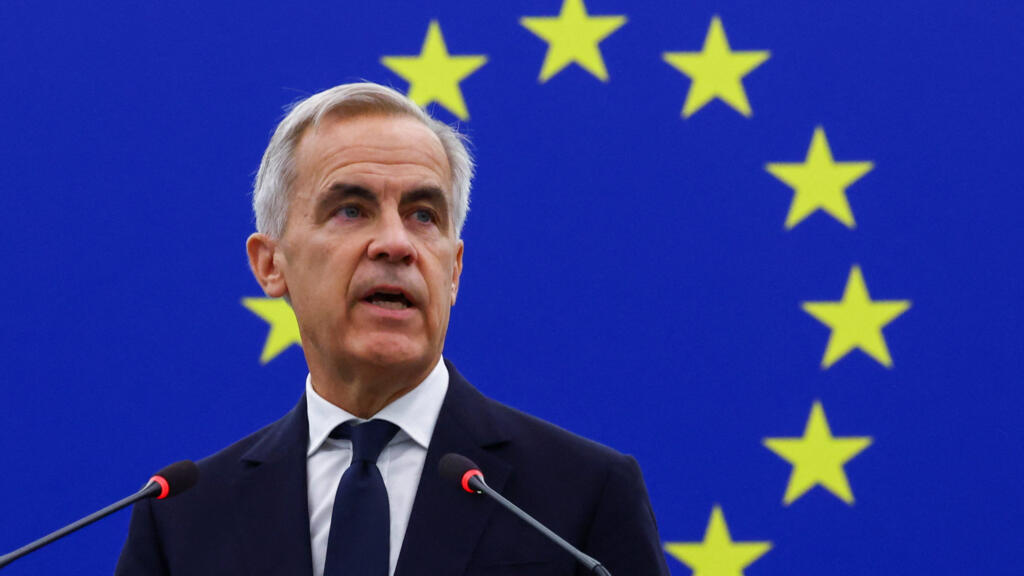
Addressing the European Parliament in Strasbourg on Thursday, Carney called for deeper cooperation between Canada and Europe across defence, energy, critical minerals, artificial intelligence, technology and economic security.
His speech came a day after European Commission President Ursula von der Leyen proposed opening the door for Canada to become the EU's first associate member.
Despite the language surrounding the proposal, Canada is not joining the European Union as a full member.
There is currently no formal associate membership category established under existing EU treaties, meaning the proposal would require negotiations to determine exactly what rights, responsibilities and institutional arrangements such a relationship would involve.
CARNEY PUSHES FOR DEEPER STRATEGIC ALLIANCE
Carney told European lawmakers that Canada and Europe should strengthen their strategic autonomy by cooperating across areas critical to their economies and national security.
He outlined opportunities for closer collaboration involving critical minerals, artificial intelligence, defence, digital trade and energy security.
The Canadian prime minister argued that closer cooperation between like minded countries could help protect national sovereignty at a time when global economic and geopolitical competition is intensifying.
Carney also stressed that the emerging relationship should not be viewed as an attempt to create another global superpower or a bloc directed against other countries.
Canada and the EU already have extensive economic ties through the Comprehensive Economic and Trade Agreement, commonly known as CETA.
The proposed new arrangement could potentially take cooperation significantly beyond the existing trade relationship.
WHAT WOULD ASSOCIATE MEMBERSHIP ACTUALLY MEAN
That remains one of the biggest unanswered questions.
Associate membership does not currently exist as a formal category under EU treaties, and officials have yet to establish precisely what Canada would gain or what obligations it would accept.
EU diplomats have also expressed questions about how such an arrangement would work in practice because the concept had not previously been agreed among member states.
European Parliament President Roberta Metsola has described the emerging concept as a possible new relationship between full EU membership and existing forms of partnership.
She has suggested that other countries including Australia and New Zealand could eventually explore similar arrangements if the model is established.
Full EU membership for Canada is not being proposed.
Instead, negotiations would seek to determine whether Canada and the EU can create a new framework allowing much deeper economic, security and political cooperation.
TRUMP THREATENS TARIFFS
The proposal has already generated opposition from Washington.
US President Donald Trump criticised the idea and threatened additional tariffs against Europe if he concluded that a Canada EU arrangement represented a hostile act towards the United States.
Carney responded by stressing Canada's sovereignty and its right to determine its own international relationships.
He said Canada would make its own decisions about partnerships while arguing that stronger Canadian relationships with Europe need not undermine ties with the United States.
The disagreement comes amid worsening trade tensions between Ottawa and Washington and Canada's wider effort to diversify its economic relationships.
Carney's government has set a goal of doubling Canada's non US trade over the next decade.
CANADA AND EUROPE DRAW CLOSER
The discussions reflect broader changes in the international economic and security landscape.
Canada and European countries are attempting to strengthen their ability to secure critical minerals, energy supplies, defence capabilities and emerging technologies while reducing vulnerabilities created by excessive dependence on individual countries.
Canada has also applied to join the United Kingdom led Joint Expeditionary Force, a rapid response military coalition involving several northern European NATO members.
Von der Leyen has presented closer Canadian ties as part of a wider effort to strengthen partnerships with countries sharing many of the EU's democratic and economic principles.
NO GUARANTEE OF A DEAL
Despite the enthusiasm surrounding the proposal, there is no guarantee that Canada will ultimately receive a formal associate status.
The concept still has to be defined and negotiated, and EU member states would have to play a central role in determining whether such an unprecedented arrangement moves forward.
Questions surrounding market access, regulation, trade protections and the extent to which Canada could participate in European programmes would also have to be addressed.
For now, associate membership remains a political proposal rather than an established legal status.
What is clear is that both Ottawa and Brussels are exploring a relationship considerably deeper than their existing trade agreement as Canada seeks to diversify its international partnerships and Europe searches for closer cooperation with like minded countries in an increasingly uncertain global environment.