GHANA’S ARTISANAL FISHERS REJECT TEMPORARY SUSPENSION, DEMAND FULL CANCELLATION OF 10 OFFSHORE GOLD LICENCES OVER THREATS TO FISH STOCKS AND COASTAL LIVELIHOODS
Artisanal fishing communities and civil society organisations are demanding the complete revocation of 10 offshore gold reconnaissance licences granted to Gold Coast GRC Ghana Limited, arguing that the government’s current suspension does not provide permanent protection for Ghana’s fisheries and coastal communities. The licences reportedly cover approximately 10,000 square kilometres of marine territory from around Half Assini toward Winneba and extend about 33 kilometres offshore. Fishers say they were not adequately consulted and warn that future exploration or mining could damage marine habitats, reduce fish stocks, restrict traditional fishing grounds and affect food security and livelihoods throughout the fisheries value chain. The Minerals Commission has suspended all activities under the licences pending consultations, environmental review and further written ministerial authorisation. Ghana News Agency
Ghana’s artisanal fishing communities and a coalition of fisheries and environmental civil society organizations are demanding that President John Dramani Mahama go beyond the government’s temporary suspension of offshore gold reconnaissance activities and permanently revoke all 10 licenses reportedly granted to Gold Coast GRC Ghana Limited. The groups say the licenses cover approximately 10,000 square kilometers of Ghana’s marine waters, stretching for roughly 300 kilometers along the coastline from Half Assini toward Winneba and extending about 33 kilometers offshore into parts of the country’s shallow continental shelf. They argue that a temporary suspension offers no lasting protection because the activities could legally resume once consultations and regulatory reviews are completed, leaving fishing communities exposed to what they describe as potentially serious risks to fish stocks, marine habitats, food security and livelihoods.
The demand marks a significant escalation in the growing dispute over whether Ghana should allow gold reconnaissance and potentially future mineral exploitation in coastal waters already under pressure from declining fish stocks, illegal fishing, climate change, coastal erosion and competition for marine space. Artisanal fishing representatives say they welcome the government’s decision to immediately halt activities under the licenses, but they do not believe suspension goes far enough. Their position is that the state should abandon the offshore gold project entirely rather than attempt to modify it through additional consultations or environmental safeguards.
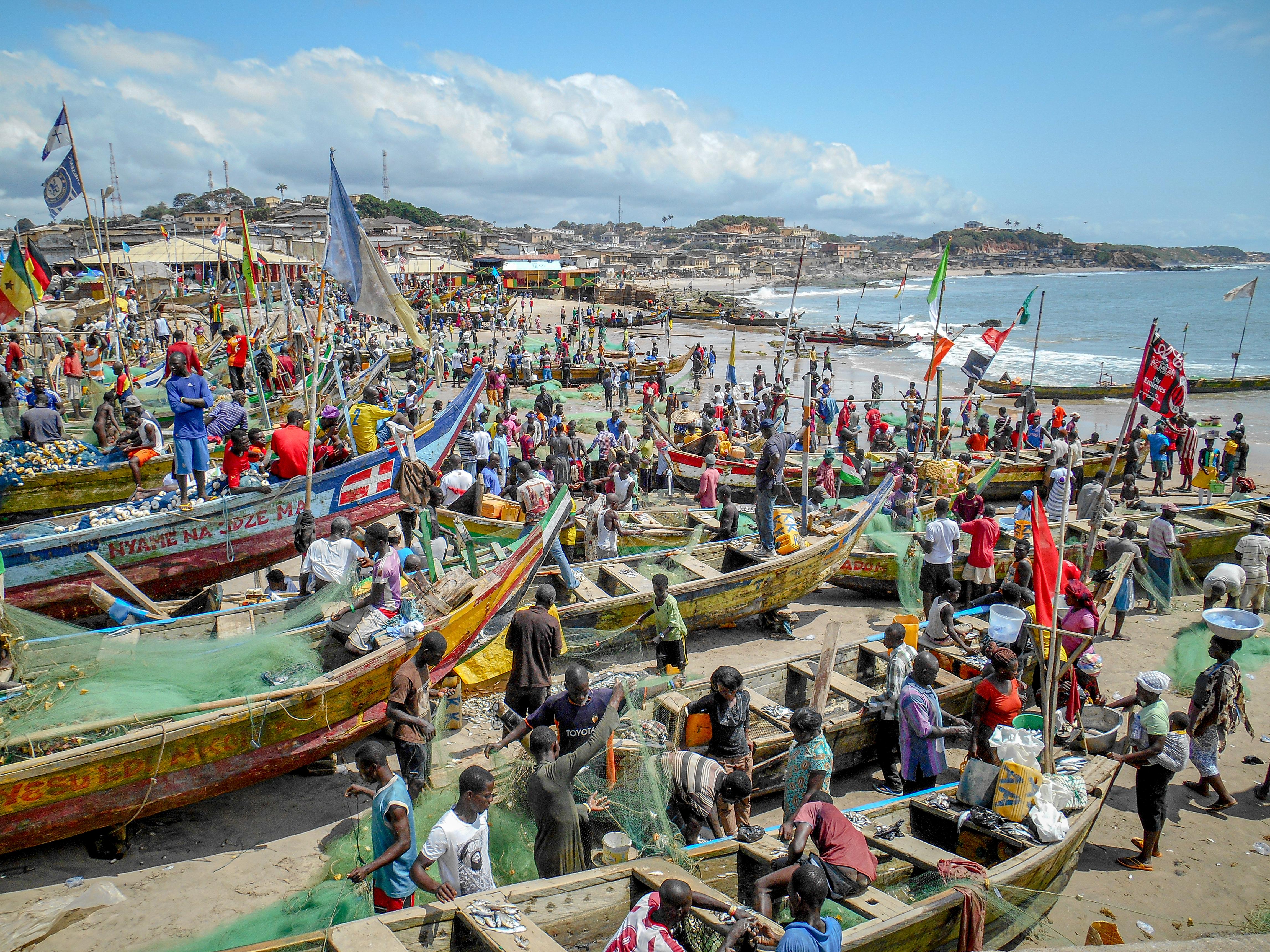
At a press conference in Accra on October 13, representatives of chief fishermen, canoe owners, fishing crews, fish processors and traders said coastal communities had not been adequately consulted before the licenses were issued. Kenneth Arthur, General Secretary of the Canoe and Fishing Gear Owners Association of Ghana, said the sea should not be treated simply as an unexplored mineral resource because it already sustains generations of families whose survival depends on fishing. The groups warned that any activity capable of disturbing marine habitats or restricting traditional fishing grounds could have consequences far beyond the people who operate canoes, because the entire fisheries value chain depends on reliable catches.
Their concerns center on 10 offshore reconnaissance licenses granted to Gold Coast GRC Ghana Limited on February 9, 2026. According to reports and letters from fisheries organizations, the licensed blocks cover about 10,000 square kilometers and extend along approximately 300 kilometers of coastline between Half Assini in the Western Region and Winneba in the Central Region. The licenses reportedly extend about 33 kilometers offshore, placing them within waters that fishers say overlap with important fishing grounds and areas central to Ghana’s marine food system.
The Minerals Commission suspended all activities under the licenses in early October after receiving objections from key stakeholders. A letter from the Commission said the company had originally been required to obtain all necessary authorizations, environmental permits and other approvals before carrying out exploration related activities. The Commission later received concerns about environmental and ecological impacts as well as complaints that consultations with communities and affected groups had not been sufficient. Acting on a directive from the Minister for Lands and Natural Resources, Emmanuel Armah Kofi Buah, the Commission ordered an immediate suspension while further consultations are conducted.
The government’s action means Gold Coast GRC Ghana Limited cannot currently undertake activities under the affected licenses. The suspension will remain in place until consultations are completed and written ministerial authorization is issued allowing operations to resume. It is precisely that possibility of future resumption that has alarmed fishing communities. They argue that suspension is temporary by definition and does not answer the larger question of whether offshore gold exploration is compatible with Ghana’s fisheries sector and long term marine conservation commitments.
Civil society organizations working on fisheries, coastal livelihoods and environmental protection have therefore joined the demand for full revocation. A coalition of groups welcomed the suspension but said the government should maintain it only as an interim measure while moving toward cancellation of the licenses. They also called for the publication of all license documents, maps, coordinates, approved work programmed and related regulatory approvals so the public can understand exactly what activities were authorized and where they could take place.
The groups say the scale of the licensed area is itself a major concern. Ten thousand square kilometers represents a substantial section of Ghana’s offshore environment, and fishers fear that even exploratory activity across such a wide area could interfere with traditional fishing routes or affect ecological zones important for breeding and feeding. They argue that discussions about economic opportunity must therefore consider the value of the existing marine economy rather than evaluating mineral resources in isolation.
Fishing remains one of the most important livelihood sectors in Ghana’s coastal communities. Thousands of canoe operators, crew members, fish processors, traders, transporters, net makers and market workers depend directly or indirectly on the sector. Women play a particularly important role in processing and trading fish after catches arrive on shore, meaning any sustained reduction in fish landings can affect household incomes far beyond the fishermen who go to sea.
Fish is also central to Ghana’s food security. For many households, particularly lower income families, fish remains one of the most accessible sources of animal protein. A significant decline in domestic supply could therefore place pressure on food prices and increase Ghana’s dependence on imported fish. Fishing organizations say that makes the offshore gold dispute a national food security issue rather than a narrow conflict between a mining company and coastal communities.
The fishers have repeatedly stressed that they are not opposed to investment or responsible use of Ghana’s natural resources. Their argument is that economic development should not destroy an existing sector that already supports communities, employment and national food supply. They say promised mining jobs, possible government revenue or future mineral discoveries should be weighed against the risk of damaging marine ecosystems that cannot easily be restored once disturbed.
That concern is particularly strong because Ghana’s fisheries are already under stress. Small pelagic fish species that form the foundation of the artisanal sector have experienced pressure from overfishing and illegal fishing practices. The government has responded with measures including closed fishing seasons, stronger enforcement efforts and expansion of the Inshore Exclusion Zone, but fishers say allowing potentially disruptive mineral activity in the same marine space could undermine those conservation measures.
The Inshore Exclusion Zone has become one of the most important aspects of the argument. Ghana expanded the zone from six nautical miles to 12 nautical miles under its new fisheries framework, giving artisanal fishers greater protection from industrial fishing vessels. Fishing groups argue that this legal protection would lose much of its meaning if activities capable of disturbing the seabed or affecting fish habitats were allowed within or near the same waters.
Their position is that the purpose of the expanded zone is not simply to keep trawlers away but to preserve marine space for artisanal fisheries and ecological recovery. They therefore question whether offshore mineral reconnaissance can coexist with a policy specifically intended to protect small scale fishing. The concern becomes even greater if reconnaissance eventually leads to commercial mining involving seabed disturbance.
A reconnaissance license is not the same as a mining license and does not automatically authorize commercial extraction. Under Ghana’s mining law, reconnaissance is generally intended to allow preliminary investigation of mineral potential. Civil society groups have nevertheless raised questions about the exact methods proposed and whether current laws allow some forms of offshore activity being contemplated. They argue that the public needs greater clarity about what the license holder can legally do now and what future approvals it might seek if gold deposits are identified.
One legal issue raised by the coalition involves restrictions under the Minerals and Mining Act. Civil society organizations have pointed to provisions that prohibit certain forms of drilling, excavation or mining activity under a reconnaissance license and regulate the use of floating platforms or other equipment for mineral extraction in natural water bodies, territorial waters, the exclusive economic zone and continental shelf. The groups say these provisions should be examined carefully before any offshore programmed is allowed to proceed.
The debate also includes concerns over whether a Fisheries Impact Assessment was conducted before the licenses were issued. The National Fisheries Association of Ghana has argued that activities likely to have a substantial effect on fishery or aquatic resources should be assessed in consultation with the Fisheries Commission before they begin. NAFAG says it was not adequately involved in the decision making process and has questioned why major fishing associations were not consulted at a sufficiently high level before the licenses were granted.
NAFAG represents several major parts of Ghana’s fishing industry, including the Ghana Industrial Trawlers Association, Ghana Tuna Association, Ghana National Canoe Fishermen Council, National Inland Canoe Fishermen Council and Ghana Inshore Fisheries Association. Its intervention therefore broadens the dispute beyond artisanal canoe fishers and shows that concern about offshore mineral activity exists across several segments of the fishing sector.
The Fisheries Commission has also expressed concern about the implications of the licenses for the marine environment and fishing communities, according to civil society statements. That is significant because the Fisheries Commission is one of the state institutions responsible for protecting fisheries resources. Fishers argue that if the country’s own fisheries regulator has reservations, the government should adopt a precautionary approach rather than allowing operations to resume before all concerns are resolved.
The precautionary principle has become central to the argument against offshore gold development. Fishing organizations say the government should not wait until environmental damage occurs before acting. Their position is that where there is uncertainty about potentially serious or irreversible harm, regulators should protect the marine ecosystem first and require promoters of the project to demonstrate that their activities will not create unacceptable risk.
Civil society groups have referred to experiences from other countries where seabed mining proposals generated concerns about sediment plumes, underwater noise, disruption of habitats and suspension of potentially toxic material. Some fisheries organizations have cited examples from Papua New Guinea, South Africa and New Zealand to argue that seabed mining remains environmentally controversial and can produce effects that are difficult to predict.
Those international examples are not identical to the Ghanaian proposal, and the reconnaissance phase does not necessarily involve the same level of seabed disturbance as commercial mining. However, the fishing groups argue that reconnaissance is the first step in a process that could ultimately lead to extraction. They therefore want the government to decide now whether commercial offshore gold mining is an acceptable long term use of Ghana’s coastal waters rather than waiting until significant investment has already been made.
This point helps explain why the groups are demanding revocation rather than a longer suspension. Once a company spends substantial money on exploration and confirms commercially valuable deposits, political and economic pressure to allow mining could become much stronger. Fishing communities fear that waiting until that stage could make it more difficult for government to reject the project even if environmental concerns remain.
The debate is therefore not simply about the immediate activities covered by the licenses. It is also about the direction Ghana wants to take with its marine economy. The country is simultaneously promoting fisheries conservation, marine protected areas, tourism, offshore energy and broader blue economy development. Those uses can compete for the same limited marine space, making careful planning essential.
Ghana recently established its first Marine Protected Area around the Greater Cape Three Points enclave, part of an effort to conserve biodiversity and rebuild marine resources. Civil society groups say the offshore license areas should be mapped against that protected zone, the expanded Inshore Exclusion Zone, spawning grounds, nursery areas and important artisanal fishing routes. They want the government to publish an independent spatial analysis showing where the licenses overlap with sensitive marine areas.
That request goes directly to the question of transparency. The fishing groups say communities cannot properly evaluate a project if they do not know the exact coordinates of the license blocks, the techniques being proposed and the conditions attached to the licenses. They want all relevant documents released so experts, local communities and independent researchers can assess the implications.
Transparency is also important because coastal communities say consultation has been inadequate. A stakeholder engagement session was reportedly held at the Accra City Hotel in July, but NAFAG says it did not receive the report from that meeting and was unable to use it to guide its formal position. Fishing representatives say consultation should involve communities directly affected by decisions rather than being limited to institutions or selected stakeholders in Accra.
For fishers in communities such as Dixcove, Axim, Half Assini and other coastal areas, the issue is intensely practical. Their livelihoods depend on daily access to the sea. Any restriction on fishing grounds can force canoes farther offshore, increasing fuel costs, travel time and safety risks. If fish populations are disturbed or catches decline, the economic consequences are felt immediately.
Women in fishing communities may be among those most affected by declining catches. Fish processors and traders often depend on a reliable supply of fresh fish to smoke, preserve and sell. When catches fall, competition for fish increases and prices can rise, reducing profit margins and threatening household incomes.
The fisheries value chain also supports many jobs that are not immediately visible at sea. Canoe builders, net repairers, ice suppliers, transport operators, market traders and food vendors all depend on functioning fishing communities. Environmental damage that reduces catches can therefore ripple through local economies.
This is one reason representatives have argued that compensation or future mining jobs cannot simply replace fishing livelihoods. Fishing is not only employment but also part of cultural identity in many coastal communities. Knowledge of currents, seasons, fishing grounds and traditional practices is passed between generations, and communities often organize socially around the fishing economy.
The groups say losing access to productive fishing grounds could therefore cause social as well as economic disruption. Younger people could be forced to migrate in search of work, while traditional fishing communities may become increasingly dependent on uncertain alternatives.
Supporters of mineral exploration could argue that Ghana should not automatically reject potential offshore resources without first understanding their economic value and whether modern technology can reduce environmental risks. Mineral development can generate tax revenue, investment and employment if it is properly regulated. The government’s current suspension suggests that it has not made a final determination and wants additional consultations before deciding whether activities can resume.
Fishing organizations accept that Ghana needs investment but insist that the burden should be on project proponents to demonstrate that offshore exploration will not undermine fisheries. They argue that the economic value of existing marine livelihoods must be included in any cost benefit analysis rather than treating the ocean as unused space.
The Fisheries Community and Fishing Association of Ghana has therefore called on President Mahama to make the suspension permanent. Nana Kwamena Sankah, speaking for the fishing communities, said they remain concerned about all 10 reported licenses and want the government to abandon any plan for offshore gold exploration or exploitation in coastal waters.
Kenneth Arthur has delivered a similar message, describing the ocean as a living system that sustains families rather than an empty area waiting for mineral exploitation. His argument is that productive fishing grounds are inherited community assets and that decisions made today could determine whether future generations are still able to make a living from the sea.
The phrase that the ocean is not a “liquid desert” has become one of the defining messages of the campaign. It reflects the fishers’ concern that offshore waters can appear empty from land even though they contain complex ecosystems, spawning grounds and traditional fishing routes that support coastal life.
Fishers say environmental damage below the surface may not be immediately visible but can still have profound effects. Seabed disturbance can alter habitats used by bottom dwelling species, while sediment movement can affect water quality and feeding grounds. Noise and vessel traffic can also change marine activity depending on the scale and methods used.
The scientific impact of the proposed reconnaissance programmed has not yet been conclusively established publicly, which is precisely why the current debate has become so intense. Project opponents see uncertainty as a reason to stop the licenses. Those favoring further assessment could see uncertainty as a reason for more studies before a final decision is made.
The government’s suspension currently sits between those two positions. It prevents operations from continuing while regulatory, environmental and social concerns are examined, but it does not prejudge the outcome. The licenses remain in existence unless they are formally cancelled.
For fishing communities, that is not enough. They fear that a consultation process could eventually end with new conditions attached to the licenses and permission for work to resume. Their demand is therefore for the legal rights themselves to be removed so that the offshore gold programmed cannot restart under the current licenses.
Civil society groups have also urged the government to examine whether all relevant statutory requirements were followed when the licenses were issued. If procedural or legal deficiencies are identified, those findings could influence whether revocation is possible and on what grounds.
Any cancellation could also raise contractual and investment issues depending on the terms of the licenses and the company’s expenditure to date. Those questions have not yet been publicly resolved. The government will therefore need to balance environmental, social and legal considerations before making a final decision.
The controversy is likely to place increasing pressure on the Lands and Natural Resources Ministry because it oversees the Minerals Commission and has responsibility for mineral policy. The Fisheries and Aquaculture Ministry and Fisheries Commission will also be important because they are responsible for protecting fisheries and marine livelihoods.
President Mahama may ultimately have to reconcile those competing policy priorities. His administration has emphasized both economic development and environmental protection, particularly through efforts to combat illegal mining on land. Allowing a new form of mineral activity in coastal waters would therefore attract intense scrutiny over whether the same environmental standards are being applied offshore.
The comparison with illegal mining on land is especially sensitive in Ghana. Galamsey has damaged rivers, farmland and forest areas and has generated widespread public anger. Fishing groups fear that Ghana could repeat similar mistakes at sea if commercial pressure is allowed to outweigh environmental protection.
Offshore gold exploration is not the same as illegal small scale mining, and licensed operations are subject to regulation. Even so, campaigners are using Ghana’s experience with terrestrial mining as a warning about what can happen when environmental risks are underestimated or enforcement is weak.
The government therefore faces a decision with long term implications. Revoking the licenses would priorities fisheries and marine conservation while potentially ending an opportunity to investigate offshore mineral resources. Allowing the licenses to continue after additional safeguards would preserve the possibility of investment but leave government responsible for convincing fishing communities that their livelihoods will not be sacrificed.
The strength of opposition suggests that obtaining what regulators often call a social license to operate may be difficult. The Minerals Commission itself acknowledged in its suspension letter that concerns raised by affected stakeholders could create regulatory challenges and undermine social acceptance of the project.
That recognition is important because major resource projects can become difficult to operate even when they hold formal legal licenses if communities remain strongly opposed. Delays, protests and legal challenges can increase costs and create political instability around the project.
Fishing groups are now trying to ensure that the consultation process does not simply become a route toward restarting activities. They want the central question to be whether offshore gold exploration should happen at all, not merely what conditions should be attached to it.
The civil society coalition has similarly said the process should determine whether offshore exploration and potential seabed mining are compatible with Ghana’s fisheries, food security and blue economy ambitions. That is a broader test than simple regulatory compliance.
At its core, the dispute is about competing ideas of value. Gold beneath the seabed may have significant financial value if deposits are ultimately confirmed. Fish stocks, healthy ecosystems and functioning coastal communities also have economic and social value, even when that value is harder to express through a single market price.
The fishers’ position is that the second form of value should take priority because it already sustains people every day and depends on ecosystems that can be extremely difficult to restore once damaged.
Their demand to President Mahama is therefore straightforward but far reaching. They want all 10 offshore reconnaissance licenses revoked, all plans for offshore gold exploration and exploitation abandoned and Ghana’s marine waters protected as a long term source of food, employment and cultural survival.
The government has already stopped the activities temporarily, which the fishers acknowledge as an important first step. The next question is whether the suspension becomes the beginning of a regulatory review that eventually allows exploration to resume or the first stage toward permanent cancellation.
For thousands of people who depend on Ghana’s coast, that decision is about much more than gold. It is about whether the sea will remain primarily a fishing ground and living ecosystem or become another frontier of mineral extraction.
The fishing communities have now made their choice clear. They do not want the government merely to pause the licenses. They want them gone permanently.