GOVERNMENT ORDERS PROTECTION OF MINEWORKERS’ SALARIES AHEAD OF DECEMBER INDUSTRY CHANGES AS GHANA PUSHES LOCAL CONTRACTORS INTO BIGGER MINING ROLES
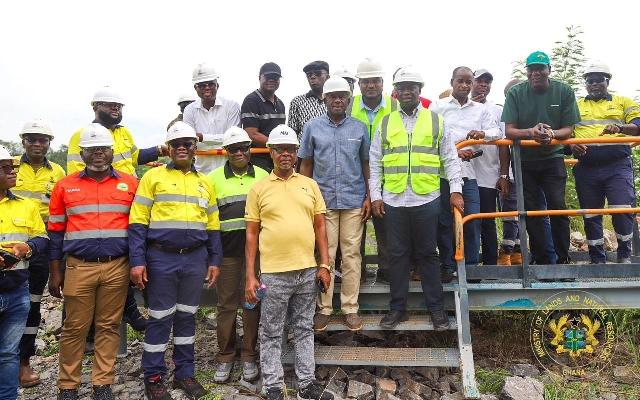
Ghana’s Ministry of Lands and Natural Resources has ordered the Minerals Commission to protect mineworkers from salary cuts, loss of benefits and weaker employment conditions as the country shifts more mining operations from multinational companies to Ghanaian contractors. The Commission must harmonise wages and conditions across the sector, classify contractors according to capacity and complete its implementation proposals by November 30. Government says local-content reform must expand Ghanaian participation without making existing workers worse off.
Ghana’s government has ordered the Minerals Commission to protect mineworkers from salary cuts, reduced benefits and weaker conditions of service as the country pushes ahead with a major local-content policy that will transfer more mining operations from multinational companies to Ghanaian contractors. The Ministry of Lands and Natural Resources says workers must not become financially worse off simply because the company directly employing them changes under the new contract-mining arrangements. The directive follows concerns from the Ghana Mineworkers’ Union, human-resource specialists and other industry stakeholders that localising mining contracts could create an unintended two-tier workforce in which employees doing comparable jobs receive significantly different salaries and benefits.
The Minerals Commission has now been instructed to develop a system that harmonises salaries, wages and employment conditions across the mining value chain while also ensuring that individual workers affected by the transition do not lose existing entitlements. The Commission has until November 30, 2026, to complete the necessary implementation work and submit proposals and supporting documents for approval. That deadline is important because the wider local-content transition is expected to accelerate from December, leaving only weeks for regulators, mining companies, contractors and organised labour to establish practical rules governing how affected workers will be treated.
Under the government’s position, a mineworker moving from an owner-operated mining structure into employment under a contractor should continue to receive wages, allowances, benefits and other incentives comparable to those previously enjoyed by workers performing similar duties. The Ministry has explicitly said that no worker should suffer a deterioration in wages, emoluments, entitlements, benefits or conditions of service because of the shift. In practical terms, the policy is designed to prevent companies from using the transition to contract mining as an opportunity to reset salaries downward or replace experienced employees with cheaper labour doing substantially the same work.
The issue has become one of the most sensitive parts of Ghana’s wider effort to increase local ownership and participation in the mining sector. Ghana remains Africa’s largest gold producer and hosts major international operators including Newmont, AngloGold Ashanti, Zijin and other companies with large-scale mining interests. For decades, a significant share of high-value technical and operational work has either been performed directly by multinational mine owners or outsourced through established contractors, some of them foreign-owned. The government now wants more of that value to remain in Ghana by requiring greater participation from indigenous companies.
For surface mining operations, contract mining is to be undertaken by indigenous Ghanaian companies under the local-content framework. Underground contract mining is subject to a different arrangement, with partnerships required in which Ghanaian-owned companies hold at least a 50 per cent interest. These requirements were incorporated into the sixth edition of Ghana’s Local Procurement List under the Minerals and Mining Local Content and Local Participation Regulations and have been in force as part of the government’s broader strategy to ensure that mining generates more domestic business activity beyond royalties, taxes and direct employment.
The policy has strong economic logic from the government’s perspective. Large mines spend substantial sums every year on excavation, drilling, blasting, hauling, engineering, maintenance, equipment services, logistics and other activities that can create profitable businesses around the extraction itself. If Ghanaian firms capture a larger share of those contracts, government expects more mining revenue to circulate through the domestic economy, support local companies and create managerial and technical expertise that remains in the country even after individual mines eventually close.
Workers and unions, however, have warned that local ownership alone does not automatically guarantee better employment conditions. A multinational mine owner may have established salary structures, pension arrangements, medical insurance, allowances, bonuses and collective bargaining agreements that smaller contractors cannot initially match. If workers are transferred to those contractors without safeguards, local-content reform could create Ghanaian-owned businesses while simultaneously reducing the income and security of Ghanaian employees.
That concern appears to have driven the latest directive. The Ministry says its objective is to make local participation complementary to worker protection rather than forcing government to choose between the two. Ghanaian contractors should receive greater opportunities, but those opportunities should not be financed through lower pay for the employees carrying out the physical and technical work. The Minerals Commission has therefore been asked to create an industry structure that protects both domestic ownership and employment standards.
Harmonising salaries across the mining value chain will not be straightforward. Ghana’s mining industry contains workers with very different qualifications, responsibilities and risk levels, ranging from heavy-equipment operators and underground miners to engineers, geologists, technicians, plant operators, safety specialists and administrative staff. Individual mines also differ in profitability, location, working arrangements and collective bargaining history. A harmonised system will therefore need to distinguish between comparable jobs rather than simply imposing identical salaries on every worker across every operation.
The central principle appears to be equal or comparable treatment for equivalent work. If a worker was performing a particular function under an owner-operated arrangement before the transition, transferring that role to a contractor should not automatically justify a lower salary or the disappearance of benefits attached to the job. The Minerals Commission will need to determine how that principle is measured, whether industry salary bands are introduced and how disputes will be resolved when contractors argue that their cost structures differ from those of major mine owners.
Government has also directed the Commission to classify eligible contractors according to their capacity to deliver mining-related services. That requirement is closely connected to the labour issue because not every Ghanaian contractor has the financial strength, technical experience, equipment base or management capacity required to assume major mining operations. Categorising contractors could allow regulators to distinguish companies capable of handling large and complex contracts from smaller businesses suited to more limited assignments.
The classification system could also reduce the risk that companies win contracts primarily because they satisfy local ownership requirements while lacking the operational capacity to perform the work safely and sustainably. Mining is capital intensive and technically demanding, and failures in drilling, blasting, underground support, haulage or equipment maintenance can have serious consequences for workers and production. Local participation therefore has to be accompanied by competence, financing and safety standards if the policy is to achieve its intended objective.
Another concern is the possibility of fronting, where a company appears Ghanaian on paper but foreign interests exercise the real control or receive most of the economic benefit. The Ministry has warned that there will be zero tolerance for fronting arrangements that undermine the intention of local-content rules. Government has similarly warned against cartelisation and bid-rigging, signalling that increasing Ghanaian participation should not become an excuse for a small group of connected contractors to divide lucrative mining contracts among themselves.
Unfair labour practices are included in that same warning. The Ministry says the local-content transition must not operate to the detriment of Ghanaian workers, meaning regulators will be expected to intervene where contractors attempt to reduce pay or employment conditions unfairly. The success of that commitment will depend heavily on enforcement because policy statements alone will not prevent cost-cutting once contracts have been awarded.
Contract mining can offer mine owners several commercial advantages. Instead of directly owning every piece of equipment and employing every worker involved in extraction, a mining company can pay specialist contractors to perform defined tasks. The contractor assumes some responsibility for equipment, staffing and operations, while the mine owner can concentrate on planning, processing, geology and overall management. In highly competitive mining markets, this model can reduce capital requirements and provide flexibility.
The same flexibility can create anxiety for employees because contractors may operate on fixed-term agreements and face intense pressure to meet cost targets. When a mining contract changes hands, employees can worry about whether they will be rehired, whether previous years of service will be recognised and whether pensions, medical benefits or bonuses will continue. Ghana’s new safeguards are intended to prevent local-content reform from producing precisely that kind of insecurity.
Job continuity will therefore be as important as salary protection. A worker who retains the same nominal hourly rate but loses medical benefits, housing support, pension contributions or job security may still be materially worse off. The Ministry’s directive is broad enough to include emoluments, entitlements and conditions of service, suggesting regulators are expected to look beyond base salary when comparing employment packages.
The government’s challenge is to protect those benefits without making it impossible for Ghanaian contractors to compete. If contractors are required to replicate every cost structure of large multinational companies while financing expensive equipment and operations with less access to capital, some may struggle to meet the new requirements. Government may therefore need to examine financing arrangements, contract pricing and access to equipment alongside labour protections.
This is one reason the November 30 deadline matters. The Minerals Commission has been given responsibility not merely to issue a statement of principle but to develop the implementation framework capable of translating the policy into actual employment practices. That could involve standardised salary benchmarks, minimum benefit requirements, contract clauses, reporting obligations and enforcement mechanisms. The Commission may also need to establish procedures allowing unions or workers to report contractors that attempt to circumvent the rules.
The Ghana Mineworkers’ Union is likely to play an important role in that process because it has raised concerns about the potential impact of the transition. Organised labour has a long history of negotiating wages and working conditions in Ghana’s large-scale mining industry, where employees often work in demanding environments involving heavy machinery, explosives, underground operations and exposure to industrial hazards. Preserving collective bargaining rights and existing union protections will therefore be important as employment relationships change.
Government says consultations have already taken place involving the union, industry experts and other stakeholders. Those engagements were intended to clarify the legal basis of the contract-mining policy and identify concerns that could undermine worker welfare. The latest measures suggest the government accepted at least part of the argument that additional protections were necessary before the transition moved further.
The broader local-content rule is not completely new, and the Ministry says most multinational mining companies have already taken steps to comply. Government argues that those examples demonstrate the policy is practical and can be implemented without disrupting production. However, the remaining transitions may involve more complicated operations or employment structures, which could explain why worker concerns have become more prominent as the December period approaches.
Major mining companies will now have to consider labour protections when negotiating contract terms with Ghanaian firms. If a contractor is expected to preserve existing employee packages, the price of the mining contract will need to reflect those costs. Otherwise, companies could create a situation where contractors win bids at prices that make compliance with the wage protections financially difficult.
That brings the government’s warning against bid-rigging and unsustainable contracting into sharper focus. Competition is important, but awarding contracts simply to the lowest bidder can create problems if the winning company can only deliver the promised price by cutting wages, benefits or safety expenditure. A contractor classification system could therefore be used not only to assess technical capacity but also financial capability.
Mining safety must remain another central consideration. Employees working underground or around large equipment require continuous training, proper protective gear, functioning machinery and strict safety systems. A local-content transition that places contractors under excessive financial pressure could theoretically encourage savings in areas that should never be compromised. Protecting salaries is therefore only one part of maintaining employment standards during the shift.
The government has said the additional measures supplement existing mining regulations rather than replacing them. That means contractors will still be subject to occupational safety, environmental and operational requirements already governing the sector. The Minerals Commission retains authority to take further lawful action where necessary to advance the objectives of the local-content regulations.
For Ghana, the political appeal of the policy is clear. The country has produced gold for generations, yet recurring debates continue over whether enough of the economic value generated by mining remains in Ghana. Governments have increased royalties, taxation, local procurement and community-development requirements over time, but public pressure continues for deeper Ghanaian ownership of the businesses surrounding the industry.
Contract mining represents one area where that deeper participation can happen relatively quickly because Ghanaian businesses do not necessarily need to own the mineral deposit itself to capture significant value. Companies that perform extraction, haulage and engineering work can build substantial enterprises while developing experience capable of being exported to mining projects elsewhere in Africa.
If implemented successfully, the policy could produce a stronger domestic mining-services industry. Ghanaian companies could acquire larger fleets, train more engineers and equipment operators and develop specialised knowledge that makes them competitive internationally. Employees could gain career opportunities in locally controlled businesses rather than seeing the highest-value contracts consistently awarded to international service companies.
The risk is that localisation becomes purely nominal. If Ghanaian companies win contracts but rely almost entirely on foreign financing, equipment, management and technical expertise, the amount of genuine local value created may remain limited. Likewise, if workers receive lower salaries after moving to local contractors, the policy could transfer value from employees to business owners rather than expanding the overall share retained within Ghana.
The latest directive is an attempt to prevent that outcome. Government’s stated position is that Ghanaian ownership must not be achieved at the expense of Ghanaian labour. That principle will now need to survive the commercial negotiations taking place between mine owners and contractors.
The policy could also affect industrial relations if workers believe new employers are attempting to reinterpret existing agreements. The mining sector has historically faced strikes and labour disputes over wages, redundancy and working conditions, and a poorly managed transition could produce renewed tension. Clear national standards may reduce those risks by establishing expectations before employees are transferred.
One unanswered question is precisely how existing employees will move between companies. In some cases, workers may formally leave a mine owner and sign completely new contracts with a contractor. In others, contractor employees may already be performing the relevant jobs. The legal treatment of accumulated service, pensions and other benefits could therefore vary depending on the structure of each transition.
Another issue is whether wage harmonisation will eventually lift salaries for contractor employees who were already receiving less than comparable owner-mining workers. The Ministry’s language suggests a wider ambition to harmonise employment conditions across the value chain rather than protecting only workers who are transferred after the new policy. If implemented broadly, the directive could have consequences well beyond the immediate December transition.
That could increase labour costs for some contractors but also reduce resentment between workers performing similar jobs at the same mine under different employers. Large industrial sites often contain multiple employment categories, and significant pay disparities can create morale problems when employees work side by side under comparable conditions.
The mining companies themselves will need predictability. Long-term mine plans are built around cost assumptions covering equipment, labour, fuel, processing and capital expenditure. Sudden changes to contractor costs can affect operating margins and decisions about which deposits remain economically viable. Government will therefore need to ensure the final wage framework protects workers without introducing uncertainty that discourages investment.
Ghana is currently benefiting from strong international interest in gold, making the timing especially significant. High gold prices improve the economics of many operations and can generate greater government revenue, but they also increase public expectations that workers and communities should receive a fairer share of the industry’s prosperity. A policy guaranteeing that employees do not lose income during localisation is therefore likely to attract considerable public support.
The policy could become more difficult if commodity prices weaken. Contractors that negotiate under favourable gold-market conditions may later face cost pressure if mining companies demand lower rates. That is another reason employment protections need to be embedded in regulation rather than depending only on voluntary promises made during the transition.
The November 30 implementation proposals should provide a clearer picture of how government intends to manage these competing interests. Workers will be looking for enforceable protection rather than general assurances, while contractors will want clarity about their obligations before accepting major operational responsibilities. Mine owners will need certainty about what employment costs must be incorporated into contracts.
The Minerals Commission will therefore be under significant pressure to produce a framework detailed enough to prevent loopholes. If terms such as comparable employment or equivalent benefits remain undefined, companies may interpret them differently and disputes could move into arbitration, labour tribunals or the courts. Clear job classifications and benefit standards could reduce that uncertainty.
Government has also indicated that it is prepared to enforce sanctions where local-content requirements are ignored. The December transition is therefore not being presented as a voluntary preference for Ghanaian contractors but as part of a regulatory framework that mining companies are expected to follow. Major operators must adapt their procurement and operating structures accordingly.
The government believes the majority of multinational operators have already demonstrated that adaptation is possible. The remaining debate is increasingly about how to ensure the process does not create casualties among the very Ghanaian workers the policy is supposed to benefit.
For mineworkers, the most immediate assurance is that their existing economic position should be protected. The Ministry says changing from owner mining to contract mining must not mean losing salary, allowances, entitlements or conditions of service. Whether those protections work in practice will become clearer once the Minerals Commission publishes the implementation framework and contract transitions begin under the strengthened rules.
For Ghanaian contractors, the policy represents a major commercial opportunity but also a substantial responsibility. Companies receiving larger mining contracts will be expected to demonstrate that local ownership can deliver professional operations, safe workplaces and decent employment conditions rather than simply cheaper services.
For multinational mining companies, the message is equally clear. Local-content compliance will not be accepted if it produces lower labour standards. Contractors selected to take over operations will need to be financially and technically capable of maintaining both production and worker welfare.
The wider question is whether Ghana can use the transition to create a stronger domestic mining industry without disrupting one of the country’s most important export sectors. Gold remains a critical source of foreign exchange and government revenue, meaning policymakers cannot afford significant production problems. Local participation therefore has to be expanded in a way that preserves operational reliability.
That is why the new directive goes beyond salaries. Contractor capacity, competition, employment conditions and enforcement are being treated as parts of the same policy because weakness in any one area could undermine the others. A poorly capitalised contractor may cut employee costs, while an artificially low bid can threaten safety and production. A front company may satisfy ownership requirements on paper without creating genuine Ghanaian capacity.
Government is now attempting to close those gaps before the next phase of the policy takes effect. The Minerals Commission’s November 30 deadline gives the regulator a short window to translate political commitments into practical rules that companies and workers can understand.
The outcome will be closely watched across Ghana’s mining communities because the transition could shape employment conditions for years. Workers are being promised that localisation will not reduce their standard of living, while Ghanaian contractors are being offered larger opportunities within an industry historically dominated by multinational capital.
If government successfully combines those objectives, contract mining could become an important vehicle for expanding Ghanaian ownership without weakening workers. If the safeguards fail, the policy could instead become associated with lower pay, employment disputes and resistance from organised labour.
For now, the government has made its position explicit. Ghana wants more mining operations in Ghanaian hands, but it says that transition cannot be funded by taking money or benefits away from Ghanaian mineworkers. The Minerals Commission has until November 30 to build the framework intended to make that promise enforceable before the industry moves deeper into the new contract-mining era.