HARRY KANE WINS 2026 BALLON D’OR AFTER RECORD-BREAKING SEASON FOR BAYERN MUNICH AND ENGLAND
Harry Kane has won the 2026 Men’s Ballon d’Or after scoring 73 goals and providing eight assists in 65 appearances for Bayern Munich and England during the 2025/26 season. The England captain finished ahead of Kylian Mbappé, Lamine Yamal, Rodri and Lionel Messi in the final voting and became the first English winner since Michael Owen in 2001. Kane also collected the Men’s Striker of the Year award on the same night after helping Bayern win the Bundesliga, DFB-Pokal and Franz Beckenbauer Supercup while England finished third at the 2026 World Cup.
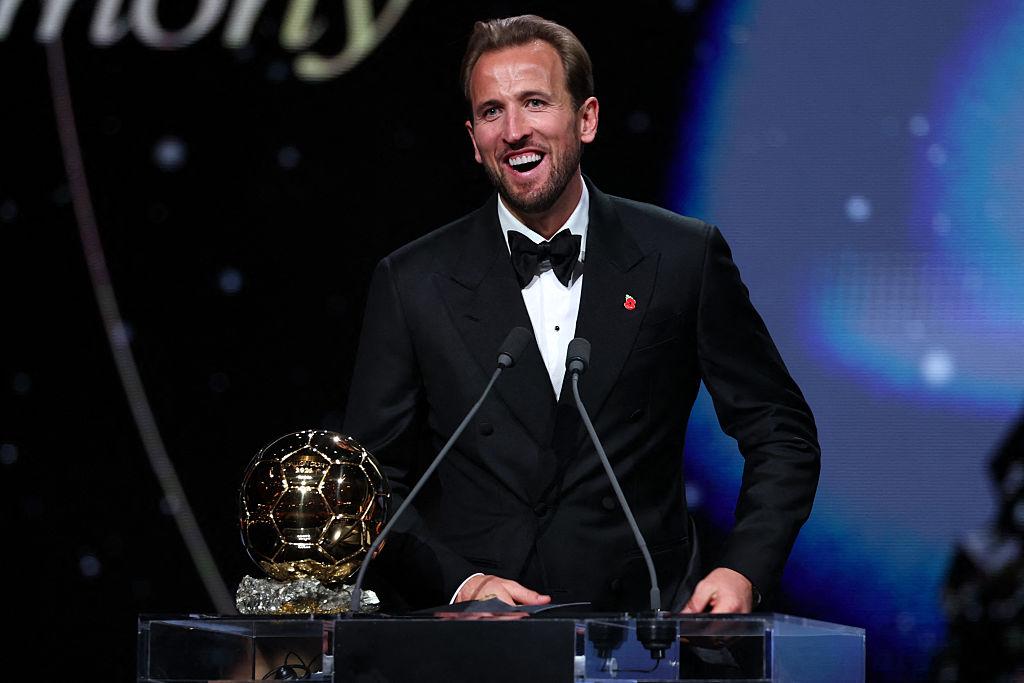
England captain Harry Kane has won the 2026 Men’s Ballon d’Or after producing the most prolific season of his career for Bayern Munich and the England national team, completing a remarkable rise from elite goalscorer to officially recognised best male footballer in the world. Kane received the award at the 70th Ballon d’Or ceremony at the London Palladium on Monday night, finishing ahead of Real Madrid striker Kylian Mbappé and Barcelona star Lamine Yamal after a season in which he scored 73 goals and provided eight assists across 65 appearances for club and country.
The award represents the biggest individual honour of Kane’s career and makes him the first English player to win the Ballon d’Or since Michael Owen in 2001. He becomes the fifth Englishman to claim the prize after Sir Stanley Matthews, Sir Bobby Charlton, Kevin Keegan and Owen, joining a historic group of players whose names are permanently linked to one of football’s most prestigious individual awards.
Kane’s victory was built on extraordinary numbers during the 2025/26 season. He scored 61 goals in 51 competitive appearances for Bayern Munich and added another 12 goals for England, taking his total to 73 goals in 65 matches. He also recorded eight assists, meaning he contributed directly to 81 goals during the eligibility period, an output that placed him among the most productive players of the modern era.
His numbers for Bayern were particularly striking. Kane scored 36 Bundesliga goals in 31 league appearances, winning the German top-flight scoring title for a third consecutive season and also claiming the European Golden Shoe. He added 10 goals in six DFB-Pokal appearances and 14 goals in 13 Champions League matches, demonstrating that his scoring form was sustained across domestic and European competition rather than concentrated in one tournament.
Kane’s goals also translated into major trophies for Bayern. The German champions retained the Bundesliga title, won the DFB-Pokal and added the Franz Beckenbauer Supercup, giving Kane one of the most successful seasons of his career from both an individual and team perspective. His contribution in the German Cup was especially significant because he scored throughout the competition and produced a hat-trick in the final, helping Bayern complete a domestic double.
The season also strengthened Kane’s international legacy with England. The national team finished third at the 2026 FIFA World Cup in the United States, Mexico and Canada, its best World Cup finish since winning the tournament in 1966. Kane scored six goals at the finals and remained central to England’s attack throughout the competition, adding another major tournament to a career in which he has already become his country’s record goalscorer.
Across the full season, Kane scored 12 times in 14 appearances for England. His international goals combined with his extraordinary Bayern output to produce a total of 73, a figure that only Lionel Messi’s 2011/12 season has exceeded among players in the 21st century. Messi scored 82 goals for Barcelona and Argentina during that campaign, leaving Kane’s total as one of the highest seasonal scoring figures recorded in modern football.
Kane’s Ballon d’Or victory was therefore based not simply on reputation but on a combination of individual production, trophies and international performance. The voting criteria for the award place strong emphasis on individual impact, team achievements, decisive performances and sporting conduct, and Kane’s season offered a strong case across each of those categories.
The Ballon d’Or is decided by an international jury of specialised football journalists representing the top 100 countries in the FIFA men’s world ranking. Each journalist ranks players from the official shortlist, with points awarded according to those selections, and the player collecting the highest overall total is declared the winner. Kane emerged at the top of that process after a season that combined historical scoring numbers with domestic trophies and a strong World Cup campaign.
Kylian Mbappé finished second in the final ranking after another outstanding season with Real Madrid and France, while Barcelona teenager Lamine Yamal placed third following another year in which he continued his rapid rise into the highest level of world football. Manchester City and Spain midfielder Rodri finished fourth, while Lionel Messi completed the top five after another influential season with Inter Miami and Argentina.
The ranking reflected the strength of the competition Kane faced. Mbappé remained one of Europe’s most dangerous attacking players and also finished ahead of Kane in the Champions League scoring chart, while Yamal continued to develop into one of Barcelona’s most important players. Rodri remained one of the most influential midfielders in world football, and Messi continued to perform at an elite level despite entering the later stages of his career.
Kane’s victory is also historically important for the Bundesliga. He becomes the first player based in Germany’s top flight to win the Ballon d’Or since Matthias Sammer in 1996, ending a 30-year wait for the league. That distinction adds another layer to Kane’s success because many of the award’s recent winners have come from Spain, France or England rather than Germany.
For Bayern Munich, the award reinforces the impact Kane has made since joining the club from Tottenham Hotspur. He arrived in Germany already established as one of the best strikers of his generation, but his performances for Bayern have pushed his career into another statistical category. The 2025/26 season in particular transformed the conversation around him because he combined extraordinary individual numbers with the major trophies that had previously been missing from his career.
For many years, Kane’s achievements were frequently discussed alongside the fact that he had not won a major team trophy. That narrative has now changed considerably. Bayern’s domestic success, combined with his Ballon d’Or and individual scoring honours, means his career is increasingly judged on the scale of what he has won rather than what he had previously lacked.
The award also represents vindication for a player whose early career was far from straightforward. Kane spent periods on loan at Leyton Orient, Millwall, Norwich City and Leicester City before establishing himself at Tottenham. He was not initially viewed as a future global superstar, but consistent development eventually turned him into Tottenham’s all-time leading scorer and England’s record goalscorer before his move to Germany.
Kane referred to that journey while accepting the award, reflecting on the work required to progress from an uncertain young striker into one of the world’s most recognised players. His career has often been defined by persistence as much as talent, and his Ballon d’Or victory provides the clearest recognition yet of that progression.
The ceremony itself carried particular symbolism because it was staged in London for the first time in the award’s history. The Ballon d’Or was created by France Football in 1956 and had traditionally been associated with ceremonies in France, but organisers moved the 2026 event to the London Palladium as part of the 70th-anniversary celebrations.
The choice of London also served as a tribute to Sir Stanley Matthews, the English football legend who became the first Ballon d’Or winner in 1956. Seventy years later, another England captain received the same trophy in the British capital, giving the ceremony a strong historical connection between the award’s first winner and its latest English recipient.
The event is now jointly organised by France Football and UEFA, a partnership that began in 2024. The Ballon d’Or remains owned and awarded by France Football, while UEFA participates in organising the wider ceremony and associated awards.
Kane did not leave the London Palladium with only the main Ballon d’Or. He also received the Men’s Striker of the Year award, formerly known as the Gerd Müller Trophy, after finishing as the most prolific scorer across club and international football during the relevant season. It was another recognition of a campaign in which his consistency separated him from most of Europe’s elite forwards.
The striker award was Kane’s second, having previously shared the honour with Mbappé in 2024. His latest victory, however, came during a season in which his overall scoring output reached a level he had never previously achieved.
The Ballon d’Or ceremony also recognised a number of other major figures in world football. Spain and former Barcelona star Alexia Putellas won the Women’s Ballon d’Or for a third time, adding another major individual honour to one of the most decorated careers in women’s football.
Lamine Yamal won the Men’s Young Talent of the Year award after another outstanding season with Barcelona and Spain, while Vicky López received the equivalent women’s honour. Athletic Club and Spain goalkeeper Unai Simón was named Men’s Goalkeeper of the Year, while Barcelona’s Cata Coll won the women’s goalkeeper award.
Spain national team coach Luis de la Fuente won the Men’s Coach of the Year award, while Barcelona coach Pere Romeu took the women’s coaching prize. Paris Saint-Germain were named Men’s Club of the Year, with Barcelona receiving the women’s club honour.
Arsenal and England winger Bukayo Saka received the Sócrates Award, which recognises humanitarian and social initiatives supported by footballers. The award has become an important part of the ceremony in recent years by recognising impact beyond performances on the field.
Despite the number of prizes presented, Kane remained the central figure of the evening. Winning both the striker award and the Ballon d’Or completed a season in which he had already claimed the European Golden Shoe and multiple domestic trophies.
His Bundesliga numbers alone would have made him one of the strongest candidates. Thirty-six league goals in 31 appearances produced another scoring title and reinforced his reputation as one of the most efficient finishers in Europe. His ability to maintain that production in cup competitions and international football made the overall case even stronger.
Kane also demonstrated that his game extends beyond finishing. The eight assists he recorded during the season reflected his long-established ability to drop into deeper positions, link play and create chances for teammates. Throughout his career, Kane has combined traditional number-nine movement with passing ability more commonly associated with attacking midfielders.
That broader influence has helped Bayern use him as both a focal point and a creator. Defenders must decide whether to follow him when he drops away from the penalty area or remain deeper to protect space behind, a dilemma that frequently creates opportunities for wide players and attacking midfielders.
His partnership with Bayern’s attacking players was one of the major reasons the team produced such consistent offensive numbers throughout the season. Michael Olise, Luis Díaz and other attacking teammates benefited from Kane’s movement and distribution, while Kane remained the primary finishing threat inside and around the penalty area.
England have similarly built much of their attacking structure around him for years. Kane’s capacity to combine goalscoring with playmaking allows England’s quicker attacking players to make runs beyond him while he participates in build-up play.
His World Cup performance strengthened his case for the Ballon d’Or because international tournaments carry significant weight in the perception of major individual awards. Six goals at the tournament ensured Kane remained one of its leading scorers, while England’s third-place finish gave him a stronger team achievement than in several previous international campaigns.
England did not win the World Cup, but their third-place finish represented their strongest performance at the tournament in six decades. Kane played a central role in that run and continued adding to his already significant international records.
The award also adds a new dimension to debates about the best strikers of Kane’s generation. His scoring records have long placed him alongside players such as Robert Lewandowski, Karim Benzema and Mbappé, but winning the Ballon d’Or gives him an individual honour achieved by only a small group of forwards in the modern era.
It may also change perceptions of his decision to leave Tottenham for Bayern. The move was initially driven partly by the opportunity to compete consistently for major trophies, and the 2025/26 season demonstrated the potential benefits of that decision. Kane now has domestic trophies, European scoring honours and the Ballon d’Or on his record.
For Bayern, his success provides international recognition for the club’s sporting project under Vincent Kompany. Winning the Bundesliga and DFB-Pokal while reaching the Champions League semi-finals established Bayern as one of Europe’s strongest teams during the season, even though the club ultimately fell short of the Champions League final.
Kane’s 14 Champions League goals were particularly impressive because they came against high-level opposition and placed him among the competition’s leading scorers. Only Mbappé finished ahead of him in that tournament’s scoring standings.
His DFB-Pokal performances may have been even more decisive from a team perspective. Kane scored in every round and produced a hat-trick in the final, helping Bayern end a six-year wait for the German Cup.
That performance carried additional personal significance because cup finals had often become part of the discussion surrounding Kane’s lack of trophies earlier in his career. Delivering a hat-trick in a major final was therefore a powerful answer to one of the few criticisms that had followed him.
The European Golden Shoe further demonstrated how dominant his league campaign had been. Kane’s 36 Bundesliga goals placed him nine ahead of Manchester City striker Erling Haaland in the European scoring race, allowing him to claim the award for the second time.
The combination of the European Golden Shoe, Bundesliga top-scorer award, striker award and Ballon d’Or means Kane has now collected virtually every major individual recognition available to a European forward.
The challenge will now be maintaining that standard during the 2026/27 season. Replicating 73 goals would be extraordinarily difficult, particularly given how rare such numbers are historically, but Kane has shown little evidence of a major decline in his finishing ability.
His age also adds significance to the achievement. At 33, Kane won the award later in his career than many previous Ballon d’Or winners, demonstrating that elite forwards can continue producing at extraordinary levels well into their thirties.
Modern sports science, training methods and player management have allowed many leading footballers to extend their careers, and Kane’s game may be particularly suited to longevity because it depends heavily on positioning, technique and decision-making rather than only explosive pace.
The Ballon d’Or victory will also increase attention on England’s future. Kane remains captain and central striker, and the national team will hope his form can continue through the next major international cycle.
For English football, his victory ends a long individual drought. Despite the Premier League’s global prominence and the number of elite English players produced over the past two decades, no Englishman had won the Ballon d’Or since Owen in 2001.
Players including Steven Gerrard, Frank Lampard, Wayne Rooney, David Beckham and Jude Bellingham have all featured prominently in discussions or final rankings over the years, but Kane is the player who has finally returned the award to England.
The fact that the ceremony took place in London made that achievement even more significant. With the Ballon d’Or celebrating 70 years and honouring Matthews as its inaugural winner, Kane’s victory created a narrative that connected two different generations of English football.
For France Football, the 2026 edition also represented an important evolution of the award. Moving the ceremony outside France for the first time demonstrated the increasingly global nature of the event while maintaining the historical connection to its origins.
The final voting also confirmed that Kane’s victory was not simply a statistical award. Journalists considered team success, influence and overall sporting performance alongside his goals, and he still emerged ahead of some of the most celebrated players in world football.
Mbappé’s second-place finish ensures the Real Madrid forward remains one of the strongest contenders for future editions, while Yamal’s third place at such a young age reinforces expectations that he could eventually become a multiple winner.
Messi’s fifth-place finish was another remarkable result given his age and the fact that he is now playing outside Europe. His continued presence near the top of the rankings underlines the extraordinary longevity of a player who has already won the trophy eight times.
For Kane, however, Monday night belonged entirely to him. Years of scoring records, near misses and debate over trophies culminated in the moment he stood on stage in London holding football’s most celebrated individual prize.
The numbers explain much of the decision: 65 appearances, 73 goals and eight assists, with 61 goals for Bayern and 12 for England. But the wider picture explains why those numbers carried so much weight. Kane combined them with the Bundesliga, DFB-Pokal, Franz Beckenbauer Supercup, European Golden Shoe and England’s best World Cup finish since 1966.
That combination turned an exceptional scoring season into a historically significant one.
Kane’s name will now appear permanently alongside the greatest players to have won the Ballon d’Or since 1956. After spending much of his career being recognised as one of the world’s best strikers without receiving football’s biggest individual prize, the England captain has finally reached the top of the Ballon d’Or podium.
For Bayern Munich, England and Kane himself, the 2026 award represents the formal recognition of a season that may ultimately be remembered as the defining year of his career.