

IRAN CLAIMS CAPTURE OF SECOND US UNDERWATER DRONE IN STRAIT OF HORMUZ
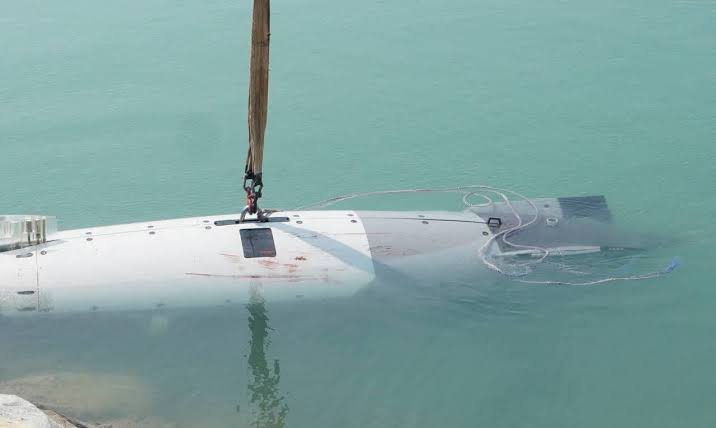
Iran's Islamic Revolutionary Guard Corps says it has captured a US REMUS 600 autonomous underwater vehicle in the Strait of Hormuz, claiming the drone was conducting espionage. The announcement marks Iran's second claimed seizure of a US underwater drone this month. The latest Iranian account remains disputed by the United States.
Iran's Islamic Revolutionary Guard Corps has claimed the capture of another US military underwater drone in the Strait of Hormuz, marking the second such incident announced by Tehran this month as tensions remain high around the strategic waterway.
The IRGC Navy said Sunday that its forces seized what it identified as a REMUS 600 autonomous underwater vehicle belonging to the US military.
According to the Guards, the underwater vehicle was operating in the Strait of Hormuz for espionage purposes.
Iran says the operation involved intelligence monitoring and electronic-warfare capabilities.
The IRGC further claimed that the vehicle is now in Iranian custody, with specialists attempting to recover information stored on the system.
The espionage allegation is Iran's claim and has not been independently established.
SECOND UNDERWATER DRONE INCIDENT THIS MONTH
Sunday's announcement is separate from another underwater-drone incident earlier in September.
On September 8, Iran announced that it had recovered a different US underwater vehicle identified as a Dive-LD near the entrance to the Strait of Hormuz.
The United States acknowledged losing that earlier vehicle but disputed Iran's characterization of what happened.
US officials said the Dive-LD had malfunctioned more than a day before Iranian forces recovered it.
The Pentagon also said that vehicle had been surveying regional waters and did not contain classified sonar or radar technology.
Today's Iranian announcement concerns a different platform.
This time, the IRGC identifies the vehicle as a REMUS 600.
WHAT IS THE REMUS 600?
The REMUS 600 is an autonomous underwater vehicle capable of operating without a crew aboard.
Systems in the REMUS family can be used for a range of underwater missions, including seabed surveying, mine countermeasures, environmental monitoring and intelligence, surveillance and reconnaissance operations.
The name reflects the platform's ability to operate at depths of up to approximately 600 meters.
Its autonomous capabilities allow missions to be programmed before deployment, with the vehicle navigating and collecting information underwater before being recovered.
The exact configuration and mission of the vehicle Iran claims to have captured have not been independently established.
IRAN SAYS SPECIALISTS ARE RECOVERING DATA
One of the most significant parts of the Iranian announcement concerns the information allegedly contained inside the vehicle.
The IRGC says specialists are attempting to retrieve data from the REMUS 600.
Iran has not publicly disclosed what information it believes the vehicle contains.
Nor has independent evidence established that the system was conducting espionage, as Tehran alleges.
Any intelligence value would depend on the particular sensors installed, the mission assigned to the vehicle and what information remained stored onboard when it was recovered.
STRAIT OF HORMUZ REMAINS AT CENTER OF TENSIONS
The incident comes amid continuing confrontation surrounding the Strait of Hormuz.
The narrow waterway connecting the Persian Gulf with the Gulf of Oman has historically been one of the world's most important maritime energy routes.
Its strategic importance has made military activity around the strait particularly sensitive.
Iranian and American forces have repeatedly operated in close proximity across the Persian Gulf and surrounding waters.
Unmanned systems have increasingly become part of those operations, allowing militaries to conduct surveillance and other missions without placing personnel directly onboard.
TWO DIFFERENT DRONES, TWO DIFFERENT INCIDENTS
The distinction between today's announcement and the September 8 incident is important.
The earlier underwater vehicle was identified as a Dive-LD.
The vehicle Iran says it has now captured is a REMUS 600.
Iran therefore describes Sunday's development as a second seizure rather than providing new information about the underwater drone recovered earlier this month.
The earlier incident was acknowledged by the US military, although Washington disputed Iran's description of how the vehicle came into Iranian possession.
The circumstances surrounding today's REMUS 600 claim remain contested.
WHAT REMAINS UNCLEAR
Several major questions remain unanswered.
It is unclear precisely where within the Strait of Hormuz the REMUS 600 was allegedly intercepted.
There is no independently established evidence showing what mission the vehicle was performing.
Iran has also not publicly disclosed what data, if any, its specialists have successfully recovered.
The US and Iranian accounts will therefore require further scrutiny as additional information emerges.
What is clear is that Iran has now publicly announced a second incident involving what it describes as a US military underwater vehicle within less than three weeks.
The first involved a Dive-LD.
The second, according to Tehran, involves a REMUS 600.
With tensions surrounding the Strait of Hormuz already high, the latest dispute adds another underwater dimension to the confrontation between Washington and Tehran.