
IT’S UP TO AMERICA” IRAN’S PRESIDENT PUTS BALL IN TRUMP’S COURT AS SECRET HORMUZ TALKS GATHER PACE
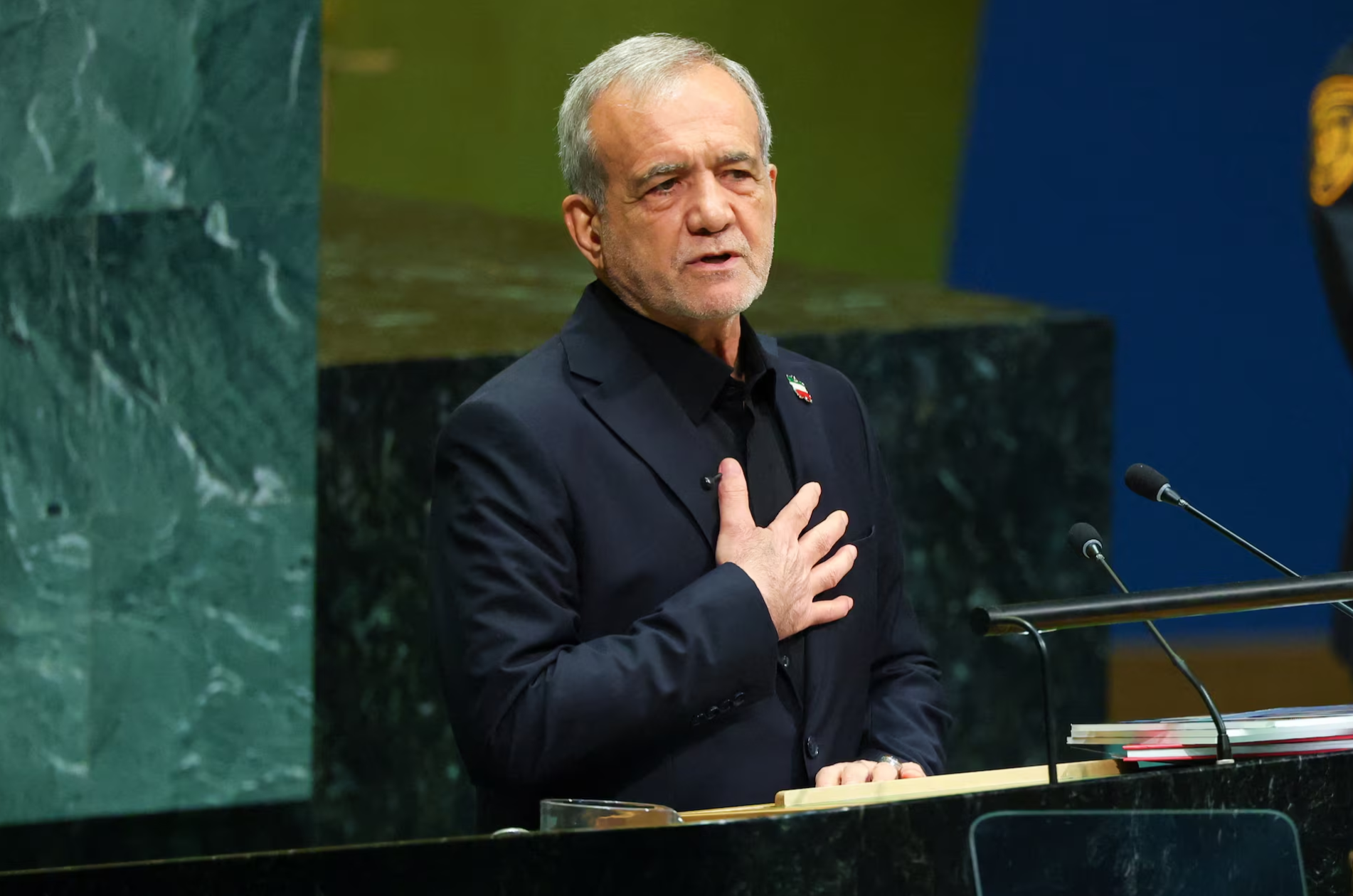
Iranian President Masoud Pezeshkian says Tehran does not want its war with the United States to continue and that Washington must decide whether it wants the conflict to end, as negotiators explore a phased agreement involving the Strait of Hormuz and the U.S. economic blockade.
Iranian President Masoud Pezeshkian has declared that Tehran does not want its war with the United States to continue, saying Washington must now decide whether it is prepared to bring the conflict to an end as diplomatic efforts intensify behind the scenes.
Pezeshkian made the remarks during an interview with Fox News aired Thursday, amid renewed negotiations between American and Iranian officials on the sidelines of the United Nations General Assembly in New York.
Asked whether the conflict could end before the end of the year, the Iranian president placed the decision squarely on Washington.
“But we do not wish to continue. It’s America that must choose whether it wants to end this or not,” Pezeshkian said.
His remarks represent one of Tehran’s clearest public signals yet that it remains open to negotiating an end to the conflict despite the increasingly confrontational rhetoric exchanged between the two governments.
Pezeshkian said disagreements that can be resolved through negotiations should not result in further loss of life and maintained that Iran did not choose the war.
At the same time, he made clear that Tehran would not accept an agreement it regarded as surrender.
That position echoes the message Pezeshkian delivered to world leaders at the United Nations General Assembly on Wednesday, when he said Iran would resist pressure from Washington while leaving the door open to diplomacy.
His comments come as U.S. and Iranian negotiators explore what could become a phased pathway towards ending the conflict.
According to sources familiar with negotiations cited by Reuters, discussions in New York have focused on an arrangement linking the reopening of the Strait of Hormuz to the easing and eventual lifting of Washington’s economic blockade against Iran.
Under proposals being discussed, Tehran could move towards reopening the strategically important waterway while Washington takes corresponding steps to ease economic pressure.
No final agreement has been reached, and significant disagreements remain.
One of the central challenges is sequencing.
Neither Washington nor Tehran wants to surrender its primary source of leverage before receiving guarantees that the other side will fulfil its commitments.
For Iran, control over navigation through the Strait of Hormuz provides enormous strategic leverage because of the waterway’s importance to global energy markets.
For Washington, economic restrictions and military pressure remain important negotiating tools.
The Strait of Hormuz is one of the world’s most strategically important maritime passages, connecting the Persian Gulf with the Gulf of Oman and global shipping routes.
A substantial share of internationally traded oil and liquefied natural gas normally passes through the waterway.
Disruption to shipping has therefore had consequences far beyond Iran and the United States, contributing to volatility in global energy markets.
Oil prices rose sharply on Thursday amid continuing Middle East security concerns before easing from session highs following reports of negotiations over reopening the Strait.
Iran has indicated that it could reopen the waterway relatively quickly if Washington begins easing military pressure and lifts its blockade on Iranian ports.
A senior Iranian official previously told Reuters that Tehran could reopen the Strait within seven days if those conditions were met.
The latest negotiations suggest both sides are examining whether reciprocal steps could overcome the distrust that has repeatedly undermined diplomatic efforts.
Nuclear policy remains another major issue.
Pezeshkian reiterated that Iran does not seek nuclear weapons and maintains that its nuclear programme is intended for peaceful purposes.
Iran is a party to the Nuclear Non-Proliferation Treaty and says it retains the right to peaceful nuclear technology under international law.
Washington has repeatedly identified preventing Iran from obtaining a nuclear weapon as a central security objective.
Iran does not currently possess nuclear weapons, according to publicly available assessments, but its uranium enrichment activities have remained a major source of international concern and disagreement.
The conflict began on February 28 after the United States and Israel attacked Iran, prompting Tehran to retaliate against Israel and Gulf states hosting U.S. military facilities.
Months of fighting have since created a wider regional security crisis and increased pressure on international energy markets.
President Donald Trump has alternated between threatening further military action and expressing optimism that negotiations could produce an agreement.
Speaking at the United Nations earlier this week, Trump warned Iran of severe consequences if diplomacy failed while also indicating that talks were taking place.
Pezeshkian’s latest comments suggest Tehran is attempting to demonstrate publicly that it remains willing to negotiate while placing responsibility on Washington for deciding whether the diplomatic process advances.
That does not mean peace is imminent.
A senior Iranian official told Reuters earlier this week that the two countries remained far apart on important elements of a settlement even as both sides agreed that diplomacy should continue.
The emerging Hormuz proposal could nevertheless provide negotiators with a framework for incremental progress rather than requiring either side to make all of its concessions at once.
A phased arrangement could allow both governments to take reciprocal steps and assess compliance before proceeding to subsequent stages.
Whether that approach can bridge disagreements over sanctions, military activity, navigation through Hormuz and Iran’s nuclear programme remains uncertain.
For now, Pezeshkian has made Tehran’s public position clear.
Iran says it does not want the war to continue and is prepared to pursue negotiations.
The question is whether the discussions underway in New York can produce terms that both Tehran and Washington are prepared to accept.