MAHAMA BREAKS GROUND ON 1,238 ACRE AFIENYA INDUSTRIAL PARK AS GOVERNMENT UNVEILS US$10 BILLION JOBS AND PRODUCTION DRIVE
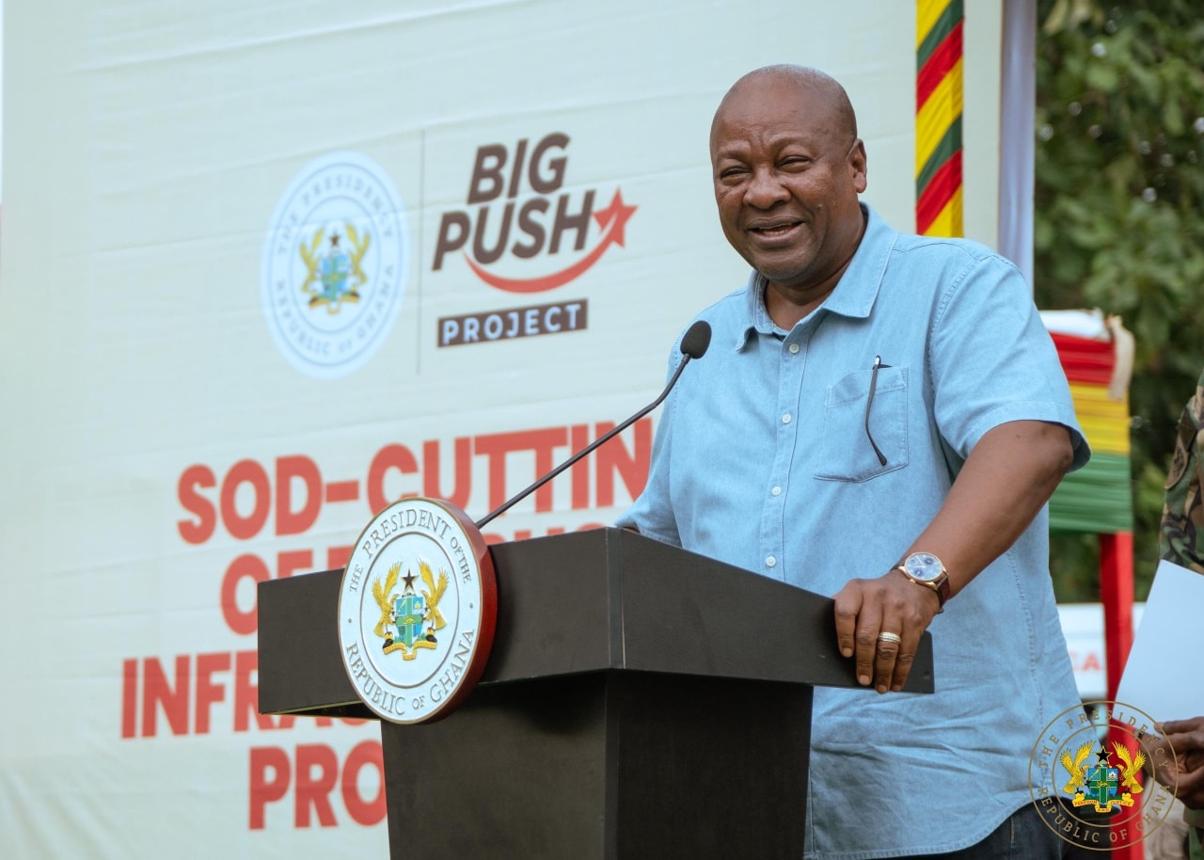
President John Dramani Mahama has broken ground on the 1,238-acre Afienya Industrial Park in the Greater Accra Region, a free zones enclave designed to host more than 120 enterprises across manufacturing, agro-processing, pharmaceuticals, automotive assembly, logistics and green industries. The project will provide serviced, litigation-free industrial land with power, water, roads and waste treatment infrastructure and will connect to the Tema-Mpakadan railway and Tema Port. It is expected to receive support from the government’s proposed US$10 billion New Economy Programme, although recent official statements contain differing figures on the planned annual investment.
President John Dramani Mahama has broken ground for the construction of the 1,238-acre Afienya Industrial Park in the Greater Accra Region, launching a major expansion of Ghana’s free zones infrastructure as his government prepares a broader US$10 billion investment program focused on industrial production, agriculture, exports and job creation.
The new industrial enclave, being developed under the Ghana Free Zones Authority, is designed to accommodate more than 120 enterprises and provide investors with serviced land, factory facilities, electricity, water, internal roads, waste treatment systems and other infrastructure required to begin production. Government officials say the project is intended to ease pressure on the Tema Export Processing Zone, where available space for new investors has effectively been exhausted.
Mahama cut the sod at Afienya on Thursday, October 15, describing the project as part of the government’s attempt to convert improving macroeconomic conditions into factories, higher production, exports and sustainable employment. The President said the administration’s next priority after economic stabilization is to create productive opportunities capable of raising incomes and expanding the country’s manufacturing base.
“With the start of the construction of this Afienya Industrial Park, we are creating space for businesses to establish and expand, for new industries to take root, and for more Ghanaians to secure productive and decent jobs,” Mahama said.
The scale of the project places it among the largest new industrial developments being pursued by the government. According to the Presidency and the Information Services Department, the park will target businesses in agribusiness, cocoa processing, cashew and oil palm processing, textiles and garments, pharmaceuticals, medical consumables, automotive assembly, engineering, logistics, renewable energy, data services and business process outsourcing.
The site has been positioned strategically near major transport infrastructure. It lies along the Eastern Corridor Road, about 20 kilometers from Tema Harbour and approximately 35 kilometers from Kotoka International Airport. The Tema-Mpakadan standard gauge railway also passes through the enclave, giving manufacturers a potential rail connection between industrial facilities, the Tema Port and inland markets.
Government officials are betting that those transport links, combined with ready-to-use industrial land, will reduce some of the longstanding barriers that have frustrated manufacturers seeking to expand in Ghana. One of the problems identified by investors has been difficulty securing litigation-free land with adequate utilities and road access.
Mahama said the Afienya model is intended to address those challenges by providing what he described as a plug-and-play environment. Investors would not have to independently search for land or negotiate multiple infrastructure arrangements before beginning construction.
The President said the government would provide land free from ownership disputes together with power, water, waste treatment, security and road infrastructure. Companies would then be expected to construct or occupy factories, install machinery and begin production.
The project is also being linked directly to the government’s proposed US$10 billion New Economy Programme, which Mahama has presented as the next phase of his administration’s economic agenda. The policy is expected to focus spending on sectors capable of generating production, exports and employment rather than concentrating only on consumption or general government expenditure.
Mahama first outlined the US$10 billion New Economy concept publicly in August, saying the investment would be spread across four years and targeted at seven strategic sectors. At that time, he said government planned to invest about US$2.5 billion annually, with approximately half of the overall envelope going into agriculture and agro-processing.
At the Afienya ceremony, however, more recent official reports quoted the President as saying the program would invest US$2 billion annually for four years. That arithmetic would amount to US$8 billion rather than US$10 billion, creating an apparent inconsistency in the public figures. The government has continued to describe the overall initiative as a US$10 billion program, and the full framework is expected to be presented by the Finance Ministry as part of the 2027 Budget process.
The industrial park is expected to receive part of its infrastructure financing through that program, although government has not yet published a full project cost for the Afienya site itself or a detailed breakdown showing how much of the US$10 billion envelope will be allocated to the enclave.
Mahama argued that expanding industrial space has become necessary because of increasing demand from investors. He said the Ghana Free Zones Authority informed him that the Tema Export Processing Zone could no longer accommodate additional companies because available land had been exhausted.
That shortage, he said, was one of the clearest indications that Ghana needed additional industrial zones capable of absorbing both domestic and foreign investment.
The President also cited Ghana Investment Promotion Centre figures showing registered foreign direct investment increasing from US$624 million in 2024 to US$2.62 billion in 2025. The Presidency has presented that rise as evidence of improving investor confidence, although the government will still have to demonstrate how much of the registered investment converts into completed projects, operational businesses and permanent employment.
For the Free Zones Authority, Afienya represents an expansion of a model already used to attract export-oriented companies. Chief Executive Officer Dr Mary Awusi said the Authority had licensed 334 enterprises as of the second quarter of 2026, supporting 78,155 direct jobs and more than 84,000 indirect jobs.
Free zones exports were reported at approximately US$3.1 billion in 2025 and about US$1.4 billion by the end of the second quarter of 2026. Graphic also reported that more than 98 percent of direct jobs under the scheme are held by Ghanaians.
The Tema Export Processing Zone has been operating for roughly three decades and has hosted more than 80 enterprises, according to the President. Mahama said the zone had generated more than US$34 billion in export earnings over that period, making it a model the government now wants to expand through Afienya and potentially replicate in other parts of the country.
The Afienya park is being designed not only as another industrial estate but as a newer generation of economic zone with renewable energy, digital connectivity and environmentally oriented manufacturing incorporated into the development plan.
Trade, Agribusiness and Industry Minister Elizabeth Ofosu-Adjare said the government wants the enclave to be digital, green and structured around cross-border value chains. The objective is to attract companies that can manufacture in Ghana while using the country as a base for markets elsewhere in Africa.
That strategy is closely connected to the African Continental Free Trade Area, whose secretariat is headquartered in Accra. Mahama told investors that companies based in Afienya should position Ghana as a launching point for exports across the continent rather than treating the domestic market as their only destination.
Government officials believe Ghana’s location, ports, political stability and access to AfCFTA markets can support a stronger regional manufacturing role. The challenge will be ensuring companies based in the park can produce competitively enough to overcome electricity costs, logistics bottlenecks, financing constraints and competition from imported goods.
Mahama has directed the Trade Ministry, the Ghana Free Zones Authority and private-sector partners to begin targeted investment outreach in selected international markets. Rather than relying only on companies that express general interest, the government wants officials to identify businesses with the financial and technical capacity to establish operating factories in the enclave.
That issue is important because industrial parks can remain underutilized if governments build infrastructure without securing anchor tenants. The administration is therefore attempting to attract companies before the site is fully completed.
Officials say that process has already begun. Fourteen industrial companies have reportedly applied for or been allocated land in the Afienya enclave, suggesting that part of the park could have tenants ready before the wider infrastructure rollout is complete.
The government has not publicly identified every one of those companies or provided a complete schedule for when each is expected to begin construction and production. That will be one of the key indicators to monitor as the project moves from the sod-cutting stage into actual development.
Mahama has also emphasized that communities surrounding Afienya should benefit directly from the project rather than simply hosting large factories whose jobs are filled from elsewhere.
He called for training programs for young people in Afienya and nearby communities so they can acquire the technical skills required by companies that move into the park.
“I believe that if enterprises are located here, there should be a programme that trains the local people so that they can get some of the jobs created in this industrial park,” the President said.
The employment plan is expected to extend beyond direct factory jobs. Mahama said farmers, transport operators, suppliers and small businesses should also be integrated into the industrial park’s supply chains.
That approach is intended to create wider economic activity around the enclave, particularly if food processing and agro-industrial companies source raw materials from Ghanaian producers.
Agriculture and agro-processing are expected to receive the largest share of the broader New Economy investment program. When Mahama first announced the initiative, he said about half of the US$10 billion would be directed toward those sectors.
That focus reflects the government’s attempt to connect industrial policy with agricultural production rather than treating manufacturing as a separate sector. Processing cocoa, cashew, oil palm and other agricultural products domestically could potentially increase export earnings compared with shipping raw commodities abroad.
The government is also targeting pharmaceuticals and medical consumables, sectors that gained additional attention after supply-chain disruptions exposed Ghana’s dependence on imported health products.
Automotive components and assembly are another target. Ghana has already attracted several vehicle assemblers, but the next stage of industrial policy would require developing local component suppliers rather than relying primarily on imported kits.
Renewable energy and green manufacturing are also included in the Afienya plan. Officials say the park will incorporate cleaner energy infrastructure and attract companies working in sectors such as solar equipment and battery manufacturing.
After the sod-cutting ceremony, Mahama toured factories at the Bright International Industrial Zone and Tema areas, including garment, battery, solar panel, truck assembly and marine manufacturing facilities. Ghana News Agency reported that the President visited Jiudine Ghana Corporation, Huaguang New Energy Battery Ghana, Qianfeng International, Zema New Energy and a truck and tanker assembly operation.
Mahama said the number of factories operating in the area had increased compared with his visit the previous year and linked that expansion to the government’s wider employment strategy, including the 24-hour economy policy.
The administration argues that factories running multiple production shifts can create more employment than businesses operating only during standard daytime hours. Whether that model becomes widespread will depend largely on power reliability, demand for manufactured goods and companies’ ability to sustain round-the-clock operations.
The Afienya project will also test the government’s ability to provide dependable infrastructure. Industrial investors typically require uninterrupted electricity, water, wastewater treatment, telecommunications, roads and security, and failures in any of those areas can undermine the competitiveness of an industrial zone.
Mahama has therefore instructed the Free Zones Authority to publish service standards in concession agreements so investors know exactly what infrastructure and services government or zone operators are obligated to provide.
The President said performance should be measurable and that companies should not have to navigate uncertainty over which institution is responsible for a particular service.
Land administration is another major concern. Industrial projects in Ghana have frequently faced delays caused by competing ownership claims, traditional authority disputes and litigation. Government officials say the Afienya land has been secured specifically to minimize that risk.
If that commitment holds, it could become one of the park’s strongest selling points. Investors often rank certainty over land tenure alongside power supply, taxation and access to transport when deciding where to build factories.
The government is also reviewing aspects of customs policy affecting free zones companies. Mahama said relevant ministers would examine the new Customs Act and determine whether amendments are required to protect the competitiveness of enterprises operating under the scheme.
That review could become important because free zones depend heavily on predictable customs treatment, particularly for imported machinery, raw materials and goods that are later exported.
The economic expectations surrounding Afienya are substantial, but the project remains at an early stage. The sod-cutting ceremony marks the beginning of development rather than completion, and the government has not yet announced a final construction timetable for all roads, utilities, factory shells and environmental systems.
There is also not yet a publicly stated final number of jobs the park itself will create. Officials have repeatedly described the project as a major job-creation initiative, but employment outcomes will depend on how many companies establish factories, the types of industries involved and the level of automation used.
That distinction matters because industrial parks can produce very different employment outcomes. Garment factories can employ thousands of workers, while highly automated pharmaceutical, data or advanced manufacturing operations may create fewer but more specialized positions.
Success will therefore need to be measured not only by acres developed or companies registered but by operating factories, export volumes, wages, local sourcing and the number of sustainable jobs created.
The US$10 billion New Economy Programme will face similar scrutiny. Announcing a large investment envelope is different from securing financing and spending it effectively. Parliament, investors and the public will likely look to the 2027 Budget for clarity on funding sources, annual allocations and how public investment will be balanced with private capital.
The apparent inconsistency between the earlier US$2.5 billion annual figure and the more recent US$2 billion annual figure will also require clarification when the full framework is presented. Both sets of official statements continue to describe the program as totaling US$10 billion over four years, but the numbers do not currently align mathematically.
What is clear is that the administration is attempting to shift the policy conversation from stabilization toward production and employment. Mahama has repeatedly argued that lower inflation, a more stable currency and improved investor confidence will have limited political and social value unless they translate into jobs and higher household incomes.
Afienya is one of the first large physical projects through which that claim will be tested.
Its location near Tema gives it several advantages. Ghana’s largest seaport, major highways, existing industrial communities and the emerging rail corridor are all within reach, potentially reducing logistics costs compared with more isolated industrial sites.
At the same time, the concentration of industrial activity in the Greater Accra and Tema corridor raises a broader policy question about how quickly the government can replicate similar infrastructure elsewhere. The administration has said it wants industrialization to spread beyond traditional urban centers, but most large-scale manufacturing remains concentrated around Accra, Tema and parts of Ashanti.
If the Afienya model works, government officials say similar approaches could be applied to other regions, particularly where agricultural production can feed processing industries.
That would require not only industrial land but also roads, rail, power, water, technical training and reliable access to financing.
For now, the Afienya Industrial Park represents a significant expansion of Ghana’s industrial infrastructure ambitions. It combines a large land bank, free zones incentives, major transport connections and the government’s proposed New Economy investment program in a single project intended to attract both domestic and foreign manufacturers.
The most important next stage will be implementation. Fourteen companies have already shown concrete interest, according to government officials, but the long-term value of the project will depend on how quickly utilities and roads are completed, whether additional investors sign binding commitments and whether factories move from allocation documents to actual production.
Mahama has said the success of the park should ultimately be judged by businesses operating, Ghanaians employed and products reaching markets across Africa and beyond.
That provides a clear benchmark for the project. The sod-cutting ceremony has established the government’s ambition, but the real test will come when the Afienya site begins producing goods, employing workers and generating exports at a scale large enough to justify its place in the broader US$10 billion industrial and economic transformation plan.