MAHAMA SETS 2030 DEADLINE TO END RAW MINERAL EXPORTS AS GHANA PUSHES LOCAL REFINING, INDUSTRIALISATION AND BRICS PARTNERSHIPS
President John Dramani Mahama has reaffirmed that Ghana will phase out exports of unprocessed mineral ores by 2030 as part of a wider effort to retain more economic value from the country’s natural resources. The policy covers minerals including bauxite, manganese, iron and lithium and will require investors to meet local-processing obligations before exporting Ghana’s resources. Government is also strengthening local gold assaying and refining through GoldBod. Mahama has linked the industrialisation strategy to Ghana’s push for broader BRICS partnerships, while the Asantehene, Otumfuo Osei Tutu II, has endorsed the general direction and called for national consensus to prevent future governments from reversing the policy.
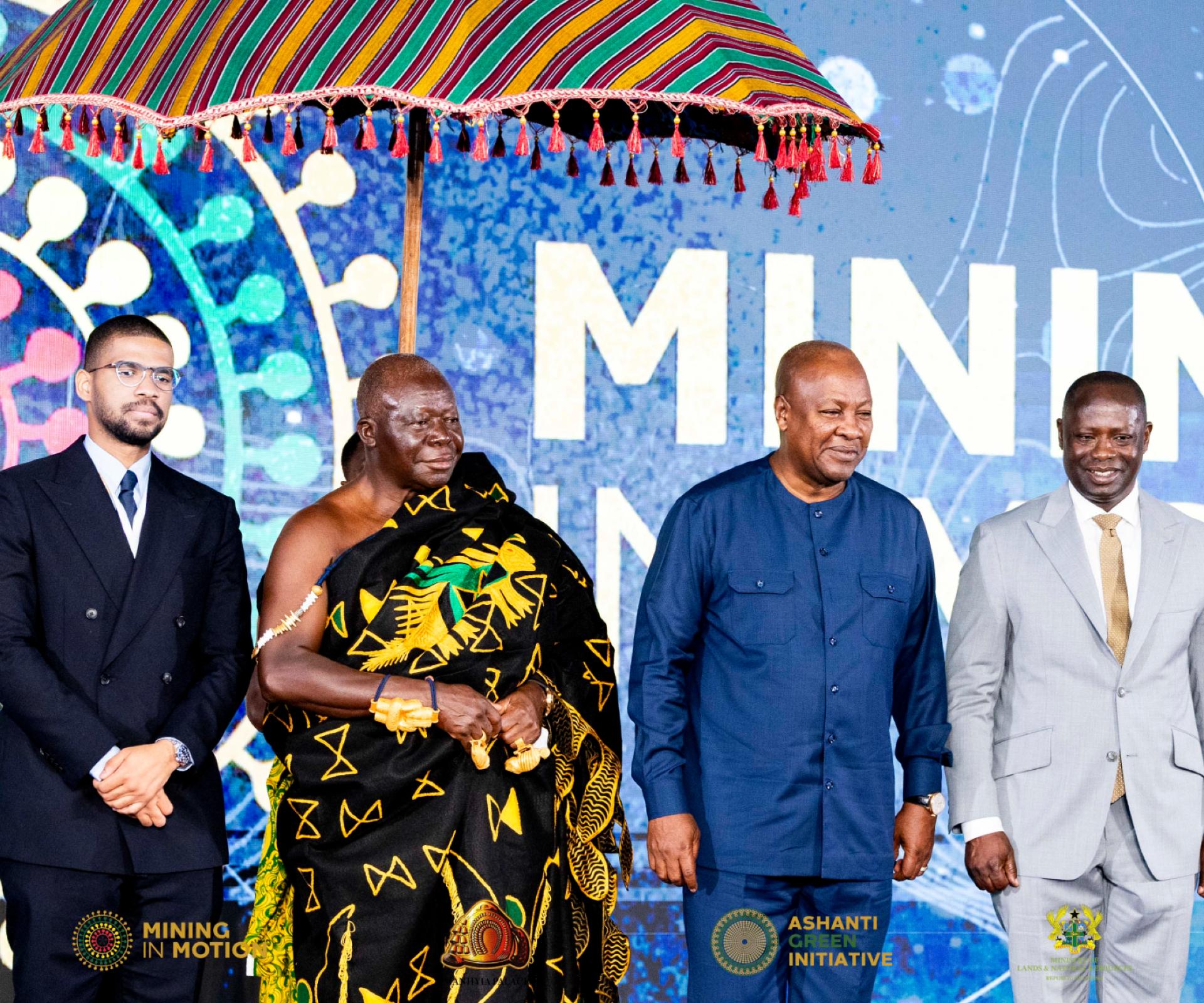
President John Dramani Mahama has reaffirmed Ghana’s commitment to ending the export of unprocessed mineral ores by 2030, declaring that the country must stop allowing some of its most valuable natural resources to leave its shores without first generating greater economic value at home. Speaking at the Mining in Motion Conference in Accra on Monday, October 19, the President said Ghana intends to phase out raw exports of minerals including bauxite, manganese, iron ore and lithium, while expanding local processing, refining and industrial activity around the country’s mining sector.
Mahama said the policy would not be implemented through a sudden blanket ban but through a phased system supported by legislation, mineral-specific requirements and clearly defined implementation timelines. Investors seeking access to Ghana’s mineral deposits would increasingly be required to demonstrate how their operations contribute to domestic processing and value addition rather than relying primarily on extracting ore for shipment abroad. The government’s objective is to retain more of the jobs, industrial activity, tax revenue, technical expertise and downstream business opportunities generated by Ghana’s natural resources.
The President described the 2030 deadline as part of a broader shift in economic policy that seeks to move Ghana away from dependence on exporting raw materials and importing finished products manufactured from those same resources. Ghana has spent decades producing significant quantities of gold, manganese, bauxite and other minerals, yet much of the higher-value processing, engineering, fabrication and manufacturing associated with those commodities has taken place outside the country.
Mahama argued that this structure has limited the economic benefits Ghana receives from its mineral wealth. While mining contributes substantially to export earnings and government revenue, the President said the country must capture a larger share of the value chain if its natural resources are to support long-term industrialisation and employment.
The policy means that by 2030, government expects mineral producers to have developed or gained access to adequate domestic processing infrastructure before exporting Ghana’s resources. The precise requirements will differ from one commodity to another because processing bauxite into alumina, refining gold, beneficiating manganese and developing a lithium value chain involve different technologies, investment costs and energy requirements.
Mahama said this is why the government intends to introduce mineral-specific obligations rather than applying one identical rule to every mining company. The administration wants investors to understand from the beginning that access to Ghanaian resources will increasingly come with responsibilities to create additional economic value inside Ghana.
The President specifically mentioned bauxite, manganese, iron and lithium as commodities that should support domestic industries rather than leave the country mainly as raw ore. Each represents a different industrial opportunity. Bauxite can feed alumina and aluminium production, manganese has applications in steelmaking and battery technologies, iron ore can support domestic steel production, while lithium has become strategically important because of its role in electric vehicle batteries and energy-storage systems.
Ghana’s gold sector is also central to the value-addition agenda. Mahama said government is strengthening local gold assaying, refining and related services through the Ghana Gold Board and its wider gold refining policy. The intention is to ensure that Ghana captures more of the financial activity surrounding gold after it is mined rather than allowing those services and associated revenues to move almost entirely to foreign centres.
Assaying determines the purity and quality of gold, while refining converts mined material into higher-purity products suitable for investment, industrial use and international markets. Expanding those services locally can support skilled jobs, laboratory services, logistics, finance, jewellery manufacturing and other businesses connected to the precious-metals industry.
For years, Ghana has remained one of Africa’s leading gold producers, but critics of the existing structure have argued that the country earns less than it potentially could because much of the value added after extraction occurs abroad. Mahama’s administration wants to change that by building the infrastructure and regulatory systems needed to keep a larger portion of the gold value chain inside the country.
The President has previously argued that Ghana should not be satisfied with producing mineral wealth if the most profitable parts of the industry remain overseas. His government sees local refining and processing as a route towards converting mining from primarily an extractive activity into a wider industrial ecosystem capable of supporting engineering companies, manufacturers, transport operators, laboratories, financial institutions and technical professionals.
The October 19 declaration reinforces a policy direction Mahama had already announced earlier in 2026. In February, he said Ghana intended to eliminate raw mineral exports within five years and specifically named manganese, bauxite and iron ore among the resources that should be processed locally. The latest statement now places the 2030 deadline firmly within the government’s continuing mining and industrialisation agenda.
Government has already begun restricting some categories of raw material exports. Mahama noted that Ghana has imposed a ban on exports of iron scrap and non-ferrous metals, arguing that valuable materials needed by domestic industry should not leave the country without creating local manufacturing opportunities.
The broader objective is to build mineral-based industries capable of supplying both Ghanaian and international markets. Instead of exporting raw material and later importing expensive manufactured products, government wants more processing and manufacturing to take place inside the country.
That strategy could have significant implications for employment. Raw mineral extraction can create jobs, but processing and manufacturing generally require a wider range of workers across engineering, laboratory science, maintenance, construction, logistics, administration and industrial operations. If Ghana succeeds in attracting large-scale refining and manufacturing investment, the employment benefits could extend well beyond mining communities.
The government also expects local value addition to create opportunities for Ghanaian businesses. Mining companies spend large amounts each year on equipment, chemicals, engineering services, maintenance, transport and other inputs. Mahama’s wider local-content strategy seeks to increase the share of that spending captured by Ghanaian companies rather than relying heavily on imported services and products.
Local ownership is another component of the policy. The President has said Ghana must develop indigenous companies capable of participating not only as small contractors but eventually as major operators within the large-scale mining industry. That ambition would require access to finance, technical expertise and partnerships capable of supporting projects that can require hundreds of millions or billions of dollars in investment.
The transition will not be simple. Mineral processing requires reliable electricity, water, transport infrastructure and large amounts of capital. Some refining and smelting operations are extremely energy-intensive, meaning Ghana’s ability to provide affordable and dependable power will be critical to whether the 2030 target succeeds.
This challenge is being experienced across Africa as governments attempt to move away from raw mineral exports. Countries including Guinea, Indonesia and others have adopted policies designed to force or encourage domestic processing, but experience shows that export restrictions alone do not automatically produce successful industries. Investors also need competitive energy prices, reliable infrastructure, stable regulations and access to international markets.
Mahama has acknowledged the need for a structured transition rather than simply closing export routes and hoping factories appear. The government says mineral-specific implementation schedules will give investors time to develop processing capacity while ensuring the 2030 deadline remains credible.
Policy consistency will also be important. Large mining and processing projects often require many years to plan and finance. Investors are more likely to commit capital if they believe regulations will remain predictable across changes of government.
This concern was highlighted by the Asantehene, Otumfuo Osei Tutu II, who publicly endorsed the government’s broader mineral strategy while calling for national consensus around it. Speaking through Essumejahene Nana Okyere Kusi Ntrama at the Mining in Motion Conference, the Asantehene argued that Ghana’s mineral policy should be treated as a national issue rather than a partisan political programme.
The Asantehene warned that future governments should not reverse the policy simply because it was introduced by a political opponent. He said Ghana needs long-term consistency if it is to successfully retain more value from its natural resources and avoid returning to a system dominated by raw exports.
Otumfuo also linked the current effort to Ghana’s longer history of attempts to secure greater national control over natural-resource wealth. His representative referred to the policies of Ghana’s first President, Dr Kwame Nkrumah, and later efforts under General Ignatius Kutu Acheampong to expand state participation and local processing.
The comparison with Nkrumah is significant because Ghana’s post-independence economic vision placed heavy emphasis on industrialisation and reducing dependence on exports of unprocessed commodities. Nkrumah argued that political independence would remain incomplete if African economies continued supplying raw materials to foreign industries while importing manufactured goods at higher prices.
The Asantehene said the current strategy reminded him of that earlier national ambition, although Ghana now operates within a different economic structure in which private capital and international investors play much larger roles. He therefore urged government to combine stronger national control with efficiency, responsible investment and commercially viable operations.
The President’s approach is designed around that balance. Government is not proposing to remove foreign investors from the mining sector. Instead, Mahama says investors must increasingly accept local-processing obligations as part of the conditions attached to access to Ghana’s resources.
This could involve partnerships between international mining companies, Ghanaian firms, state institutions and development-finance organisations. Large processing projects often require capital and technology that may not currently be available domestically, making partnerships necessary if Ghana wants to reach the 2030 target without significantly reducing mineral production.
The government’s broader foreign-policy strategy is also being linked to the mining and industrialisation agenda. Mahama has said Ghana’s application to become a partner of the BRICS grouping is intended to expand trade, investment and South-South cooperation with major emerging economies.
BRICS includes some of the world’s largest developing economies and increasingly presents itself as a platform for cooperation outside traditional Western-led financial and trade institutions. Ghana is not seeking to abandon existing partnerships with Europe, the United States or other countries, but Mahama says the country wants to broaden the range of markets and investors available to support industrial development.
A BRICS partnership could potentially create new opportunities for mineral processing because countries within and around the grouping include major consumers, refiners and manufacturers of critical minerals. China and India, for example, have large industrial sectors that depend heavily on mineral supply chains, while other BRICS economies have experience in mining, metallurgy, manufacturing and infrastructure development.
Mahama has said Ghana’s diplomatic strategy should focus on attracting investment that increases productive capacity rather than simply financing consumption or raw commodity extraction. The mineral-processing agenda fits directly within that approach because it requires long-term capital, technology transfer and access to international markets.
The administration is therefore attempting to connect foreign policy, mining policy and industrialisation. Instead of treating mining primarily as an export sector, government wants minerals to become inputs for manufacturing and broader economic transformation.
Lithium illustrates the potential importance of this approach. Global demand for the mineral has increased because of electric vehicles, renewable-energy storage and battery technology. Countries that simply export raw lithium ore capture only a relatively small share of the final value generated by battery cells, electronic components and vehicles.
Mahama’s policy suggests Ghana wants to avoid repeating that pattern. If lithium production expands, investors may be required to undertake more processing domestically before export. The exact level of processing expected has not yet been publicly finalised, and significant technical and financial questions remain about how far Ghana can realistically move down the battery value chain by 2030.
Bauxite presents an equally ambitious challenge. Ghana has significant deposits and has long discussed plans for an integrated aluminium industry. Such a system would involve mining bauxite, refining it into alumina and ultimately producing aluminium locally.
The concept is not new, but financing, environmental concerns and infrastructure requirements have repeatedly delayed implementation. Mahama’s 2030 policy creates additional pressure to convert those longstanding plans into functioning industrial capacity.
Manganese is another major export commodity where processing could retain more value. Ghana currently participates strongly in manganese mining, but more advanced processing could support industries linked to steel and potentially battery materials.
Iron ore also presents opportunities for Ghana’s steel industry. A stronger domestic supply chain could reduce dependence on imported steel inputs while supporting construction, manufacturing and infrastructure development.
However, government will have to avoid policies that make existing mines economically uncompetitive before domestic processing facilities are ready. If companies are prevented from exporting raw ore without having a viable local buyer or processor, production could decline and jobs could be lost.
This is why the phased approach is important. The success of the policy will depend on whether processing capacity grows quickly enough to absorb material that would otherwise have been exported.
Financing will be another major challenge. Refineries, smelters and processing plants require large upfront investment and may take years before they generate returns. Ghana will need a combination of domestic capital, foreign direct investment, development finance and potentially public-private partnerships.
Energy is likely to be the most difficult structural requirement. Mineral processing can consume enormous amounts of electricity, particularly in aluminium and heavy industrial operations. Ghana will have to expand reliable power generation and transmission if it expects to compete with established processing hubs.
The cost of electricity matters as much as availability. A refinery supplied with expensive power may struggle to compete internationally even if it has access to local raw materials. Ghana must therefore coordinate industrial policy with energy planning rather than treating them as separate issues.
Transport infrastructure will also be essential. Mining areas need reliable roads and railways capable of moving large volumes of ore to processing plants and finished products to ports or regional markets.
Government has previously discussed railway development as part of its strategy for mineral-rich regions. Successful local processing could strengthen the economic justification for such infrastructure by creating larger and more predictable industrial cargo flows.
Environmental safeguards will also become more important as processing expands. Refining and smelting can create pollution risks if poorly regulated, meaning Ghana must ensure that value addition does not simply replace one environmental problem with another.
The President has repeatedly linked the mining agenda with responsible extraction, reclamation and stronger regulation. That will be particularly important as government simultaneously fights illegal mining and promotes greater industrial use of mineral resources.
The distinction between legal industrial development and environmentally destructive mining must remain clear. Government wants to increase the economic contribution of properly regulated mining while reducing galamsey operations that damage forests and water bodies.
The GoldBod initiative is part of this broader restructuring. Government wants more gold to pass through formal systems where it can be traced, assayed, refined and exported transparently. This could help Ghana capture greater revenue while reducing smuggling and strengthening oversight of small-scale mining.
Local refining could also support Ghana’s ambition to develop a stronger gold-trading and financial ecosystem. Refined gold can support bullion markets, jewellery manufacturing and other activities that generate additional income beyond extraction.
Mahama’s argument is ultimately that Ghana should not measure mining success only by export receipts. A country can earn billions from mineral exports while still missing out on much of the value created after those minerals leave its borders.
The 2030 target is therefore intended to change the structure of the industry rather than simply increase production.
If successful, Ghana would export fewer raw ores and more refined, processed or manufactured mineral products. The country could capture more taxes, more industrial jobs and more technical expertise while creating new opportunities for local businesses.
The policy could also strengthen Ghana’s position under the African Continental Free Trade Area. Processed mineral products manufactured in Ghana could potentially serve markets across Africa rather than being shipped primarily as raw materials to Asia, Europe or other destinations.
Regional markets could be particularly important for steel, aluminium products, construction materials and other manufactured goods. AfCFTA provides a framework for reducing trade barriers, but Ghanaian industries would still need to remain competitive on cost and quality.
The 2030 deadline is ambitious because it leaves only a few years to develop processing facilities across multiple mineral sectors. Government will therefore face increasing pressure to release detailed implementation plans showing which commodities will face restrictions first and what milestones investors must meet.
Businesses will also want clarity about exemptions and transition arrangements. Mines that already have long-term export contracts may require time to renegotiate agreements or invest in processing capacity.
Legal frameworks will need to be carefully designed to avoid disputes. Ghana has investment agreements and mining leases that may contain specific rights and obligations, meaning new processing requirements must be introduced in a way that is enforceable and consistent with existing law.
Mahama says the government intends to use the necessary legal measures to support the transition. The credibility of that promise will depend on whether legislation is enacted early enough for companies to prepare rather than waiting until the 2030 deadline approaches.
Public expectations will also need to be managed. Ending raw exports does not automatically guarantee immediate prosperity. Processing plants can take years to construct, and government must ensure that revenue and employment benefits are distributed effectively.
The Asantehene’s call for national consensus addresses this long-term challenge. Major industrial policy often extends beyond one presidential term, meaning projects started under one government may only become fully operational under another.
If every administration reverses the strategy of its predecessor, investors may delay decisions and national objectives can repeatedly restart from zero.
Otumfuo’s message was therefore that Ghana’s mineral policy should survive partisan competition. He argued that the objective of retaining more value from natural resources should be treated as a national development principle rather than an NDC or NPP policy.
That endorsement gives the strategy additional symbolic weight because the Asantehene is one of Ghana’s most influential traditional leaders and the Ashanti Region remains central to the country’s mining economy.
His reference to Nkrumah also places the policy within a broader historical debate about economic sovereignty. Ghana gained political independence in 1957, but the structure of commodity exports remained heavily dependent on foreign processing and international markets.
More than six decades later, many African economies continue exporting raw materials while importing finished goods. Mahama has increasingly described this as a structural problem that must be corrected if the continent is to create enough jobs for its rapidly growing youthful population.
The President used similar language at the United Nations in September when he argued that Africa should not continue exporting wealth while importing poverty. His 2030 mineral deadline turns that broader political message into a specific domestic target.
Whether Ghana can achieve it will depend on implementation rather than rhetoric.
The government must attract investment, expand electricity generation, improve transport, build industrial skills and maintain policy consistency. Mining companies must decide whether local processing projects are commercially viable. Financial institutions will need to provide capital, while regulators must ensure environmental and safety standards are maintained.
The BRICS partnership push could help provide additional investment options, but it is not a substitute for domestic reform. International investors will still assess Ghana’s power costs, tax regime, infrastructure, legal stability and access to markets before committing billions of dollars.
The strongest advantage Ghana possesses is the mineral resource base itself. Companies seeking access to valuable deposits may be willing to invest in processing if the rules are clear and the economics are workable.
Mahama’s government intends to use that leverage more aggressively. The message to investors is that access to Ghana’s resources will increasingly require a greater contribution to Ghana’s industrial economy.
For communities located around mines, the policy could create additional employment and business opportunities if processing facilities are located close to extraction areas. However, government will need to ensure that local residents actually benefit rather than watching large industrial projects operate around them with limited participation.
Skills development will therefore be essential. Universities, technical institutions and vocational centres may need to expand programmes in metallurgy, engineering, laboratory science, industrial maintenance and related disciplines.
Without enough qualified Ghanaian workers, new processing plants could still depend heavily on foreign technical staff, reducing some of the local employment benefits.
The government’s wider local-content strategy is intended to address that by linking mining policy with workforce development and indigenous business participation.
The 2030 deadline should therefore be understood as one part of a much larger economic transformation programme. It is not simply a ban on exports. It is an attempt to restructure how Ghana interacts with its mineral wealth.
Mahama wants extraction to feed processing, processing to support manufacturing, manufacturing to create employment and exports to contain more Ghanaian value before leaving the country.
The Asantehene’s endorsement gives that vision influential domestic support, while Ghana’s BRICS partnership application reflects an effort to find new international partners capable of financing and buying the products generated by a more industrialised mining sector.
The policy now moves from declaration to implementation. Investors will be watching for legislation, processing requirements and timelines. Ghanaian businesses will be looking for opportunities to participate in new supply chains. Mining communities will expect jobs and development, while citizens will ultimately judge whether the strategy produces tangible improvements in the wider economy.
By setting 2030 as the deadline, Mahama has given the government a measurable target against which the policy can eventually be judged.
If Ghana reaches that date with functioning refineries, processing plants, stronger local ownership and significantly fewer raw mineral exports, the policy could represent one of the country’s most important shifts in resource management.
If the infrastructure and investment fail to materialise, the deadline could become another ambitious industrial promise that proves difficult to implement.
For now, however, the President has made the policy direction unmistakable. Ghana does not want to remain primarily a supplier of raw mineral ores. By 2030, Mahama says the country intends to process far more of its bauxite, manganese, iron, lithium, gold and other mineral resources at home before they enter international markets.