MOTHER AND CHILD KILLED AS TWO CONTAINER TRUCKS OVERTURN IN LAGOS
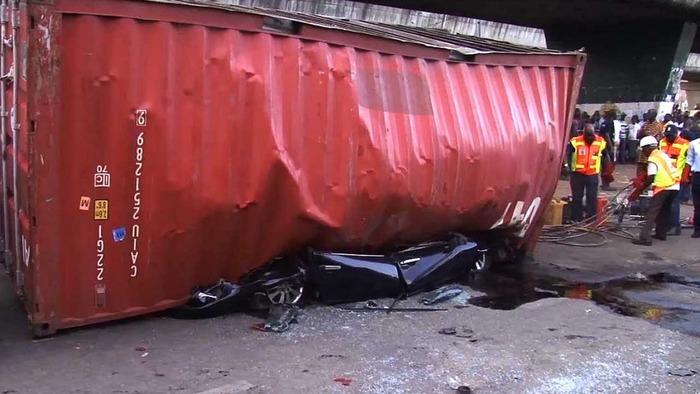
A mother and her child have died after two heavily laden 20-foot container trucks overturned at Mile 2 near Freeman Market, inward Apapa, Lagos. LASTMA rescue teams cordoned off the area, diverted traffic and used a crane and heavy-duty tow vehicle to remove the trucks and containers, while police secured the scene. The victims’ remains were taken to the Police Mortuary in Yaba. LASTMA has called for an investigation into possible mechanical defects, overloading, improper cargo distribution or driver negligence and renewed calls for strict roadworthiness and cargo-safety compliance.
A mother and her child have been killed in Lagos after two heavily laden container trucks overturned at Mile 2 near Freeman Market, inward Apapa, trapping the victims beneath the vehicles and their cargoes in another deadly accident involving articulated trucks on one of the city’s busiest freight corridors. The Lagos State Traffic Management Authority said rescue and recovery teams were deployed to the scene over the weekend, where officers found the victims trapped beneath the overturned trucks and 20-foot containers. The exact cause of the crash has not yet been established, and state traffic authorities have called for a thorough investigation into whether mechanical failure, excessive loading, poor cargo distribution, driver negligence or another factor caused the trucks to overturn.
LASTMA said the affected section of the road was temporarily cordoned off after the crash, while motorists were diverted through an adjoining service lane to reduce congestion and prevent secondary collisions. A crane and a high-capacity tow vehicle were brought to the scene to remove the overturned trucks and containerized cargoes, while officers of the Nigeria Police Force provided security during the recovery operation. The remains of the mother and child were subsequently evacuated to the Police Mortuary in Yaba for the necessary procedures.
The agency’s General Manager, Olalekan Bakare-Oki, described the deaths as a tragic loss and urged security and road-safety authorities to establish the immediate and underlying causes of the accident. He said investigators should examine the mechanical condition of the trucks, whether the vehicles were carrying excessive loads, whether the containers were properly distributed and secured, and whether driver error contributed to the crash. His comments reflect growing concern in Lagos over the safety of articulated trucks carrying heavy containers through densely populated commercial corridors.
Bakare-Oki also renewed calls for operators of heavy-duty commercial vehicles to ensure that their trucks are roadworthy before being placed on public roads. He stressed the importance of regular inspections of braking systems, tyres, steering components and other safety-critical parts, while also warning that containers and other cargo must be properly secured to reduce the risk of catastrophic accidents. The LASTMA chief said preventive maintenance and responsible driving remain essential to protecting lives, particularly on routes where heavy trucks operate alongside buses, motorcycles, private cars and pedestrians.
The Mile 2-Apapa axis is one of Lagos’ most important commercial transport corridors because it provides access to the Apapa port complex and accommodates a high volume of articulated trucks moving containers and other cargo. That concentration of heavy-duty vehicles has repeatedly raised concerns about roadworthiness, driver fatigue, overloading and the way containers are secured to trailers. When such vehicles overturn, the weight of their cargo can turn otherwise survivable road incidents into fatal crashes, particularly when smaller vehicles, pedestrians or motorcycles are caught beneath them.
The latest accident is especially troubling because it occurred only weeks after another serious truck crash in the Mile 2 area. On October 6, four people were critically injured after a Mack truck carrying a 40-foot container reportedly lost control at First Gate, inward Mile 2, and collided with another truck, a commercial bus and nine motorcycles. LASTMA said preliminary findings in that earlier case suggested brake failure may have contributed to the crash, although investigations were required to establish responsibility.
That earlier incident left three men and one woman with multiple fractures and again prompted warnings about the mechanical condition of articulated trucks. The drivers involved were handed over to police for investigation and possible prosecution, while LASTMA emphasized the need for operators to inspect braking systems, tyres and steering mechanisms before allowing vehicles onto major roads. The repetition of serious truck accidents within the same corridor has strengthened calls for enforcement that goes beyond public warnings after fatalities have already occurred.
Lagos has experienced numerous fatal accidents involving container trucks over the years, with some incidents involving containers detaching from trailers and crushing cars, buses, tricycles or pedestrians. The danger is particularly severe where containers are inadequately secured or where trailers suffer mechanical failure while traveling through congested urban areas. A heavy shipping container can weigh several tonnes even before cargo is added, meaning the consequences of a rollover can be devastating for anyone caught in its path.
The safety issue is therefore not limited to driver behavior. Effective prevention requires coordinated enforcement involving vehicle inspection agencies, traffic authorities, port operators, police and transport regulators. Heavy-duty trucks must meet mechanical standards before entering the road network, while operators must ensure that trailers, tyres, brakes and securing mechanisms are capable of safely carrying the assigned load. Authorities must also ensure that drivers are properly licensed, rested and familiar with the restrictions governing articulated vehicles.
Proper cargo distribution is another important factor. When containers or other heavy loads are badly positioned, a truck’s center of gravity can become unstable, increasing the likelihood of rollover when the driver brakes suddenly, changes direction or encounters poor road conditions. Investigators in the Mile 2 case are therefore expected to determine whether the containers were loaded and secured according to required safety standards.
Overloading can create similar risks by increasing braking distance and placing excessive pressure on tyres, suspension systems and other vehicle components. A truck operating beyond its safe design capacity may be more difficult to control, particularly in congested traffic or when traveling on uneven roads. For that reason, LASTMA’s call for investigators to examine the possibility of excessive loading is important even though no evidence has yet established that overloading caused the latest crash.
The current investigation must also determine whether the two trucks overturned independently or whether one vehicle’s movement triggered the other. Initial reports confirm that two heavily laden 20-foot container trucks overturned at the same location, but authorities have not yet released a detailed reconstruction explaining the sequence of events. Until that investigation is completed, any claim about brake failure, excessive speed, collision between the trucks or driver negligence would remain speculative.
The tragedy has renewed attention on the vulnerability of ordinary road users who share Lagos roads with large articulated vehicles. A smaller car, motorcycle or pedestrian has almost no physical protection if trapped beneath an overturned container. This imbalance makes preventive regulation particularly important because emergency services may have little opportunity to save victims once a fully loaded container falls on them.
Emergency response in the latest incident required specialized heavy equipment because ordinary rescue tools were insufficient to move the overturned trucks and cargoes. LASTMA’s deployment of a crane and high-capacity tow vehicle illustrates the scale of the operation required to reopen the road and recover the victims. Such incidents can also create prolonged traffic disruptions, particularly on a corridor already known for congestion linked to port activity and commercial traffic.
The Nigeria Police Force secured the area during the operation, while traffic officers diverted vehicles to reduce the risk of another crash around the recovery scene. These measures are important because crowds, blocked lanes and heavy recovery equipment can create additional hazards after an initial accident. Authorities must often balance the urgent need to rescue victims and remove wreckage with maintaining enough traffic movement to prevent gridlock across surrounding routes.
The deaths of the mother and child have added a human dimension to a road-safety problem often discussed primarily in terms of traffic congestion and freight movement. The victims were not identified in the initial official statement, and authorities have not released additional information about where they were traveling or how they became trapped beneath the trucks. Their deaths nevertheless underscore the consequences of failures in heavy-vehicle safety, whether those failures ultimately prove to involve maintenance, loading, driving or another cause.
The accident also raises questions about the effectiveness of existing enforcement measures. Lagos authorities have issued repeated warnings to truck operators and have periodically conducted inspections and enforcement operations, yet dangerous accidents continue to occur. Road-safety advocates have long argued that warnings must be combined with regular mechanical checks, penalties for unsafe vehicles and stronger accountability for companies that place poorly maintained trucks on public roads.
Commercial pressures within the haulage sector can complicate enforcement. Truck operators may face incentives to keep older vehicles in service for long periods, maximize loads and minimize downtime for maintenance. Drivers can also work long hours under pressure to move containers quickly between ports, depots and inland destinations. Regulators therefore need systems capable of identifying unsafe practices before they result in crashes rather than relying primarily on post-accident investigations.
Port-linked trucking presents additional challenges because Lagos handles enormous volumes of containerized cargo. Thousands of trucks move through the Apapa area and surrounding routes, making heavy-duty vehicles an unavoidable part of the city’s economic infrastructure. A complete restriction on their movement is not realistic, meaning the focus must remain on making operations safer through inspections, route management, driver regulation and enforcement of loading standards.
The Lagos State government has previously introduced policies intended to reduce the risks created by articulated vehicles, including movement restrictions and safety requirements. Implementation, however, has frequently been challenged by congestion, the scale of freight traffic and inconsistent compliance. Serious accidents often trigger renewed calls for enforcement, but sustained improvement requires those measures to continue even when public attention shifts elsewhere.
The October 6 crash at First Gate provides a recent example of how quickly mechanical failure can create a multi-vehicle emergency in the Mile 2 area. According to LASTMA, the truck involved may have suffered brake failure before colliding with another container truck, a bus and multiple motorcycles. That event did not result in confirmed deaths, but four people suffered serious injuries. Less than three weeks later, the latest rollover has now killed two people in the same broader corridor.
Those incidents do not prove a single underlying problem affecting every truck on Lagos roads, but they do demonstrate why authorities are demanding stricter compliance with mechanical and safety standards. Each crash must be investigated individually, yet patterns involving brakes, tyres, cargo security and overloaded vehicles remain significant enough to justify stronger preventive inspections.
Truck owners also have a responsibility to ensure that vehicles undergoing daily commercial use receive regular maintenance rather than repairs only after major faults become obvious. Brake systems on heavy trucks experience substantial wear, particularly in stop-and-start urban traffic where vehicles are repeatedly required to control large loads. Tyres must similarly be capable of carrying heavy weight safely, and worn or damaged tyres can increase the likelihood of loss of control.
Drivers must also adjust speed to the weight and handling characteristics of their vehicles. A container truck cannot maneuver or stop as quickly as a passenger car, and sudden steering movements can increase rollover risk when the vehicle is heavily loaded. Responsible operation therefore requires larger following distances, controlled speeds and careful navigation through intersections and congested areas.
Authorities will also need to examine the structural condition of the trailers carrying the containers. Twist locks and other securing mechanisms are designed to hold containers firmly in position during transport. If those systems are damaged, improperly engaged or absent, containers can shift or detach during sudden movement. That danger is particularly severe when a truck turns, brakes or loses balance.
LASTMA’s latest warning therefore extends beyond one accident. The agency is again calling for a culture in which roadworthiness is treated as a continuous obligation rather than a requirement checked only at licensing or inspection periods. Operators who transport extremely heavy cargo through populated urban areas carry an elevated responsibility because a single mechanical or operational failure can kill people who had no connection to the trucking operation.
The Lagos government will also face pressure to determine whether regulatory failures contributed to the latest tragedy. If investigators discover that either truck had known mechanical defects, lacked required roadworthiness documentation or carried improperly secured loads, questions will arise about how the vehicles were able to continue operating. Any evidence of such violations could also influence whether owners or drivers face prosecution.
At the same time, responsibility should not be assigned before the investigation is completed. LASTMA has identified several possible causes for examination but has not concluded that any specific one caused the crash. Mechanical defects, excessive loading, cargo distribution and driver negligence are investigative possibilities, not established findings.
That distinction is important because road crashes involving heavy vehicles can result from combinations of factors rather than a single failure. Road conditions, another vehicle’s actions, sudden mechanical failure or cargo movement can interact within seconds. A credible investigation should therefore reconstruct the sequence of events, inspect both trucks and review any available eyewitness accounts or surveillance footage before determining responsibility.
For the family of the victims, however, those technical questions come after an irreversible loss. LASTMA’s General Manager extended condolences and described the deaths as deeply painful, while emphasizing that preventing similar tragedies must remain the priority. The identities of the mother and child had not been publicly released in the initial reports, and responsible reporting should respect the family’s privacy unless authorities or relatives choose to provide further details.
The latest incident should also serve as a reminder that heavy-truck safety is not solely a Lagos problem. Container and articulated-truck accidents occur across major transport corridors in Nigeria, particularly around ports, industrial areas and highways carrying commercial freight. Improving Lagos enforcement could therefore provide lessons for other states facing similar challenges involving aging trucks, poorly secured cargo and inconsistent mechanical inspections.
The most immediate next step is the formal investigation requested by LASTMA. Authorities will need to establish why the two trucks overturned, determine whether either vehicle violated safety rules and clarify whether criminal negligence or regulatory breaches occurred. Any resulting sanctions will be important, but their wider value will depend on whether they are accompanied by stronger preventive enforcement.
For now, the confirmed facts are that two heavily laden 20-foot container trucks overturned at Mile 2 near Freeman Market, inward Apapa, trapping and killing a mother and her child. LASTMA and police managed the rescue and recovery operation, the victims’ bodies were taken to the police mortuary in Yaba, and the cause of the crash remains under investigation.
The tragedy has once again placed the safety of Lagos’ articulated-truck operations under scrutiny. Authorities are urging operators to maintain roadworthy vehicles, secure cargo correctly and comply strictly with safety regulations, but the effectiveness of those warnings will ultimately depend on sustained inspection and enforcement. As Lagos continues to rely on heavy freight traffic to support one of Africa’s largest commercial economies, preventing another mother, child or other road user from being crushed beneath an overturned container will require safety standards that are enforced before trucks enter the road, not simply renewed after lives have already been lost.