
NIGERIA AND US SIGN CRITICAL MINERALS INVESTMENT PACT
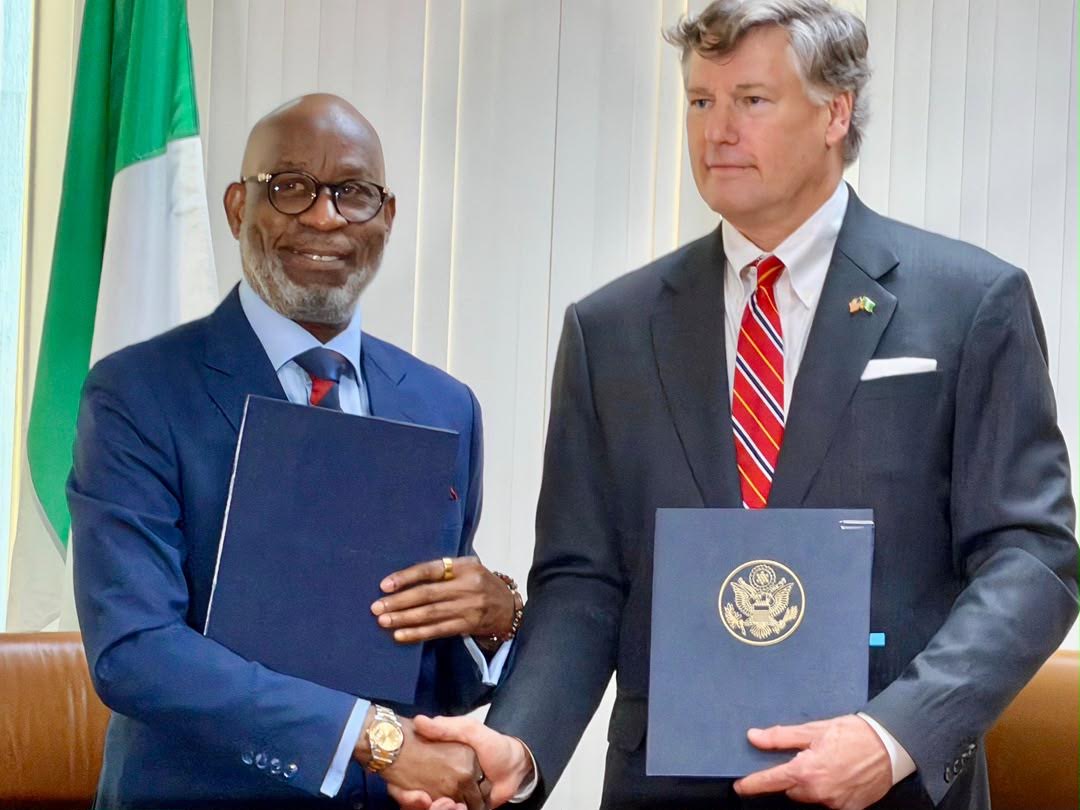
Nigeria and the United States have signed a new memorandum of understanding aimed at expanding investment and cooperation across Nigeria's solid minerals sector, with a focus on exploration, processing, infrastructure, technical capacity and secure critical mineral supply chains.
Nigeria and the United States have signed a new critical minerals cooperation agreement aimed at attracting investment into Nigeria's mining industry while expanding domestic processing and reducing the country's dependence on exporting raw mineral resources.
The memorandum of understanding was signed at the Nigerian Mission House in New York on the sidelines of the 81st United Nations General Assembly.
Minister of Solid Minerals Development Dele Alake signed on behalf of Nigeria, while U.S. Deputy Secretary of State Christopher Landau represented the United States.
The agreement establishes a framework for cooperation across several areas of Nigeria's mineral value chain, including geological data and exploration, mineral development and processing, infrastructure and technical capacity.
Both countries also identified the development of secure and resilient critical mineral supply chains as a central objective of the partnership.
The agreement comes as global competition intensifies for minerals required for advanced manufacturing, artificial intelligence infrastructure, electric vehicles, renewable energy systems and other strategic industries.
Nigeria possesses deposits of several minerals considered increasingly important to global supply chains, including lithium, gold, tin and other resources.
Alake said Nigeria intends to use growing international interest in those resources to develop a larger domestic mining and processing industry rather than remaining primarily an exporter of unprocessed minerals.
"We are not here to remain a source of raw material for the value that others create," the minister said.
He said Nigeria's objective was to convert its mineral resources into lasting economic value through stronger domestic processing, skills development, quality employment and new opportunities for Nigerian businesses.
The government has increasingly made local value addition a central part of its mining policy, arguing that extracting minerals without developing processing and manufacturing capacity limits the economic benefits retained within the country.
Alake said implementation of the agreement would focus on identifying commercially viable projects, mobilizing investment and developing partnerships capable of delivering measurable results.
The minister said the success of the framework would ultimately be judged by projects developed, facilities constructed, investment attracted and skills transferred to Nigerians.
Landau described the agreement as another indication of deepening cooperation between Washington and Abuja.
He said the United States could contribute investment, technical expertise and capital while recognizing Nigeria's desire to retain a greater share of the value generated from its natural resources.
The agreement follows months of discussions between Nigerian and U.S. officials over cooperation in mining and critical minerals.
Earlier engagements focused on geological exploration, processing, refining, investment and the development of supply chains considered important to both countries.
Nigeria has also been working to improve geological information available to potential investors.
The Nigerian Geological Survey Agency has been expanding the mapping and digital cataloguing of mineral deposits in an effort to provide investors with more reliable information and reduce some of the risks associated with exploration.
The government has separately held discussions with major international mining companies as it attempts to attract greater private investment into a sector historically overshadowed by oil and gas.
The latest agreement also fits into a wider push by African governments to capture more value from the continent's mineral resources.
At a critical minerals meeting held during UNGA this week, Nigerian officials called for African countries to expand processing and refining rather than competing primarily as exporters of raw materials.
Nigeria has identified mining as one of the industries capable of supporting its broader economic diversification strategy.
The country remains heavily dependent on petroleum for a significant portion of its foreign exchange earnings and government revenue, leaving the economy vulnerable to developments in global energy markets.
Expanding commercially viable mining, processing and manufacturing could provide another source of investment, exports and employment.
The memorandum itself does not guarantee that proposed investments or processing facilities will materialize. Those outcomes will depend on subsequent commercial agreements, financing, regulatory conditions and implementation by both governments and private investors.
The next phase will therefore focus on converting the diplomatic framework into specific projects.
For Nigeria, the broader objective is to ensure that rising global demand for critical minerals translates into investment not only in extraction but also in processing, infrastructure, technology and jobs within the country.