
NLC GIVES TINUBU TWO WEEKS TO CUT FUEL PRICE, REOPEN MINIMUM-WAGE TALKS AS PETROL HITS ₦1,430
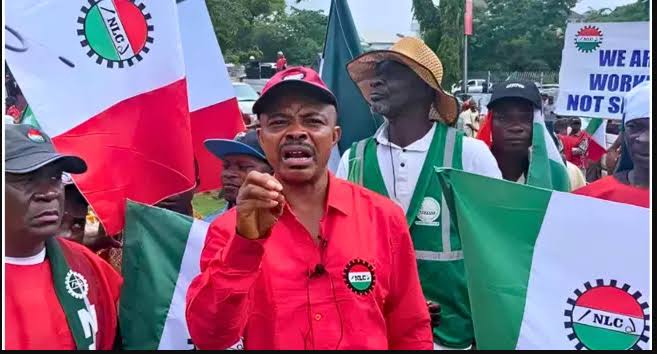
The Nigeria Labour Congress has given President Bola Tinubu’s government two weeks to reduce petrol prices toward their 2024 level and begin negotiations for a new minimum wage, arguing that the ₦70,000 wage has been overwhelmed by rising living costs. The government, meanwhile, is proposing a ₦1,350-per-litre ceiling at the ex-gantry or landing-cost level, a 30-day discount at NNPC stations, tax relief and transport support while rejecting a return to blanket fuel subsidy. Petrol has recently sold around ₦1,430 per litre or more in major cities, intensifying pressure on transport, food and household costs.
Nigeria’s largest labour federation has given President Bola Tinubu’s government two weeks to bring down petrol prices and begin negotiations for a new national minimum wage, escalating a confrontation over living costs just as the Federal Government rolls out a temporary fuel-price relief package and insists it will not restore the petrol subsidy abolished in 2023. The Nigeria Labour Congress said the ultimatum takes effect from Friday, October 9, and warned that failure to meet its demands could trigger further action by organized labour, raising the possibility of renewed industrial disruption if the government and unions fail to reach an accommodation before the deadline expires.
The NLC wants the government to reduce the price of Premium Motor Spirit, commonly known as petrol, to around the level prevailing when President Tinubu signed the current ₦70,000 national minimum wage into law in July 2024. At that time, NNPC retail stations were selling petrol at roughly ₦580 per litre, while official national-average figures were higher, at about ₦770 per litre. Petrol now sells at approximately ₦1,430 per litre or more in some major cities, according to labour and recent market reports, meaning the cost of the fuel underpinning much of Nigeria’s road transport economy has risen dramatically while workers remain on the same statutory minimum wage.
The ultimatum was contained in a communiqué issued after a joint meeting of the NLC’s National Executive Council and Central Working Committee in Abuja and signed by NLC President Joe Ajaero. Labour said the increase in petrol prices, depreciation of the naira and persistent rise in food, transportation, rent, healthcare and education costs had effectively destroyed the purchasing power of the existing minimum wage. The union said workers who were granted a ₦70,000 statutory floor little more than two years ago can no longer meet basic household expenses under current economic conditions.
The NLC is therefore demanding more than a temporary reduction in petrol prices. It wants the Federal Government to formally commence renegotiation of the national minimum wage before the end of October, despite the 2024 legislation originally providing for periodic wage reviews. Labour’s position is that extraordinary changes in inflation, fuel costs and the value of the naira have overtaken the economic assumptions under which the current wage was negotiated, making an earlier review necessary.
The confrontation comes at a particularly sensitive moment because the Tinubu administration unveiled its own emergency response to higher fuel prices on the same day. Finance Minister and Coordinating Minister of the Economy Taiwo Oyedele announced that the government is negotiating a mechanism that would place a ceiling of ₦1,350 per litre on the ex-gantry or landing cost of petrol, alongside a 30-day discount at NNPC retail stations. The administration says the package is intended to limit price volatility caused by rising international crude and refined-product prices without returning Nigeria to the blanket subsidy system Tinubu abolished on his first day in office in May 2023.
The proposed ₦1,350 figure has already generated confusion because it is not necessarily a nationwide pump-price cap. Government officials have described it as a proposed ceiling on the ex-gantry or landing cost of petrol, meaning transportation, distribution, retailer margins and other costs could still result in a higher final price at filling stations. The government says the mechanism would be reviewed monthly and is designed to smooth extreme price movements rather than permanently fix retail prices.
For the next 30 days, NNPC Limited is also expected to sell petrol at cost through its retail network by giving up its normal retail margin, with public transport operators receiving priority. The government says that intervention should translate into a discount for consumers and commuters, although the precise pump price that will apply at every NNPC station has not been fixed publicly. Officials have been careful to describe the policy as a commercial margin concession rather than a return to subsidy.
That distinction is politically important for the Tinubu administration. Subsidy removal has been one of the defining economic policies of the presidency, and the government argues that restoring the old system would reverse fiscal gains, create enormous budgetary liabilities and increase pressure on the naira. The Presidency has explicitly rejected suggestions that the latest intervention represents a subsidy comeback, insisting that NNPC is simply selling at cost for a limited period.
The government has gone further, warning that a wholesale return to the old petrol subsidy regime could eventually produce even more severe economic distortions. Officials say the fiscal cost of subsidizing petrol at current international energy prices would be enormous and could undermine the currency, public finances and spending on infrastructure and social services. The administration’s broader position is that Nigerians need targeted relief from the current price shock rather than a permanent restoration of artificially cheap petrol.
Labour is unconvinced. The NLC argues that whatever terminology government uses, workers are confronting an immediate decline in their real incomes. A minimum wage of ₦70,000 has the same nominal value it had when approved in 2024, but it buys significantly less food, transport, housing and other essentials when fuel costs and broader prices have risen sharply. From labour’s perspective, the core question is therefore not whether the latest petrol intervention technically qualifies as a subsidy but whether ordinary workers can afford to live on their current earnings.
Petrol occupies an unusually powerful position in the Nigerian economy because the country relies heavily on road transport for the movement of people and goods. Unlike economies with extensive urban rail and mass-transit networks, increases at filling stations quickly affect bus fares, motorcycle transport, logistics costs and the cost of moving agricultural produce from farms to markets. Businesses dependent on petrol-powered generators can also face higher operating expenses when electricity supply is unreliable.
That means fuel-price increases do not remain confined to motorists. A rise in petrol costs can appear in the price of tomatoes transported into Lagos, the fare paid by a worker commuting in Abuja, the distribution bill for consumer products and the cost of running small businesses dependent on generators. It is this cascading effect that the NLC cites in arguing that fuel prices and wages can no longer be treated as separate issues.
The current minimum wage was signed into law by Tinubu on July 29, 2024, following months of tense negotiations between the government, organized labour and private-sector representatives. The final ₦70,000 figure was higher than the Federal Government’s earlier offer and represented a significant nominal increase from the previous ₦30,000 wage, but unions warned even during those negotiations that inflation was rapidly eroding its value.
Two years later, the NLC argues that those warnings have materialized. The union says the combination of currency depreciation, fuel-price increases and rising prices has made it increasingly difficult for workers to afford even basic necessities. Labour has consequently shifted from demanding only temporary wage awards to insisting that negotiations for another formal minimum wage should begin.
The union’s communiqué goes beyond petrol and minimum wage. It also demands implementation of the February 5, 2026 terms of settlement reached with the Joint Health Sector Unions and Assembly of Healthcare Professionals, resolution of outstanding demands from the Joint Public Service Negotiating Council, agreed tax relief for workers and immediate payment of wage awards intended to cushion the cost-of-living crisis.
Those additional demands make the two-week ultimatum broader than a simple argument over pump prices. It represents a consolidation of multiple outstanding labour grievances into a single deadline and increases pressure on the government to demonstrate progress across several fronts at once.
Public-sector workers had already staged a three-day warning strike earlier in October over fuel prices, wage awards and minimum-wage negotiations. That action demonstrated that the dispute was moving beyond public statements before the NLC issued its latest ultimatum. The congress has now instructed affiliates to remain organized and prepared for further directives if the Federal Government fails to respond adequately within the two-week period.
The NLC has not yet announced a nationwide general strike beginning automatically at the end of the ultimatum. Its communiqué says the congress will take what it describes as remedial steps as directed by its relevant organs. That wording leaves room for further negotiations, another warning action or a larger shutdown depending on how the government responds.
For Tinubu, the dispute presents both an economic and political challenge. His administration has consistently argued that subsidy removal and other reforms were necessary to correct structural problems in Nigeria’s economy, free government resources and reduce distortions. It has also maintained that the benefits of those reforms require time to become visible.
For workers, however, the timeline is less abstract. Food, transport and housing bills are paid continuously, and households cannot indefinitely absorb price increases while waiting for macroeconomic reforms to improve living standards. That gap between government’s long-term reform argument and workers’ immediate experience is now at the heart of the latest standoff.
The administration’s new intervention attempts to bridge that gap without abandoning its economic framework. Beyond the 30-day NNPC discount and proposed ₦1,350 landing-cost ceiling, government officials have outlined additional measures involving tax relief for lower-income earners, support for public transportation, efforts to build strategic fuel reserves and measures intended to reduce future exposure to international oil-price shocks.
The government also wants domestic refiners and importers to participate in a price-modulation arrangement under which temporary spikes in international costs could be absorbed and recovered later as market conditions improve. Such a mechanism is intended to prevent every short-term increase in global oil prices from being immediately transferred to Nigerian consumers.
Whether private refiners and marketers will accept such an arrangement, and how the government would enforce or finance it without effectively recreating a subsidy, remains an important question. Any scheme requiring businesses to sell below replacement cost for a period would need a credible mechanism for recovering the difference later, particularly in a volatile market.
Nigeria’s refining landscape has changed substantially since the 2023 subsidy removal. The Dangote refinery has become a major supplier of petrol and other petroleum products, while NNPC and other domestic facilities remain part of the broader supply system. Increased local refining has reduced some dependence on imported finished products, but domestic pump prices remain exposed to crude-oil values, foreign exchange, distribution costs and commercial margins.
This has frustrated expectations among some Nigerians who believed domestic refining would automatically restore very cheap petrol. Refining inside Nigeria can remove some import-related costs and improve supply security, but crude oil still has an international market value and refineries still incur financing, operating and distribution expenses. Government policy must therefore balance political pressure for cheaper fuel against the commercial viability of refiners.
Labour argues that Nigeria’s status as a crude-oil producer should give the government more room to shield citizens from global price shocks. The NLC has repeatedly questioned why higher international crude prices, which can increase government oil revenue, should simultaneously result in higher domestic petrol costs without more direct relief for workers.
Government officials counter that crude revenue cannot simply be converted into permanently subsidized petrol without major fiscal consequences. They say the country must avoid returning to a system in which trillions of naira were spent keeping pump prices artificially low, often with limited transparency and substantial opportunities for arbitrage and smuggling.
The result is a policy dispute with no simple solution. If government allows petrol prices to reflect international market conditions fully, households and businesses face immediate inflationary pressure. If it heavily subsidizes fuel again, public finances absorb the cost. If it introduces temporary discounts or price ceilings, questions arise over how long they can be sustained and who ultimately pays.
The NLC’s demand for a new minimum wage introduces another fiscal challenge. A substantial increase in public-sector wages would raise recurrent expenditure for the federal, state and local governments, while private employers would also be required to comply with a higher statutory minimum. Yet keeping wages unchanged as living costs rise carries its own economic and social consequences, including declining household consumption and increasing worker hardship.
This is why the next two weeks are likely to involve intensive discussions between government and labour. The administration may attempt to persuade the NLC that its new fuel-relief package should be given time to work, while labour is likely to insist that temporary measures cannot substitute for a structural wage adjustment.
The exact petrol price the NLC considers acceptable is also important. Its communiqué does not simply demand ₦500 per litre, although public-sector negotiating bodies have previously used that figure in their demands. The NLC specifically says prices should return to the level prevailing when the current minimum wage was signed in 2024. Depending on which benchmark is used, that could mean the roughly ₦580 price then charged at NNPC stations or the higher national average recorded across the country.
That ambiguity may become relevant in negotiations because there is a substantial difference between reducing petrol to ₦1,350, the government’s proposed ex-gantry ceiling, and returning it toward the levels seen in 2024. Even if the new government package lowers pump prices modestly, it would still fall far short of the reduction labour appears to be seeking.
The government is also under pressure to show that the 30-day discount will produce visible savings outside NNPC stations. NNPC does not control every retail outlet in Nigeria, and private marketers operate under their own cost structures. A temporary concession by NNPC may influence the broader market, but it does not automatically guarantee uniform reductions across all filling stations.
Similarly, prioritizing public transporters will only ease household pressure if lower fuel costs translate into lower or at least stabilized fares. Without monitoring or agreements with transport unions, there is no certainty that the full value of a fuel discount will be passed on to passengers.
Those implementation questions will shape public judgment of the package. Nigerians are unlikely to assess the policy based on whether officials describe it as a discount, modulation mechanism or non-subsidy intervention. They will judge it by the prices displayed at petrol stations, the fares charged by buses and taxis and the effect on household expenses.
For organized labour, the same practical standard applies to wages. A new negotiating committee or promise of future discussions may not be enough if workers do not see actual income relief. The NLC has therefore tied its ultimatum to the commencement of negotiations before the end of October and demanded interim wage awards and tax relief while those talks proceed.
The confrontation also arrives as Nigeria moves closer to another election cycle, increasing the political sensitivity of fuel prices and wages. Opposition figures have already criticized the government’s 30-day petrol intervention, while the Presidency insists the measures are economic responses to global conditions rather than electoral concessions. Labour, meanwhile, is presenting its demands primarily as a defense of workers whose incomes have been eroded by inflation.
For now, neither side has announced a compromise. Tinubu’s government has ruled out a return to blanket fuel subsidy and is offering targeted temporary relief, while the NLC wants a much deeper petrol-price reduction and a fresh wage negotiation. The difference between those positions remains substantial.
The two-week deadline therefore creates a clear test for both sides. Government must decide how far it is willing to move beyond its newly announced measures, while labour must determine what action it will take if pump prices remain far above 2024 levels and minimum-wage negotiations do not begin.
The immediate risk is another round of industrial unrest in an economy already struggling with household pressure and high business costs. A broad strike could disrupt government services, transport and commercial activity, while prolonged confrontation could further weaken confidence among workers and businesses.
The broader issue is whether Nigeria can design a fuel-pricing system that protects public finances without repeatedly transferring global energy shocks directly to households with limited incomes. The same challenge applies to wages: salaries cannot be continuously adjusted after every price movement, but they also cannot remain static while the cost of essential goods rises far faster.
The Federal Government’s ₦1,350 proposed ceiling, 30-day NNPC discount, tax measures and transport support are its first major attempt to manage the latest shock without abandoning subsidy reform. The NLC’s response shows that organized labour does not believe those measures go far enough.
Unless negotiations narrow that gap over the next two weeks, Nigeria could be heading toward another major confrontation between the Tinubu administration and organized labour, with the price of petrol and the value of workers’ wages once again at the center of a national debate over who bears the cost of economic reform.