
RUSSIA STRIKES KYIV AND DNIPRO HOURS AFTER ZELENSKYY WARNED OF A “MASSIVE ATTACK”
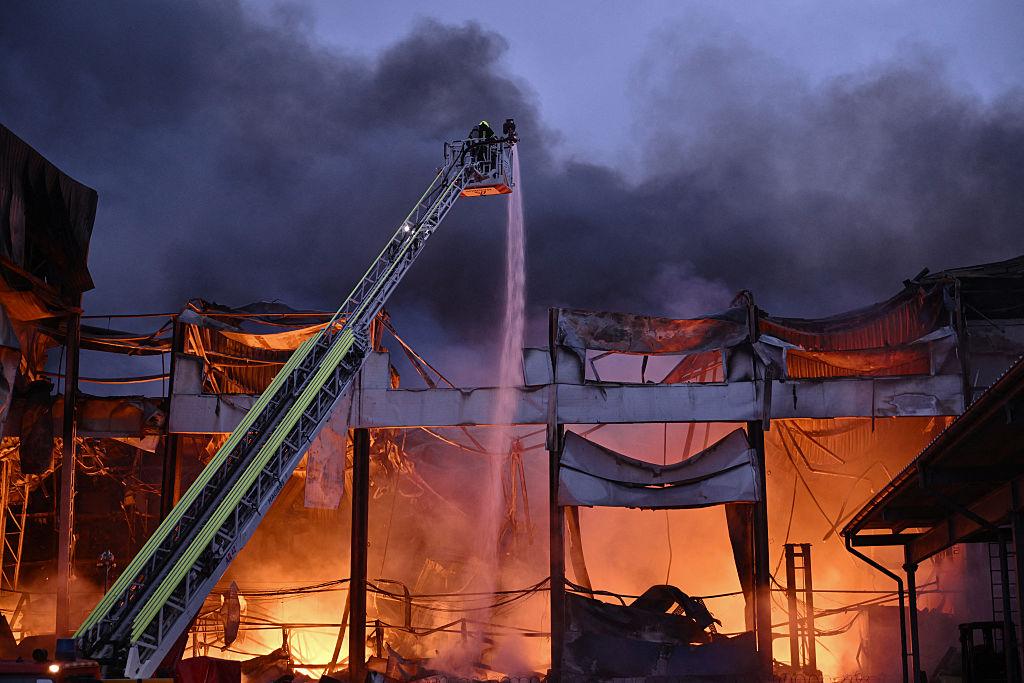
Russia struck Kyiv and Dnipro in the early hours of October 7, damaging buildings, warehouses and an industrial facility only hours after President Volodymyr Zelenskyy said Ukrainian intelligence had detected preparations for a “massive attack.” Ukrainian defenses remain on heightened alert as authorities assess whether the overnight strikes are the beginning of a broader assault.
Russia launched a new wave of air attacks against Ukraine in the early hours of Wednesday, striking Kyiv and Dnipro only hours after President Volodymyr Zelenskyy warned that Ukrainian intelligence had detected preparations for what he described as a “massive attack.” Explosions were heard across the Ukrainian capital, buildings and warehouses were damaged, and a separate strike hit an industrial facility in Dnipro, turning what had been an intelligence warning on Tuesday evening into an active nationwide security threat by the early hours of October 7.
Kyiv Mayor Vitali Klitschko said the capital came under renewed attack overnight and reported damage to buildings and warehouse facilities as emergency crews responded across the city. The full scale of the strikes, including the weapons used and any casualties, was still being assessed in the first hours after the explosions. In Dnipro, regional authorities said an industrial facility was damaged in a separate Russian attack, adding another major population and industrial center to the list of locations hit during the latest wave.
The timing is particularly important because Zelenskyy had warned only hours earlier that Ukrainian intelligence believed Russia was preparing another large-scale aerial assault. In his Tuesday evening address, he said Ukraine’s air-defense units, military commands and other services had been instructed to prepare, while emphasizing that the country’s ability to withstand a major strike would depend partly on whether international partners continued supplying the weapons needed to intercept Russian missiles and drones.
The latest attacks do not yet establish that every element of the large operation Zelenskyy described has begun. Ukrainian officials had not, in the opening hours of Wednesday, provided a complete count of missiles and drones launched nationwide or confirmed whether the strikes on Kyiv and Dnipro represented the full assault anticipated by intelligence services. What has changed is that the warning is no longer only about preparations detected inside Russia. Russian weapons are again striking major Ukrainian cities while defense forces remain on heightened alert for the possibility of additional waves.
Ukraine has repeatedly experienced attacks that unfold over several hours and sometimes in separate phases. Russia has increasingly combined large numbers of attack drones with cruise missiles and ballistic weapons in an effort to complicate Ukrainian defenses, force interceptor launches and create pressure across multiple regions at the same time. The first drones can be used to probe air-defense positions or exhaust cheaper interception systems before faster and more difficult targets arrive later in the operation.
That pattern means the significance of the overnight strikes may not be clear until Ukrainian authorities are able to determine how many weapons Russia launched, which regions were targeted and whether further attacks follow. Air raids during the war have sometimes involved hundreds of drones and missiles, with waves entering Ukrainian airspace from different directions and forcing civilians to remain in shelters for hours.
The attacks also come during a period of sharply increased long-range warfare between Russia and Ukraine. Only a day earlier, Russia said Ukrainian forces had launched hundreds of drones toward Russian territory in one of the largest such operations of the war, with Moscow and its surrounding region among the principal targets. Russian authorities reported deaths, injuries and damage to residential property, while Russian military bloggers said a major fuel storage facility in the Moscow region had also been hit.
Ukraine has expanded those deep strikes as it tries to damage oil infrastructure, fuel storage facilities, military production sites and other assets that Kyiv says support Russia’s war effort. Moscow has responded with continuing attacks against Ukrainian cities, transport links, industrial facilities and infrastructure, creating a cycle in which both sides are increasingly using long-range systems far beyond the immediate front line.
Kyiv has been under particularly heavy pressure in recent weeks. Russian attacks have repeatedly targeted infrastructure in and around the capital, including bridges crossing the Dnipro River, warehouses, communications facilities and other sites. Several strikes have caused deaths and injuries, while damage to transport infrastructure has disrupted movement through one of the country’s most important urban and logistical centers.
Earlier this week, Russian attacks damaged Kyiv’s Northern Bridge, one of the major crossings linking different parts of the capital. The strike came after other bridges and transport facilities had already been targeted, increasing concern that Moscow is attempting to make movement through Kyiv more difficult while simultaneously placing greater pressure on the city’s air-defense network.
Russia has said many of the sites it targets are linked to Ukraine’s military, defense industry or logistics system. Ukrainian authorities have accused Moscow of deliberately striking civilian infrastructure and populated areas, pointing to repeated damage to homes, businesses, schools, hospitals, energy facilities and other civilian sites throughout the war. Independent reporting has documented extensive civilian casualties and infrastructure damage during Russian aerial attacks, even when Moscow has said its intended targets were military or military-linked facilities.
Dnipro has also become a frequent target because of its industrial importance and position as a major logistical hub in central-eastern Ukraine. The city supports manufacturing, transport and military supply networks and lies relatively close to the front compared with Kyiv, making it strategically important to both Ukraine’s civilian economy and its war effort. Russian attacks have previously struck businesses, industrial areas and residential districts in Dnipro, causing deaths, injuries and significant property damage.
Wednesday’s attack on an industrial facility therefore fits into a broader Russian campaign against Ukrainian production and logistics. The precise function of the damaged site had not been publicly established in the opening hours after the strike, and Ukrainian officials had not said whether it was directly involved in military production. That distinction will matter because Russia routinely describes industrial and transport targets as connected to Ukraine’s defense network, while Kyiv often accuses Moscow of using broad military claims to justify damage to civilian infrastructure.
The overnight attacks also renew attention on Ukraine’s air-defense shortages. Zelenskyy used his Tuesday address to make another appeal to the United States, European governments and other partners for additional defensive weapons, particularly systems capable of intercepting ballistic missiles. Ukraine has developed increasingly sophisticated ways to destroy drones, including electronic warfare, mobile firing teams and interceptor drones, but some of Russia’s fastest weapons remain difficult to stop without advanced Western systems.
The American-made Patriot remains one of Ukraine’s most important defenses against ballistic missiles. Kyiv has repeatedly asked partners for additional batteries and interceptor missiles, arguing that the effectiveness of the system depends not only on possessing launchers but on having enough ammunition available during repeated attacks.
That problem becomes more serious during large-scale strikes. A single major Russian operation can force Ukraine to fire significant numbers of expensive interceptors in a matter of hours, and replacing those missiles depends heavily on production outside Ukraine. Kyiv has increasingly invested in domestic weapons designed to destroy slower drones more cheaply so that Patriot and other advanced systems can be reserved for the threats that require them.
The shortage is one reason Zelenskyy framed Tuesday’s intelligence warning partly as an appeal to foreign governments. He said Ukraine’s defense forces would respond with the capabilities available to them but stressed that the outcome of a large Russian strike could depend on decisions made by countries possessing the weapons Ukraine still needs.
The United States remains central to that discussion because some of the most effective ballistic missile defenses used by Ukraine are American-built. European countries have also supplied air-defense systems and funded ammunition purchases, while Kyiv has been working to expand its network with additional aircraft, radar systems and domestically produced interceptors.
The renewed attack on Kyiv demonstrates why Ukraine continues pressing those requests even after building one of the most heavily defended airspaces in Europe. Kyiv has multiple layers of air defense, but no system can guarantee that every missile or drone will be intercepted. Large attacks are designed partly to exploit that reality by creating more incoming targets than defenders can engage efficiently.
Even when most weapons are destroyed, debris can still fall onto residential areas or infrastructure, and a small number of successful strikes can cause serious damage. Ukrainian officials therefore continue to tell civilians to treat air-raid warnings seriously rather than assuming that the presence of air defenses means shelters are unnecessary.
Russia has meanwhile expanded its own missile and drone production. Ukrainian officials say Moscow has accumulated substantial stocks of ballistic missiles and continues producing additional weapons each month. Exact Russian stockpile figures are difficult to independently verify because much of the information is classified, but the frequency and scale of Russian attacks demonstrate that Moscow continues to possess the ability to conduct large operations despite years of Western sanctions against its defense industry.
Russia has also developed new drone variants and tactics intended to complicate interception. Some recent attacks have included faster jet-powered drones, while other operations have mixed armed drones with decoys. The objective is to force Ukraine to distinguish quickly between threats, conserve ammunition and protect several regions simultaneously.
Ukraine has responded with increasingly innovative defenses. Electronic warfare can jam the navigation or communications systems used by some drones. Mobile air-defense teams equipped with machine guns and short-range weapons can destroy slower targets. Fighter aircraft, including F-16s, can be used against other threats, while advanced ground-based systems are reserved for missiles that cannot be handled by cheaper options.
The continuing arms race has made long-range aerial warfare one of the defining features of the conflict. Neither Russia nor Ukraine has achieved the kind of decisive breakthrough on the ground that would rapidly end the war, so both countries increasingly use drones and missiles to impose economic, military and psychological costs deep behind the front.
For Russia, attacks on Ukrainian infrastructure can disrupt military movement, industrial production, electricity supplies and civilian life without requiring territorial advances. Ukraine uses a similar logic when it attacks Russian refineries, depots and industrial facilities, arguing that reducing Moscow’s fuel production and logistics capacity weakens the resources available to continue the invasion.
The overnight strikes followed one of the largest Ukrainian drone attacks reported inside Russia during the war. Russian authorities said hundreds of drones were intercepted or brought down across multiple regions, including around Moscow. Two people were reported killed and several others injured, while houses, apartments and vehicles were damaged. Russian military bloggers also reported an attack on a major oil storage facility serving the Moscow region.
The scale of the Ukrainian operation inevitably raises questions about whether Wednesday’s Russian strikes were linked to retaliation, but Moscow had not publicly characterized the latest wave in those terms in the first reports. Russia has previously described major attacks as retaliatory after Ukrainian strikes, though the sequence of preparations required for large missile operations means individual attacks may be planned well in advance.
That is also why Zelenskyy’s intelligence warning remains relevant. If Ukrainian intelligence detected Russian preparations before the latest wave began, then the operation may have been assembling before the full scale of Tuesday’s Ukrainian drone assault was known.
Kyiv’s immediate concern is therefore not assigning a political label to the attack but determining whether more is coming. Ukrainian air-defense units remain on alert while military and emergency authorities assess damage and monitor Russian aircraft, missile units and drone launch areas.
The possibility of repeated waves is especially concerning because large attacks can be designed to exhaust defenders. Russia can send drones over several hours, force Ukraine to activate radar and air-defense systems, and then follow with faster missiles when crews and ammunition have already been placed under pressure.
Ukraine has been preparing for exactly that possibility. Zelenskyy said Tuesday that intelligence services had provided updated information about Russian preparations and that defense units had received instructions in response. He also said Ukraine was strengthening electronic warfare protection around critical infrastructure and taking additional measures to defend facilities considered especially important.
Energy infrastructure remains one of the most sensitive categories as Ukraine approaches another winter. Russia has repeatedly targeted power plants, substations and transmission systems during the war, leaving millions of Ukrainians facing outages and forcing authorities to carry out emergency repairs under continuing threat of further attacks.
Kyiv has spent months strengthening the resilience of its energy system by repairing damaged infrastructure, installing backup generation and building additional physical protection around key sites. Those preparations reduce vulnerability but cannot eliminate it, particularly if Russia launches sustained attacks across several regions simultaneously.
Industrial facilities are also a major concern because they can be difficult to protect comprehensively. Ukraine’s defense industry has expanded dramatically since the beginning of the invasion, producing drones, ammunition and other equipment domestically. Russia has repeatedly tried to identify and destroy those facilities, while Ukraine has dispersed production and moved some manufacturing underground or into smaller locations.
The strike reported in Dnipro will therefore be examined closely once more details become available. Initial reports confirmed damage to an industrial facility, but the extent of the destruction, whether production was interrupted and whether anyone was killed or injured had not been fully established.
In Kyiv, emergency authorities were similarly working through multiple damaged locations. Warehouses and other buildings were reported hit or damaged, while residents across the city reported hearing explosions as air defenses engaged incoming threats.
The attack adds to a series of recent strikes that have made the capital more exposed than during some earlier periods of the war. Kyiv remains one of the best-defended locations in Ukraine, but Russia has increased pressure on the city with ballistic missiles, cruise missiles and advanced drones designed to penetrate or overwhelm defensive systems.
The war has also shown that improved defenses can lead to changes in offensive tactics rather than a reduction in attacks. As Ukraine becomes better at destroying one type of weapon, Russia alters routes, timing, altitude, speed or the composition of attack packages. Ukraine then adjusts again, creating a constant competition between offensive and defensive technology.
That technological contest has grown alongside the political struggle over Western assistance. Ukraine argues that the fastest way to reduce the damage caused by Russian attacks is to provide more interceptors and allow Kyiv to build a deeper defensive reserve. Some partner governments have increased support, while others face their own stockpile limitations and competing security commitments.
Zelenskyy has repeatedly argued that those constraints should be treated as a production problem rather than a reason to reduce support. Ukraine wants Western manufacturers to expand output so that partner countries can protect their own stockpiles while continuing to supply Kyiv.
Wednesday’s attack strengthens that argument from the Ukrainian government’s perspective. Hours after publicly warning that intelligence showed Russia preparing a major operation, Kyiv and Dnipro were again under attack, providing an immediate example of the threat Zelenskyy had described.
It remains too early, however, to say whether the current strikes represent the entirety of the “massive attack” he warned about. No full nationwide weapons count had been released in the first reports, and Ukrainian authorities were still assessing both the damage and Russia’s continuing military activity.
That uncertainty is likely to keep Ukrainian defenses on elevated alert through the coming hours. Large Russian attacks have previously continued after initial waves, and Ukrainian officials have repeatedly warned that the absence of immediate follow-up strikes does not necessarily mean an operation has ended.
The current situation therefore represents a clear escalation from Tuesday evening’s warning but not yet the final picture of what Russia may be preparing. Kyiv and Dnipro have already been hit, damage has been confirmed, and Ukraine’s air-defense network is operating under renewed pressure. The unanswered question is whether those strikes were the first phase of the large-scale assault Zelenskyy said intelligence services had detected or another major attack within a broader campaign that is still building.
For Ukrainian authorities, the response will remain focused on keeping air defenses supplied, repairing damaged infrastructure and preparing civilians for further alerts while intelligence services continue monitoring Russian launch preparations. The latest strikes have shown how quickly intelligence about a possible attack can move into an active emergency, and the next several hours will determine whether the assault remains concentrated on the locations already hit or develops into the wider nationwide operation Kyiv had been preparing to confront.