TAIPEI MAYOR BOOED AT MASSIVE PRIDE PARADE AS GAY BAR RAID IGNITES POLICING BACKLASH
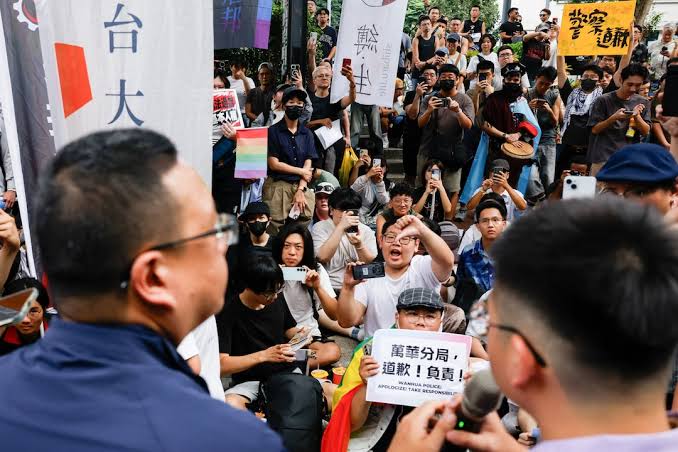
More than 170,000 people attended Taiwan Pride in Taipei on October 31, where Mayor Chiang Wan-an faced protesters angry over an October police raid on the Commander D gay bar. Police questioned 51 patrons and arrested the venue’s owner during the operation, and six police officials were later disciplined over inappropriate conduct. Chiang has apologised and ordered stronger discipline while defending Taipei’s commitment to equality. The controversy has also entered the mayoral election campaign, with Chiang seeking re-election against DPP challenger Puma Shen. Reuters
Taipei Mayor Chiang Wan-an faced an angry reception from protesters as more than 170,000 people filled the streets of Taiwan’s capital for the annual Pride parade on Saturday, turning one of East Asia’s largest LGBTQ+ celebrations into an unexpected political confrontation over policing, discrimination and the limits of Taiwan’s reputation as the region’s most progressive jurisdiction on LGBTQ+ rights. Chiang, who is seeking re-election as the Chinese Nationalist Party candidate in Taipei’s November 28 mayoral election, made a brief appearance at the parade but was met by demonstrators still furious over an October police raid on Commander D, a well-known gay bar in the city’s Ximending district. Protesters shouted against the raid and openly expressed support for Chiang’s Democratic Progressive Party challenger, Puma Shen, transforming the mayor’s appearance into one of the most politically charged moments of this year’s Pride event.
The controversy traces back to an October 3 operation by officers from Taipei’s Wanhua Precinct at Commander D, where police said they were acting under a court-authorised search warrant after receiving complaints about possible violations of public-decency laws. Officers questioned 51 people and arrested the establishment’s owner, while some patrons said they were detained for more than six hours. Police initially defended the operation as lawful, but videos and witness accounts quickly triggered outrage over the way officers treated people inside the venue, particularly remarks viewed by LGBTQ+ organisations as discriminatory and humiliating.
One widely circulated video showed a police officer questioning a wheelchair user in a manner that activists said was degrading and discriminatory. Rights organisations accused officers of using inappropriate language, treating patrons as though their identities or presence at the venue were themselves suspicious and conducting an unnecessarily heavy-handed operation at a location closely associated with Taipei’s LGBTQ+ community. The Taiwan Alliance to Promote Civil Partnership Rights and other organisations argued that the controversy went beyond individual misconduct and reflected deeper problems involving how LGBTQ+ spaces are policed.
Taipei Police subsequently reviewed body-camera footage and disciplinary records and acknowledged that several officers had acted improperly. Four officers were disciplined for inappropriate language, the lead investigator received punishment for failing to intervene quickly enough, and Wanhua Precinct Chief Chen Yung-hua also faced disciplinary action over inadequate supervision. Police Commissioner Lin Yen-tien nevertheless maintained that the underlying search operation itself was lawful and had been authorised through a warrant following repeated complaints about alleged indecent conduct at the venue.
That distinction has done little to calm anger among LGBTQ+ organisations, which argue that lawful authority to conduct an investigation does not excuse humiliating or discriminatory treatment during enforcement. Activists have called for clearer rules governing police conduct in LGBTQ+ venues, independent scrutiny of the Commander D operation and stronger protections ensuring that minority communities are treated with dignity when police exercise coercive powers.
Chiang responded to the criticism earlier in October by apologising to people affected by inappropriate police behaviour and promising a rigorous review. He said Taipei must remain a city where residents enjoy equal protection regardless of age, gender, sexual orientation, identity, ethnicity or belief, and instructed police officials to strengthen discipline and take immediate action where misconduct was established. Those assurances, however, were not enough to prevent the dispute from following him directly into Saturday’s Pride parade.
Reuters reported that demonstrators shouted slogans against gay-bar raids as Chiang appeared at the event, while some openly voiced support for his election rival. The contrast became particularly striking because Puma Shen received a much warmer reception elsewhere at the parade. With Taipei’s mayoral election less than a month away, the Pride controversy has therefore moved beyond questions of police conduct and into the city’s electoral debate, although the underlying allegations involving discrimination remain a matter of rights and law enforcement rather than simply party politics.
Chiang formally launched his re-election campaign headquarters earlier this week and is seeking another term as Taipei mayor on the KMT ticket. His principal challenger, DPP legislator Puma Shen, has repeatedly used the Commander D controversy to argue that a city cannot describe itself as inclusive only during Pride events while allowing questionable treatment of LGBTQ+ residents during routine police operations. Shen has said officers should be allowed to enforce the law where offences are suspected but that their methods, legal authority and treatment of citizens must remain open to scrutiny.
Saturday’s parade therefore placed two competing political messages in the same public space. Chiang attempted to reaffirm Taipei’s reputation as a diverse and welcoming city while acknowledging failures connected to the raid, whereas critics argued that inclusivity must be demonstrated through everyday state conduct rather than speeches and appearances at Pride events. The protesters’ anger showed that an apology and disciplinary measures have not completely resolved concerns about how the operation was planned, carried out and initially defended by authorities.
The scale of the Pride gathering amplified that political pressure. More than 170,000 participants attended this year’s event, according to organisers cited by Reuters, maintaining Taipei Pride’s position as one of Asia’s biggest LGBTQ+ public gatherings. Thousands of people marched through central Taipei carrying rainbow flags, banners and signs promoting equality, while corporations, advocacy groups, community organisations and international visitors participated in the event.
Taiwan Pride has grown dramatically since its first march in 2003 and has become a highly visible symbol of the island’s transformation on LGBTQ+ rights. Taiwan became the first jurisdiction in Asia to legalise same-sex marriage in 2019 after years of activism, constitutional litigation and political debate. That achievement gave Taiwan an international reputation for social progress that sharply contrasts with many neighbouring jurisdictions where same-sex relationships remain heavily restricted or socially marginalised.
The Commander D raid has therefore created particular discomfort because critics argue that the policing episode clashes with the image Taiwan has built internationally. LGBTQ+ groups have said legal recognition of same-sex marriage does not automatically eliminate prejudice inside public institutions and that equality legislation must be reflected in how police, government departments and other authorities interact with sexual minorities.
President Lai Ching-te has also addressed the controversy, saying respect for LGBTQ+ people should be reflected in the exercise of public authority. His intervention added national attention to what began as a Taipei policing dispute and reinforced pressure on the city government to demonstrate that the disciplinary measures announced after the raid are accompanied by wider institutional change.
Pride organisers themselves modified aspects of this year’s messaging following the raid, saying the episode revived painful memories of earlier periods when LGBTQ+ people in Taiwan faced much greater state scrutiny, social stigma and police harassment. For older members of the community, the images of people being taken from a gay venue for questioning echoed experiences from a period before contemporary legal protections and public acceptance had developed.
That historical dimension helps explain why the Commander D operation triggered such a strong response. Taiwan has changed significantly over the past two decades, but activists argue that institutional culture does not always move as quickly as legislation. Same-sex couples may now marry legally, yet questions remain over whether LGBTQ+ people encounter equal treatment in policing, employment, education and other areas of public life.
Police have rejected claims that the raid itself was motivated simply by the sexual orientation of patrons. Officials say Commander D had been the subject of repeated complaints involving alleged public-indecency offences and that the search was conducted pursuant to a judicial warrant. They have also said officers encountered evidence they believed required further investigation and that the people questioned were not detained merely for being gay or for attending a gay bar.
That defence is significant because it means the central dispute is not whether police have authority to investigate suspected offences but how that authority was exercised. Even LGBTQ+ organisations critical of the operation have generally focused on excessive enforcement, inappropriate remarks, treatment of patrons and the broader question of whether similar tactics would have been used at venues serving a different clientele.
Taipei Police have acknowledged part of that criticism by disciplining officers after reviewing video evidence. The action represents an official recognition that aspects of the operation fell below expected standards even while authorities continue defending the legal basis for the search. Whether those measures satisfy activists is another question, particularly because several organisations are pushing for structural reforms rather than punishment of only individual officers.
Chiang now faces the difficult task of convincing voters that his administration can address those concerns without appearing to condemn police for carrying out lawful enforcement. His apology has emphasised inappropriate conduct rather than challenging the legality of the operation itself, allowing him to defend police authority while acknowledging that enforcement must respect dignity and equality.
The situation illustrates a wider challenge for governments that promote themselves as socially progressive. Symbolic participation in Pride events can demonstrate political acceptance, but minority groups increasingly judge administrations by less visible measures such as police behaviour, administrative rules, healthcare access and protection from discrimination. For activists, equality becomes meaningful when it shapes routine encounters with public authority, not only when politicians appear at major celebrations.
Saturday’s reception showed that many Pride participants were unwilling to separate Chiang’s attendance from the unresolved anger surrounding the raid. A mayor appearing at an LGBTQ+ celebration only weeks after police under his city administration were disciplined for inappropriate conduct was always likely to face scrutiny, particularly during an election campaign.
The presence of Puma Shen added another political dimension because demonstrators could immediately contrast the incumbent with his challenger. Reuters reported that some protesters expressed support for Shen during Chiang’s appearance, while the DPP candidate was warmly received elsewhere during the event. That does not determine how Taipei voters as a whole will respond in November, but it demonstrates that the raid has become part of the city’s campaign conversation.
Chiang’s campaign has otherwise focused heavily on his record in office, family policies, urban development, technology and public services. He formally opened his campaign headquarters on October 26 and has argued that voters should judge him on his performance across the full range of municipal responsibilities. The Commander D controversy, however, forces his administration to defend its record on civil rights at a moment when Taiwan Pride places those issues under international attention.
The dispute also coincides with growing scrutiny of police accountability around the world. Law-enforcement agencies increasingly operate in environments where body-camera recordings, mobile-phone videos and social media allow the public to examine encounters that previously might have remained largely invisible. In the Commander D case, video evidence appears to have played an important role in forcing closer examination of officers’ language and conduct after some aspects of the initial police response were challenged by activists.
This increased visibility can strengthen accountability but can also produce competing interpretations of incomplete footage. Independent investigations therefore remain important for determining the full context surrounding contentious operations. Taipei authorities have promised further review, and activists are expected to continue pressing for the disclosure of information about how the raid was authorised and conducted.
The legal issue surrounding alleged public indecency is itself likely to remain controversial. One patron told Reuters that they were taken for questioning after removing their shirt because the venue was crowded and hot, while police said officers had information suggesting sexual or obscene conduct and initially could not determine which individuals might have been involved. Police later indicated they were unlikely to fine the 51 people questioned.
Such details have fuelled criticism that enforcement was excessively broad, with numerous patrons subjected to hours of questioning even though most were never accused of specific wrongdoing. Rights groups argue that police should use more targeted investigative methods when dealing with alleged offences inside private venues rather than treating large groups of patrons as potential suspects.
For the city government, restoring trust may require more than disciplinary action. LGBTQ+ organisations have called for police training on sexual orientation, gender identity and disability rights, clearer operational guidelines and accountability mechanisms that make it less likely that discriminatory behaviour will recur.
Chiang has said the city will strengthen police discipline and has acknowledged the harm caused by the incident. Whether those commitments produce lasting policy changes will likely determine how long the controversy remains politically and socially significant after the election campaign ends.
The episode also reinforces the distinction between legal progress and lived equality. Taiwan’s same-sex marriage law was historic and continues to distinguish the island from much of Asia, but formal equality does not guarantee that every institution behaves without bias. The Commander D controversy has become a reminder that civil-rights gains require continued enforcement and institutional reform.
Taiwan Pride itself remains evidence of how dramatically public attitudes have evolved. A gathering attracting more than 170,000 participants in the heart of Taipei would have been difficult to imagine during earlier decades when homosexuality was much more heavily stigmatised and LGBTQ+ organisations had far less public influence.
That progress is precisely why activists reacted so strongly to the October raid. Many view modern Taiwan as having moved beyond the era when LGBTQ+ establishments were treated as inherently suspicious spaces, and any policing action perceived as returning to that approach carries unusually strong symbolic weight.
Saturday’s march therefore became both a celebration of achievements and a protest over unfinished work. Rainbow flags, music and celebrations filled Taipei while demonstrators simultaneously demanded accountability from the government responsible for policing the city.
For Chiang, the episode created an uncomfortable political scene: an incumbent mayor attending one of Taipei’s internationally recognised civic events while sections of the crowd loudly challenged his administration’s record. His willingness to attend despite expected criticism may allow him to argue that he is prepared to engage directly with affected communities, but demonstrators made clear that attendance itself would not erase the controversy.
For Shen, the episode offers an opportunity to present himself as a stronger advocate for scrutiny of state authority, although his own proposals and record will also be subject to examination as campaigning continues. Pride attendees expressing support for him represent one constituency within Taipei rather than the entire electorate, and the November election will be decided by voters considering a broad range of local issues.
The political implications should therefore not overshadow the underlying legal and civil-rights questions. Whether Chiang or Shen wins the mayoral election, Taipei’s police department will still need to demonstrate that officers can investigate alleged offences without humiliating or discriminating against minority communities.
The broader Taiwanese government faces a similar responsibility. The country’s international reputation for LGBTQ+ rights increasingly creates expectations that its institutions will meet the standards associated with that image. When those expectations are not met, criticism can be particularly intense because the gap between legal progress and enforcement practice becomes more visible.
Saturday’s massive turnout shows that Taiwan Pride remains a powerful institution in the island’s civic life. More than 170,000 people gathering publicly around LGBTQ+ rights represents a level of visibility and acceptance that remains rare in much of Asia.
But the confrontation surrounding Chiang also showed that Pride has become more than a festival. It is a political and civic platform where officials are expected to answer for how equality is implemented beyond ceremonial support.
The Commander D raid may eventually be remembered as an isolated policing failure corrected through discipline and reform, or it may become evidence for activists who argue that deeper institutional problems remain. That judgment will depend on the results of investigations, changes to police procedures and whether similar incidents recur.
For now, the controversy has reached the streets in unmistakable fashion. Taipei’s mayor arrived at Pride seeking to participate in one of the city’s largest annual public events and instead encountered protesters demanding answers about the conduct of police under his administration.
Taiwan’s legal position on LGBTQ+ rights remains historically significant: it was the first jurisdiction in Asia to recognise same-sex marriage. Saturday’s events, however, demonstrated that legal milestones do not end debates about discrimination. For more than 170,000 people marching through Taipei, the question is increasingly whether the equality recognised in law is consistently respected when citizens encounter the power of the state.