TRUMP HEADS TO IOWA AS REPUBLICANS FACE UNEXPECTEDLY TOUGH ELECTION BATTLES IN FORMER STRONGHOLD
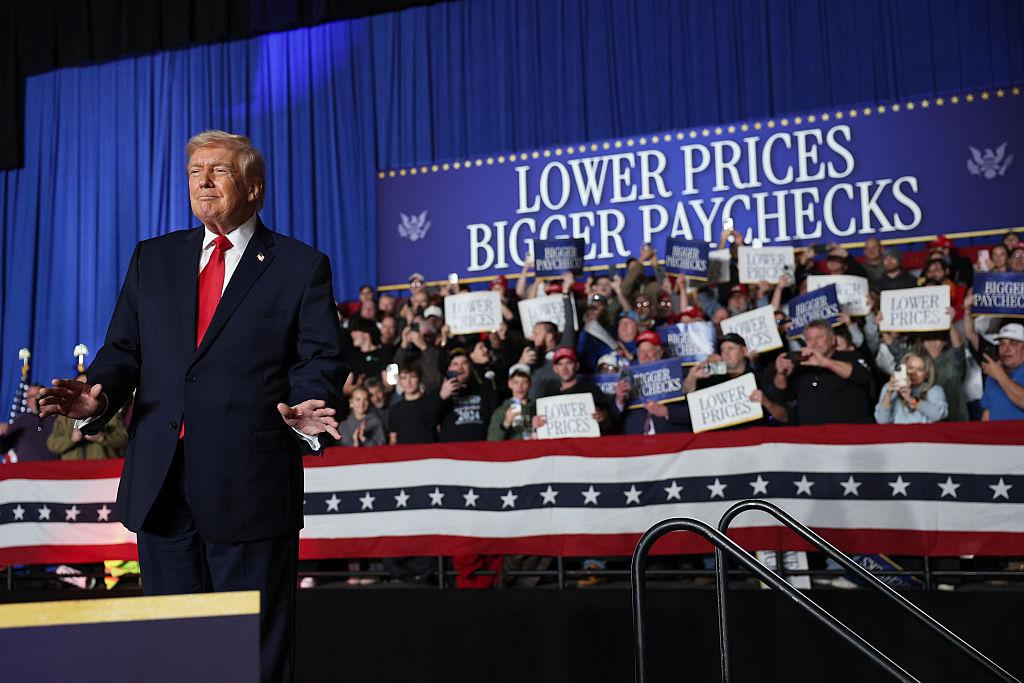
President Donald Trump is travelling to Iowa as Republicans face unusually competitive races in a state he won by 13 percentage points in 2024. Republicans are defending a Senate seat, three House districts and the governor’s office, while voter concern over fuel prices, food costs and personal finances has become a major campaign issue. A recent Iowa poll found 42% of likely voters saying their finances had worsened over the past year, while Trump’s national approval has fallen to 31%. The November 3 election remains undecided, but Iowa’s Senate and House races could contribute directly to determining control of Congress. Reuters
President Donald Trump is heading to Iowa on Thursday, October 22, for a major campaign rally as Republicans fight to protect a US Senate seat, three competitive House districts and the governor’s office in a state that only two years ago delivered Trump a decisive 13-point presidential victory. The visit to Sioux City comes less than two weeks before the November 3 midterm elections and reflects growing Republican concern that economic frustration, high fuel and grocery prices and declining approval of the president have transformed what would normally be considered safe territory into a collection of closely watched contests. Trump is expected to use the rally to energise Republican voters who strongly supported him in presidential elections but may be less motivated to participate when his own name is not on the ballot.
Iowa has become an important test of whether the political coalition Trump built across rural and working-class America remains powerful enough to carry Republican candidates through a difficult midterm environment. The president won the state comfortably in 2024, continuing a shift that turned Iowa from a former presidential battleground into reliable Republican territory. Republicans subsequently consolidated control of much of the state’s political representation, but the 2026 campaign has become considerably less predictable as voters express growing concern about household finances and several Republican candidates attempt to create distance from parts of Trump’s current agenda while still relying on his supporters to turn out.
Trump’s Thursday rally is scheduled for Sioux Gateway Airport in Sioux City, with the main programme beginning in the afternoon and the president expected to speak in the evening. He is campaigning primarily in support of Republican Senate candidate Ashley Hinson, gubernatorial candidate Zach Lahn and Republican congressional candidates whose races have become increasingly competitive. The president is also scheduled to return to Iowa on November 1, only two days before Election Day, demonstrating how seriously Republicans are treating a state they would ordinarily expect to hold without requiring repeated visits from a sitting president.
The highest-profile contest is the race for Iowa’s open US Senate seat, where Republican Representative Ashley Hinson is running against Democratic state Representative Josh Turek. A Marist survey conducted from October 8 to October 11 found Turek at 48 per cent among likely voters and Hinson at 45 per cent, a difference of three percentage points that falls well within the poll’s 6.6-point margin of error for likely voters. The same survey found a larger Democratic advantage among registered voters, but the race remains unresolved and the polling should not be interpreted as predicting the final result.
Hinson has built much of her national profile as a Republican aligned with Trump, but the closing weeks of the campaign have forced her to navigate growing voter dissatisfaction over economic conditions and the administration’s foreign policy. She has publicly called for an immediate end to the Iran war, arguing that Iowa households should not continue paying higher fuel and grocery prices because of the conflict. Her position represents one example of the balancing act facing Republican candidates who want Trump’s endorsement and voter base while also demonstrating independence on issues where the president’s policies have become unpopular with parts of the electorate.
The economic pressure is particularly visible in Iowa because agriculture and transportation are central to the state’s economy. Farmers operate machinery that consumes large amounts of diesel, while fertiliser, transportation and other agricultural inputs have become increasingly expensive. Trade uncertainty also matters because Iowa produces substantial quantities of corn, soybeans, pork and other commodities that depend on domestic and international markets. Higher operating costs can therefore affect farmers directly while also feeding through into food production, transport and household expenses.
A Marist poll released on October 15 found that 42 per cent of likely Iowa voters said their personal financial situation had become worse over the previous year, compared with 36 per cent who said it had remained about the same and only 20 per cent who said it had improved. The result is especially significant because economic perceptions often influence midterm voting even when national economic statistics present a more complicated picture. More than half of likely-voting independents reported worsening finances, making that group particularly important in close statewide contests.
Trump’s standing inside Iowa remains stronger than his national approval rating, but the same Marist survey still showed more likely Iowa voters disapproving of his performance than approving. Forty-four per cent approved of the job he was doing while 53 per cent disapproved. The survey also found that 35 per cent of likely voters described their congressional vote as a vote against Trump, compared with 21 per cent who said they viewed their ballot as a vote for him. Another 44 per cent said the president was not a major factor in their congressional choice.
Those figures explain the unusual challenge confronting Republicans. Trump remains capable of attracting large crowds and strongly motivating loyal supporters, yet his presence may simultaneously energise voters who oppose him. Republican strategists therefore need the president to boost turnout among conservative voters without allowing every competitive race to become entirely a referendum on his administration.
The national environment is also difficult for the governing party. The latest national poll measuring Trump’s job performance found his approval rating at 31 per cent, the lowest recorded during either of his presidential terms. Sixty-six per cent disapproved of his overall performance, while 68 per cent disapproved of his handling of the economy. Among registered voters in the same survey, Democrats held a 47 per cent to 35 per cent advantage when respondents were asked which party they would support in a congressional election.
National generic-ballot polling cannot directly determine who will win individual House or Senate races because congressional control is decided district by district and state by state. Republicans benefit from favourable political geography in several Senate contests and from congressional maps that differ considerably across the country. Nevertheless, national dissatisfaction creates a more difficult campaign environment because candidates in normally Republican territory may be forced to spend money and political attention simply defending seats that would ordinarily require fewer resources.
Iowa demonstrates that problem particularly clearly. Republicans are not only defending the Senate seat but also facing pressure in multiple congressional districts. Representative Mariannette Miller-Meeks is again running against Democrat Christina Bohannan in Iowa’s 1st Congressional District, a race that was decided by only hundreds of votes in the previous election. Miller-Meeks has also broken with the administration on selected issues, including joining Democrats in an effort to limit Trump’s war powers in Iran.
Representative Zach Nunn faces another competitive reelection campaign in Iowa, and he similarly joined Democrats in voting to restrict the president’s authority over the Iran conflict. That vote is politically notable because Republican candidates rarely want to create unnecessary conflict with a president from their own party immediately before an election. The decision suggests that some lawmakers believe voter concerns about the war and its economic consequences are significant enough to justify a public break with the White House.
Democrats are also targeting Iowa’s open 2nd Congressional District, where Republican Joe Mitchell is running against Democrat Lindsay James. The district includes substantial rural territory in northeastern Iowa and had previously been considered reliably Republican. Its growing competitiveness is another sign that Democrats are attempting to reduce Republican margins in rural areas rather than relying only on traditional urban and suburban strongholds.
Democratic strategy in Iowa does not depend on suddenly winning every deeply Republican rural county. Candidates are instead attempting to improve their margins in areas where Trump previously dominated while maintaining stronger performance in cities, university communities and suburban areas. A relatively small shift across several rural counties can matter in a statewide Senate or governor’s race even if Republicans still win those counties comfortably.
The governor’s race has added another major complication for the Republican Party. Democrat Rob Sand is running against Republican Zach Lahn, and the October Marist survey placed Sand at 52 per cent among likely voters compared with Lahn at 45 per cent. The survey’s margin of error again means the race remains subject to considerable uncertainty, but Sand’s position has forced Republicans to devote attention to an office they have controlled during a period of strong statewide Republican performance.
Sand has attempted to appeal beyond the Democratic base by presenting himself as politically independent on selected issues and focusing heavily on government accountability and household economics. Lahn, meanwhile, is campaigning as the Republican candidate in a state where the party retains a substantial organisational advantage. Trump’s presence in Sioux City is designed in part to ensure that voters who supported him strongly in 2024 also turn out for Lahn and other Republican candidates lower on the ballot.
The turnout question is central to the president’s entire midterm strategy. Trump has repeatedly told supporters to vote as though he himself were on the ballot because Republican strategists understand that some of his voters are less consistent participants in non-presidential elections. He has developed a coalition containing many working-class and lower-frequency voters whose participation can change substantially depending on whether he is personally running.
The challenge is that Democrats appear highly motivated as well. Voters opposed to the president have multiple reasons to participate because control of Congress will determine whether Trump continues governing with Republican majorities or faces one or both chambers controlled by Democrats. That makes the November 3 election consequential even though the presidency itself is not being contested.
Republicans currently hold narrow control of both chambers of Congress. They have a 53 to 47 advantage in the Senate and a 218 to 214 advantage in the House. Democrats therefore require a net gain of four seats in each chamber to take control, although the pathways are different because every House seat is being contested while only a portion of Senate seats are on the ballot.
Iowa’s Senate race could become important to that national calculation. A Democratic victory there would represent a pickup from Republicans and reduce the number of additional seats Democrats would need elsewhere. A Republican victory would preserve one of the seats the party expected to hold at the beginning of the election cycle and make the Democratic path to Senate control more difficult.
The House contests may be equally important because the Republican majority is so small that only a limited number of seat changes could determine which party controls the chamber. Losing several Iowa districts that Republicans currently hold would therefore have national consequences extending well beyond the state. House control affects legislation, federal spending, committee investigations and the ability of either party to set the congressional agenda.
If Republicans retain both chambers, Trump would have a stronger opportunity to advance legislation during the final two years of his term, although internal disagreements within the party could still complicate individual bills. If Democrats gain control of the House, they would obtain committee chairmanships and greater power to investigate the administration while being able to block or reshape legislation. If Democrats also gain the Senate, they would gain far more control over the legislative process, although presidential veto power would remain.
The stakes help explain why Trump is spending valuable campaign time in places like Iowa, Kansas and South Carolina instead of concentrating exclusively on traditional swing states. His recent schedule has increasingly included Republican-leaning areas where Senate and House contests have become more competitive than party officials expected months earlier. Republicans are also directing significant campaign money into states where they had hoped to spend relatively little.
Iowa’s transformation into a late-stage battleground also reflects broader dissatisfaction across parts of rural America. Trump’s political rise was built partly on voters who believed traditional political leaders had neglected smaller communities and industrial and agricultural regions. Many of those voters remain strongly supportive of him, but economic pressure has created openings for Democrats to argue that Republican control has not delivered the lower costs voters expected.
Fuel prices have become particularly politically damaging because they are visible every time voters visit a petrol station and because their effects spread across the economy through transportation and production costs. Diesel prices matter even more in farming communities where tractors, combines and trucks consume significant quantities of fuel. The Iran war has contributed to global energy disruption, and Republican candidates facing close races have increasingly criticised the economic consequences even when they remain supportive of much of Trump’s broader agenda.
Food prices add another layer because voters experience them weekly. Campaign messages about economic growth or investment can be difficult to translate into political support when households believe their grocery bills are increasing faster than their incomes. Both parties are therefore focusing heavily on affordability during the final days of the campaign.
Trump has argued that prices will come down and has defended his administration’s broader economic record, but his rallies have not always remained focused on the specific cost pressures dominating voter surveys. His campaign is betting that the president’s ability to motivate supporters, attack Democratic candidates and frame the election around his overall agenda will be enough to overcome dissatisfaction with individual policies.
Republican candidates have not all adopted the same approach. Some continue to embrace the president closely, while others highlight disagreements on specific issues without rejecting the wider Republican agenda. Ashley Hinson’s Senate campaign illustrates this strategy because she can campaign with Trump while simultaneously calling for an end to the Iran war and differentiating herself on selected economic issues.
Democrats are attempting to exploit that tension by arguing that Republican candidates supported the administration when its policies were popular but are distancing themselves only because the election has become difficult. Republicans counter that disagreement within a political party is normal and that candidates should be judged on their own records rather than every White House decision.
Voters will ultimately decide which argument carries more weight, and current polling cannot settle the question. The Marist Iowa survey contains relatively wide margins of error, particularly among likely voters, and several races remain close enough that turnout differences could easily alter the final result. Early voting and late campaign events may also influence the electorate before November 3.
Trump’s Sioux City visit is therefore less a celebration of Republican dominance in Iowa than an attempt to preserve it. A state that gave him a 13-point victory in 2024 is now receiving repeated presidential attention because Republican strategists believe several important offices require additional turnout assistance.
The president is scheduled to return again on November 1, giving him another opportunity to make a final appeal before Election Day. That second visit also means Iowa voters will see Trump at the centre of the campaign twice within the final two weeks, reinforcing his decision to make the midterms partly a referendum on his own administration.
The strategy carries obvious benefits and risks. Trump can attract media attention that most individual candidates could never generate, raise enthusiasm among Republican voters and remind supporters of the policy stakes attached to congressional control. At the same time, his 31 per cent national approval rating and weak economic numbers give Democrats another reason to make him the central issue of their campaigns.
Iowa may therefore provide one of the clearest tests of whether Trump’s political influence remains more powerful as a turnout tool than his unpopularity is as a mobilisation tool for opponents. It will also show whether economic dissatisfaction is strong enough to change voting behaviour in a state that has moved sharply Republican over the past decade.
None of the major races is decided. Polling snapshots show competitive contests, not election outcomes, and both parties still have nearly two weeks to mobilise supporters, advertise and respond to new developments. Iowa remains structurally favourable to Republicans in many respects, while Democrats believe the political environment has created opportunities that did not appear realistic earlier in the cycle.
The confirmed development on October 22 is that President Trump is returning to Iowa because those opportunities have become serious enough to demand presidential attention. Republicans are defending a Senate seat, three House districts and the governor’s office while voters express significant concern about personal finances and the president’s economic performance. Democrats are attempting to convert that dissatisfaction into gains, while Republicans are betting that Trump can still motivate enough of the voters who transformed Iowa into a stronghold to keep the state largely in their column.
What happens on November 3 will have consequences far beyond Iowa. The Senate and House races could contribute directly to determining control of Congress, while the governor’s contest will reveal whether the state’s recent Republican dominance extends to every major statewide office during a difficult national environment. For Trump, the stakes are especially high because congressional control will shape how much of his legislative agenda he can pursue during the final two years of his presidency.
For now, Iowa has become something Republicans did not expect it to be at this stage of the campaign: a state requiring repeated presidential visits, substantial political resources and serious defensive attention. Trump won it comfortably two years ago, but the 2026 midterms are forcing both parties to test whether that victory represented durable Republican dominance or whether economic frustration has reopened political competition in the heart of the Midwest.