TRUMP RULES OUT NUCLEAR STRIKE ON IRAN AS U.S. WEIGHS ‘MOTHER OF ALL BOMBS’ OPTION
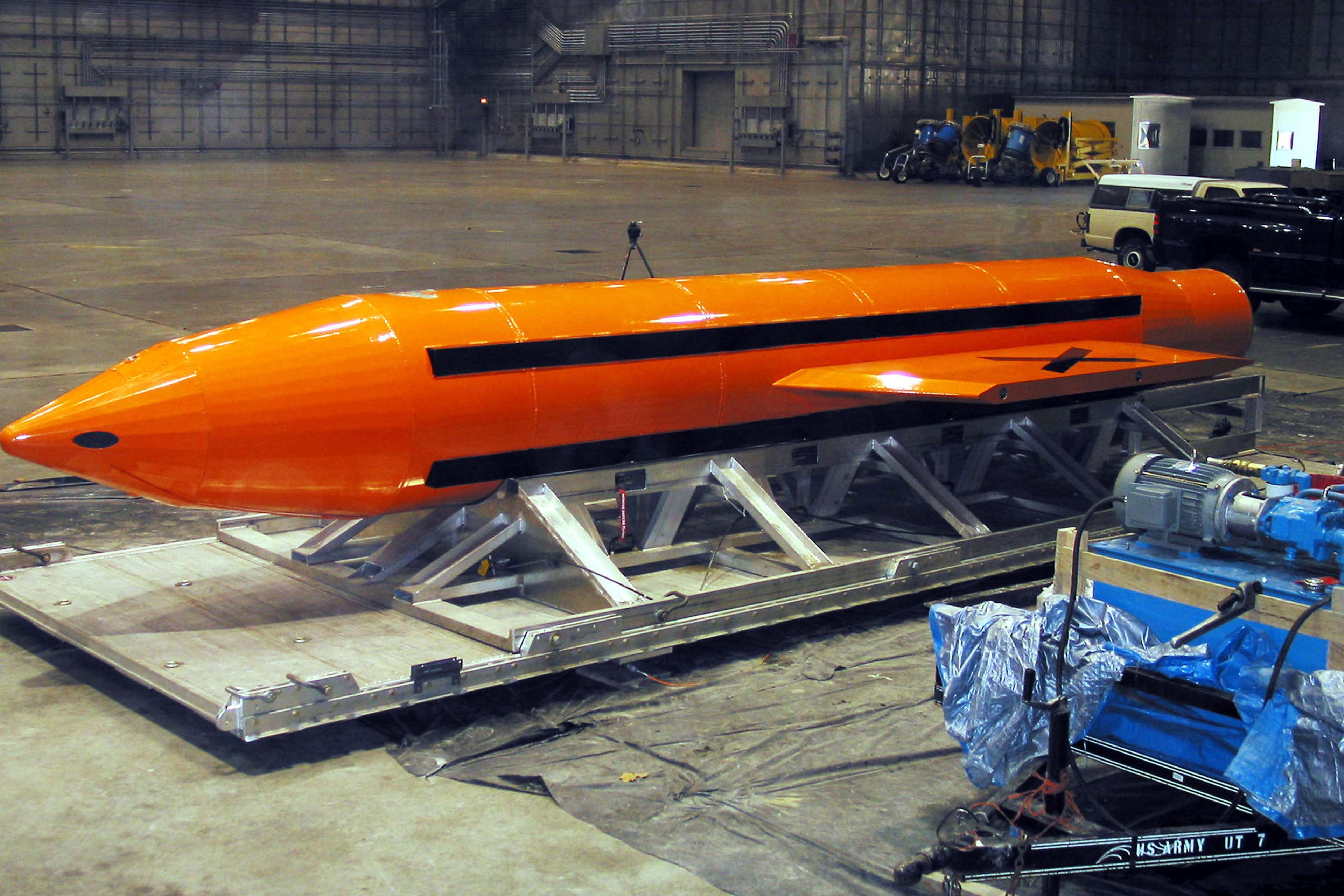
President Donald Trump has explicitly ruled out using nuclear weapons against Iran, telling Newsmax, “No, I wouldn’t use nuclear. We don’t have to.” His remarks came as U.S. military planners reportedly developed contingency options involving the GBU-43/B Massive Ordnance Air Blast bomb, known as the “Mother of All Bombs,” for possible future strikes if Trump orders renewed operations. Reports say potential targets could include Iranian energy, military and nuclear infrastructure, but no strike has been authorized publicly and some details remain based on unnamed officials familiar with classified planning.
President Donald Trump has ruled out using nuclear weapons against Iran while leaving open the possibility of further conventional military strikes, as reports indicate that U.S. military planners have prepared contingency options that could include deploying the GBU-43/B Massive Ordnance Air Blast bomb, widely known as the “Mother of All Bombs,” against Iranian targets if the President orders a new phase of combat operations.
Speaking in an interview with Newsmax on Thursday, Trump was asked directly whether he would consider using nuclear weapons against Iran as Washington evaluates its military options. He rejected the possibility, saying the United States did not need to cross the nuclear threshold and emphasizing that the MOAB being discussed in reports is a conventional weapon despite its extraordinary destructive power. “No, I wouldn’t use nuclear. We don’t have to,” Trump said, while describing the massive conventional bomb as an option fundamentally different from a nuclear weapon.
Trump’s comments came after reports that the Pentagon has developed new strike plans involving some of the most powerful conventional weapons available to the U.S. military. CNN, citing multiple American officials familiar with the discussions, reported that military planners are considering potential use of the GBU-43/B in future operations against Iranian energy infrastructure and nuclear facilities if Trump authorizes renewed combat. Reuters subsequently reported the claims but said it could not independently verify CNN’s account, making it important to distinguish the existence of reported contingency planning from a presidential decision to carry out an attack.
CBS News separately reported that the White House and Pentagon have prepared plans that could involve the MOAB against Iranian military targets if ordered by Trump. A Pentagon official told the network that the Department of Defense routinely prepares for a wide range of operational scenarios so it can execute presidential and defense leadership directives if required. That explanation reflects standard military planning practice, under which commanders develop multiple options for political leaders even when there has been no final decision to use them.
The distinction is significant because the preparation of a military option does not mean an attack is imminent. U.S. defense officials routinely prepare contingencies involving different weapons, targets and levels of force, allowing the President to choose among them if the security situation changes. The reported MOAB option therefore represents one possible course of action within a broader military planning process rather than confirmation that the weapon will be used against Iran.
The GBU-43/B is among the most powerful conventional bombs ever developed by the United States. It was designed to produce an enormous blast over a wide area and weighs more than 20,000 pounds. The weapon is delivered from a cargo aircraft rather than a conventional fighter jet and is guided toward its target after being released. Its destructive effect comes primarily from a massive blast wave rather than the radioactive or thermal mechanisms associated with nuclear weapons.
The United States has used the MOAB in combat only once. In April 2017, during Trump’s first presidency, the U.S. military dropped one on an Islamic State tunnel complex in Afghanistan’s Nangarhar province. The strike drew global attention because of the weapon’s size and destructive power, but it remained a conventional military operation rather than a nuclear attack.
Its possible use against Iran would nevertheless represent a major escalation because the strategic environment is very different from the remote Afghan battlefield where it was previously deployed. Iran possesses significant missile, drone and military capabilities and has demonstrated an ability to strike U.S. interests and regional infrastructure. Any major American attack on Iranian nuclear, energy or military facilities could therefore generate retaliation across the Middle East.
Military specialists have also questioned whether the MOAB is ideally suited for some of the deeply buried facilities that appear in discussions about Iran’s nuclear program. The bomb produces an enormous surface and near-surface blast, but it was not primarily designed as a deep earth penetrator capable of reaching heavily fortified installations built far beneath mountains. That has led some analysts to question whether its use against certain underground Iranian nuclear complexes would produce the strategic effect policymakers might expect.
One facility receiving particular attention is a suspected underground complex commonly referred to in recent reporting as Pickaxe Mountain. Iranian nuclear infrastructure has increasingly been moved underground or protected by significant layers of rock and reinforced construction, making conventional targeting more difficult. U.S. military planners have therefore considered different combinations of weapons depending on the depth, design and location of specific facilities.
The United States possesses specialized bunker-busting munitions designed for deeply buried targets, but the MOAB operates differently. Its primary purpose is to create an exceptionally large blast and pressure effect across an area, which could make it useful against certain surface installations, entrances, supporting facilities or concentrations of military infrastructure even if its ability to destroy deeply buried nuclear sites remains uncertain.
That uncertainty appears to be part of the internal debate surrounding the reported planning. Officials familiar with the discussions have raised questions about whether using such a large conventional weapon would materially advance the United States’ stated strategic objectives or instead produce a highly visible escalation without eliminating Iran’s nuclear capabilities. The Pentagon has not publicly detailed its target analysis or confirmed which locations would be included in any possible operation.
Trump himself did not publicly confirm that he had approved the MOAB option. Instead, he emphasized during his interview that the weapon is non-nuclear and reiterated that he sees no need to use America’s nuclear arsenal against Iran. He also indicated that he does not currently foresee the deployment of large numbers of U.S. ground forces into Iran, another potential escalation that has generated concern as tensions remain high.
The President’s decision to explicitly rule out nuclear weapons is significant because nuclear escalation has remained one of the most sensitive questions surrounding confrontation with Iran. Washington maintains the world’s second-largest nuclear arsenal by total stockpile, while Iran continues to insist that its nuclear program is intended for peaceful purposes. Western governments and Israel have long expressed concern that Tehran could eventually develop a nuclear weapon if its enrichment capabilities are not constrained.
Trump has repeatedly said that Iran must not obtain a nuclear weapon, and his administration has been willing to use military force against nuclear infrastructure. At the same time, his latest remarks indicate that he does not consider nuclear weapons necessary for achieving U.S. objectives, even if Washington decides additional strikes are required.
The reported conventional strike options emerge against the backdrop of months of U.S.-Iran conflict and increasingly complicated diplomacy. Fighting that began earlier in 2026 has damaged military and energy infrastructure across the region, disrupted shipping and increased pressure on global oil and gas markets. Iran and affiliated forces have demonstrated the ability to strike strategic facilities throughout the Gulf, while U.S. and Israeli operations have targeted Iranian military capabilities and nuclear-related infrastructure.
The economic dimension has become increasingly important. Energy installations in Iran and across the Gulf form part of one of the world’s most strategically important oil and gas systems, meaning attacks on those facilities can rapidly affect global markets. A significant strike on Iranian energy infrastructure could reduce Tehran’s revenue and military capacity but could also drive oil prices higher or provoke retaliation against neighboring producers and shipping routes.
Iran has previously warned that major attacks on its territory could lead to broader retaliation against U.S. military positions and regional infrastructure. Tehran has extensive missile and drone capabilities and maintains relationships with armed groups across the Middle East, creating multiple potential avenues for response. That makes any decision to expand the target list beyond military facilities especially consequential.
U.S. officials therefore face a strategic calculation extending well beyond the physical destruction a single weapon could produce. Military planners must assess whether striking a particular installation would meaningfully weaken Iran’s capabilities, how Tehran might respond, what risks would be created for American forces and allies, and whether escalation could be controlled afterward.
Those questions are particularly important when discussing nuclear facilities. Destroying buildings or entrances does not necessarily eliminate scientific expertise, nuclear materials or the ability to rebuild. Military action can delay a nuclear program, but analysts have long debated whether strikes alone can permanently remove the technical knowledge required to reconstruct it.
Iran’s own preparations have also evolved. Recent satellite imagery and reporting indicate that Tehran has strengthened defenses around several strategic and nuclear sites while preparing for the possibility of additional U.S. or Israeli attacks. Underground facilities, hardened entrances and dispersal of equipment are among the measures that can complicate targeting and make it difficult for outside observers to assess the full impact of an attack.
The reported MOAB option therefore appears to be part of a broader effort to give Trump additional conventional choices without crossing the nuclear threshold. It could provide commanders with a weapon capable of producing destruction considerably beyond ordinary aerial bombs while avoiding the unprecedented political, humanitarian and strategic consequences that would accompany nuclear use.
Trump’s language suggests he wants to maintain that distinction clearly. By repeatedly emphasizing that the “Mother of All Bombs” is not nuclear, the President sought to separate consideration of an exceptionally powerful conventional strike from speculation that Washington was contemplating nuclear warfare. His statement that the United States does not need nuclear weapons against Iran is one of his clearest public declarations on the subject during the current confrontation.
The remarks do not, however, amount to a broader commitment to end military operations against Iran. Trump left open the possibility of additional conventional strikes, particularly if his administration concludes that Iranian nuclear or military capabilities continue to pose an unacceptable threat. The White House has therefore narrowed one part of the military debate while keeping several other options available.
That approach also allows Washington to maintain pressure in negotiations. Military contingency plans can serve both operational and diplomatic purposes by demonstrating that the United States has options available if talks fail. Iran, meanwhile, has sought to strengthen its defenses and signal that further attacks would produce significant consequences throughout the region.
The question of whether the MOAB would actually be effective against Iran’s most fortified nuclear facilities remains unresolved. Analysts cited in international reporting have warned that the bomb’s enormous blast does not automatically make it the ideal weapon for a deeply buried target. The United States would need detailed intelligence on geology, facility depth, ventilation systems, access points and structural design before determining what type of munition would be most effective.
There is also the question of civilian risk. Iranian energy and nuclear infrastructure can be located near populated areas, industrial workers or civilian facilities. The blast radius associated with a weapon as powerful as the MOAB means target selection and timing would carry significant humanitarian considerations. U.S. commanders would be required under the laws of armed conflict to assess expected civilian harm against the anticipated military advantage of any strike.
Energy targets create additional environmental risks. Damage to oil facilities, pipelines or industrial complexes can produce fires, toxic releases and long-term contamination extending beyond the immediate military target. Those effects could also disrupt electricity, fuel supplies and other services used by civilians.
For those reasons, reported planning does not establish that the MOAB is the preferred or likely option. It demonstrates that military planners are examining what the United States could do if Trump orders an escalation, while political leaders weigh the consequences of each scenario.
The Pentagon’s public response has remained deliberately broad. Rather than confirming specific targets or weapons, defense officials have emphasized that military planning for multiple contingencies is routine. That position allows the administration to preserve operational security while avoiding a public commitment to an attack that may never occur.
Reuters’ inability to independently verify the CNN reporting is also important. Multiple outlets have now reported versions of the planning, and CBS has independently described preparations involving the MOAB, but detailed target lists remain based primarily on unnamed officials familiar with classified discussions. The existence of contingency planning is credible, while the exact scope and likelihood of individual strike options remain less certain.
Trump’s statement on nuclear weapons, by contrast, is direct and public. He has now explicitly said he would not use them against Iran under the circumstances being discussed. That does not remove the possibility of significant conventional escalation, but it establishes a public limit on one of the most consequential military options available to a U.S. president.
The difference between nuclear and conventional weapons is therefore central to understanding the current debate. The MOAB may produce an enormous explosion and has acquired a dramatic nickname, but it does not create a nuclear chain reaction, nuclear fallout or the strategic precedent associated with the first wartime use of a nuclear weapon since 1945.
Its deployment against Iran would still carry major political and military consequences. A strike using the weapon against a nuclear or energy facility would likely be viewed internationally as a significant escalation and could prompt Iranian retaliation, additional regional instability and renewed diplomatic pressure for a ceasefire or negotiated settlement.
The administration must also consider how any escalation would affect U.S. forces stationed throughout the Middle East. American personnel operate at bases and facilities across several Gulf states, Iraq and elsewhere in the region, some of them within range of Iranian missiles and drones. Increased hostilities could expose those forces to retaliatory attacks and require additional air defenses and force protection measures.
Regional governments would face similar concerns. Saudi Arabia, the United Arab Emirates, Qatar, Bahrain, Kuwait and other Gulf states host critical energy infrastructure and maintain different forms of security cooperation with the United States. Many have strong incentives to prevent a wider conflict that could damage oil facilities, airports, desalination plants and other essential infrastructure.
The strategic consequences therefore extend far beyond Iran and the United States. Any major strike could affect global energy markets, shipping through the Strait of Hormuz, commercial aviation and the broader security environment across the Gulf.
Trump’s decision to publicly rule out nuclear weapons reduces one extreme uncertainty but does not resolve the underlying confrontation. Washington continues to consider conventional military options, Iran continues strengthening its defenses, and diplomatic efforts have yet to produce a durable settlement capable of ending the cycle of threats and military action.
The next significant development will be whether the White House moves from contingency planning to an actual strike order. Until that happens, reports involving the MOAB should be understood as evidence of military preparation rather than confirmation of an impending attack. The President alone would have to authorize a major escalation of the kind being discussed, and Trump has not publicly announced such a decision.
For now, the clearest position from Washington is that nuclear weapons are off the table while powerful conventional options remain under consideration. The military has reportedly prepared scenarios involving the GBU-43/B and other weapons, but questions about effectiveness, civilian risk, Iranian retaliation and broader strategic consequences continue to surround any renewed attack.
Trump’s statement has therefore narrowed the range of possibilities without ending the threat of escalation. His administration is signaling that it believes it can pursue its objectives against Iran without nuclear weapons, while maintaining enough conventional military capability to strike again if diplomacy fails or the President decides further action is necessary. Whether those contingency plans remain on paper or become another phase of the conflict will depend on decisions in Washington and developments in Tehran in the days and weeks ahead.