ANTI-GALAMSEY TASKFORCE DESTROYS VEHICLES, MOTORBIKES AND STRUCTURES AT WASSA ESAMAN AS 20 SUSPECTS ARE ARRESTED IN FOREST RESERVE CRACKDOWN
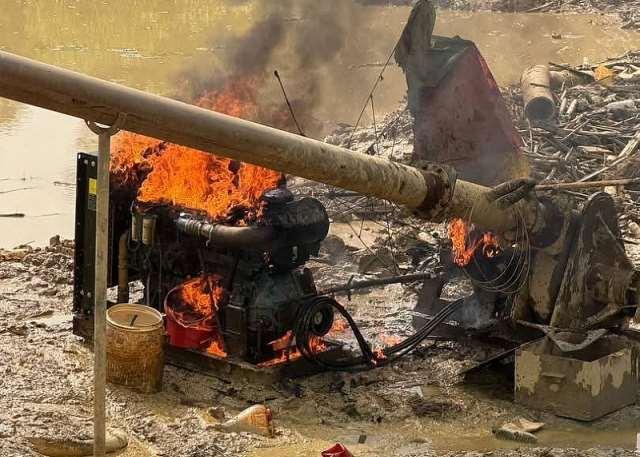
An anti-galamsey operation at Wassa Esaman in the Mpohor Wassa East District of the Western Region has resulted in the arrest of 20 suspected illegal miners and the destruction or immobilization of vehicles, motorcycles, changfang machines, pumps and temporary structures inside the Subri Forest Reserve. Forestry Commission officials say illegal mining has seriously affected seven of the Western Region’s 19 forest reserves, while 159 people have been arrested in forest-related galamsey operations this year and 36 cases are currently before the courts.
An anti-galamsey operation at Wassa Esaman in the Mpohor Wassa East District of the Western Region has led to the destruction or immobilisation of vehicles, motorcycles, mining machines and makeshift structures allegedly being used to support illegal mining inside the Subri Forest Reserve. The operation, carried out over the weekend as part of intensified enforcement against illegal mining in protected forest areas, resulted in the arrest of 20 people suspected of taking part in galamsey activities. Forestry Commission officials said scores of vehicles, including SUVs, trucks and saloon cars, were found at the site together with motorbikes, rickshaws, generators, pumping machines and changfang equipment, some of which were burnt while others were rendered unusable to prevent their immediate return to mining activity.
The raid forms part of a wider campaign by the Forestry Commission and national anti-illegal mining enforcement structures to reclaim forest reserves that have been heavily damaged by illegal mining. Government has in recent months relied on a combination of Forestry Commission rapid response teams, the National Anti-Illegal Mining Operations Secretariat, military personnel, intelligence officers and other security agencies to conduct operations in areas where illegal miners have established camps, dug pits, diverted watercourses or placed heavy machinery inside protected forests. The Wassa Esaman operation fits into that broader strategy of making it more difficult for illegal miners to quickly return after a raid by destroying equipment, removing logistical support and keeping pressure on sites that have previously been cleared.
The Subri Forest Reserve has become one of the areas where illegal mining activity has created significant concern for forestry authorities in the Western Region. According to the Forestry Commission, illegal mining is now the most serious threat facing several forest reserves in the region, with seven out of 19 reserves already seriously affected by galamsey and related environmental destruction. At Wassa Esaman, officers said they discovered not only machines directly involved in mining but also a much wider support system, including vehicles used to transport people and supplies, motorcycles, generators, pumping equipment and temporary structures that allowed miners to remain on site for extended periods.
Western Regional Manager of the Forestry Commission Nana Poku Bosompem said the latest Wassa Esaman operation resulted in 20 arrests while machines being used for illegal mining were immobilised or burnt. He also provided wider figures from enforcement work carried out between January and September 2026, saying 159 people had been arrested for illegal mining in forest reserves, with 36 separate cases before the courts. Across seven forest reserves, three excavators had been immobilised and 1,103 changfang dredging machines had been completely burnt, causing what the Commission estimated to be about GH¢28 million in losses to illegal mining operators.
The scale of equipment destroyed across the region illustrates the industrial nature of much of the illegal mining taking place inside protected forests. Forestry officials said 1,420 pumping machines and 387 temporary structures had also been destroyed in separate enforcement operations, showing that many of the mining sites are not temporary gatherings of a few individuals but organised operations with machinery, shelter, transport and water-management systems. The presence of SUVs, trucks and saloon cars at Wassa Esaman suggests that some of the operators had established a substantial logistical network around the mining site, allowing workers, fuel, equipment and other supplies to move in and out of the reserve.
The destruction or immobilisation of vehicles and machines has become a central part of Ghana’s current anti-galamsey strategy because enforcement teams say simply removing miners from a site is often not enough. In many areas, operators have returned shortly after security personnel leave, repaired abandoned equipment or brought in new machines and resumed mining. NAIMOS recently reported similar behaviour along the Pra River, where miners returned after an earlier raid and installed new changfang machines to replace equipment destroyed by enforcement teams. That pattern has convinced government that sustained pressure and repeated visits are necessary if illegal miners are to be prevented from quickly reoccupying cleared areas.
President John Dramani Mahama has also acknowledged this problem, saying illegal miners had previously returned to forest reserves after troops withdrew and responsibility was handed back to forest guards. He recently announced that soldiers would remain stationed in nine forest reserves previously designated as red zones because of severe destruction and the presence of heavily armed illegal miners. According to the President, those reserves have now been cleared, but troops will stay in place to prevent renewed incursions while reclamation and reforestation work begins.
The Wassa Esaman raid therefore sits within a broader transition from occasional anti-galamsey swoops to a model of sustained enforcement. Government has increasingly argued that one-off raids allow illegal miners to wait until security personnel leave before returning to damaged sites, particularly where gold deposits remain accessible. Permanent or semi-permanent deployments are intended to make that cycle more difficult by maintaining a security presence after the initial clearance.
NAIMOS itself was established as a central coordinating body for anti-illegal mining operations and brings together institutions connected to the Ministries of Defence, Interior and Lands and Natural Resources as well as the National Security architecture. The secretariat was created to improve coordination after years of criticism that separate agencies sometimes conducted overlapping or poorly coordinated operations against galamsey. Government has said that all major anti-illegal mining operations should now be coordinated through the national structure so that intelligence, security deployments and follow-up investigations can be better managed.
Although the latest confirmed reporting from Wassa Esaman specifically details a Forestry Commission operation, the broader enforcement campaign in the Western Region is being conducted alongside NAIMOS and other national anti-galamsey structures. This distinction is important because not every operation involving illegal mining in the area is carried out by the same team, even though the agencies share the same objective of protecting forest reserves and water bodies. The Wassa Esaman action should therefore be described accurately as part of Ghana’s coordinated anti-galamsey enforcement effort rather than assuming that every officer at the site belonged to a single taskforce.
The Western Region remains one of the most difficult areas for anti-galamsey enforcement because of the number of forest reserves, gold-bearing communities and established mining routes. The region has long contributed significantly to Ghana’s gold production, but the same geological resources have attracted illegal operators who enter forests and farmlands without the required permits or environmental controls. In many cases, mining activity strips vegetation, destroys topsoil, creates large open pits and leaves water bodies heavily polluted by sediment and chemicals.
Forestry officials say illegal mining now represents a greater threat to forest reserves in the region than illegal logging and other forms of encroachment. Once miners move into a protected area with excavators, pumping machines and changfang equipment, environmental damage can happen very quickly because large volumes of soil and water are disturbed. Roads, streams and vegetation can be destroyed in a matter of days, while restoring the land may take years and require significant public expenditure.
The destruction of temporary structures during raids is intended to make it more difficult for miners to remain inside protected areas. Makeshift camps often function as living quarters, storage points and operational bases, allowing workers to stay close to the mining pits and operate for long periods without returning to nearby towns. Removing those structures therefore targets the support system that keeps illegal mining sites functioning rather than focusing only on the machinery directly extracting gold.
Vehicles are equally important to that support network. Trucks may transport fuel, equipment or excavator parts, while smaller vehicles and motorbikes can move workers, food and supplies through forest tracks that are difficult for conventional security vehicles to access. Immobilising or destroying vehicles found at an illegal mining site can therefore disrupt operations beyond the immediate loss of mining machinery.
The strategy is controversial because the burning of equipment and vehicles can raise legal and due process questions, particularly when ownership has not yet been established in court. Enforcement agencies argue that many machines are found actively operating inside protected forest reserves and that leaving them intact creates a high risk that they will be moved or reused before formal proceedings are completed. Critics have nevertheless called for stronger documentation, transparent inventories and clearer accountability over seized or destroyed assets to ensure that enforcement powers are not abused.
The government has responded to some of those concerns by emphasising intelligence-led operations and by calling for suspects and seized items to be properly handed over for investigation and prosecution. The Lands and Natural Resources Ministry has repeatedly said that people arrested in illegal mining operations should face the law regardless of their status or political connections. In September, the Ministry said prosecutions arising from NAIMOS operations were being handled through the Attorney-General’s office and insisted that suspects would not be allowed to escape legal consequences simply because of influence or connections.
Prosecution, however, remains one of the biggest weaknesses in Ghana’s anti-galamsey campaign. Lands and Natural Resources Minister Emmanuel Armah-Kofi Buah acknowledged in August that arrests were occurring in large numbers but that successful prosecutions remained difficult. He said the government had arrested hundreds of suspects and seized large quantities of equipment, but delays in moving cases through the justice system were limiting the deterrent effect of enforcement.
The same concern has been raised by the Forestry Commission in the Western Region. Nana Poku Bosompem said 36 separate galamsey cases were pending before the circuit courts in Takoradi while other arrests remained under police investigation. He expressed frustration about delays in securing convictions and what he described as insufficient urgency in moving some cases forward after arrests had been made.
That gap between enforcement and prosecution matters because destroying equipment alone may not dismantle the financial networks behind illegal mining. Operators can replace machines if the financiers who fund the activity remain untouched, while arrested workers may be replaced by others if organisers face little legal or financial consequence. NAIMOS has therefore announced plans to increasingly target financiers, facilitators and equipment suppliers rather than focusing only on people physically working at mining pits.
This shift is part of Operation Water Shield, a national enforcement campaign aimed at protecting rivers, watersheds and other critical water resources. NAIMOS has said the campaign will target the criminal and financial structures that allow illegal mining to continue, including those who supply machinery, fuel and financing. The strategy recognises that galamsey often operates as a business network involving investors, equipment owners, land access, transporters and buyers rather than a collection of isolated miners acting independently.
The Wassa Esaman operation provides a practical example of why that wider approach is necessary. The number of vehicles, machines and temporary structures discovered suggests significant capital had been invested in maintaining the site. Even if miners are arrested and equipment destroyed, investigators may still need to determine who financed the machinery, who owns the vehicles, who provided access to the land and where the gold produced at the site was being sold.
Following the money could therefore become as important as destroying machines. Financial investigations can help identify people who remain far from mining sites but benefit from the proceeds or provide the resources necessary to keep operations running. Government has increasingly said that such individuals should be treated as central targets of anti-galamsey enforcement rather than allowing responsibility to fall only on labourers found at the pits.
Forest reserve enforcement has also become more dangerous because some illegal mining groups employ armed guards or so-called macho men to block Forestry Commission personnel from entering affected areas. Nana Poku Bosompem said this remains one of the significant concerns facing forest officers in the Western Region, where enforcement teams have sometimes encountered people prepared to resist operations physically.
Earlier this year, a Forestry Commission rapid response operation in the Subri River Forest Reserve resulted in the arrest of four heavily armed men who were allegedly providing security for illegal miners. Officers recovered four pump-action guns and immobilised an excavator after reinforcements were called to confront the group. The incident demonstrated that some galamsey sites have developed security structures capable of challenging ordinary forest guards.
President Mahama has similarly said forest guards were previously fired upon in some red-zone reserves, with some personnel losing their lives. His decision to keep soldiers stationed in cleared reserves reflects the government’s assessment that Forestry Commission officers alone may not be able to hold certain areas where miners have previously used firearms or organised resistance.
The growing use of weapons has transformed galamsey from an environmental and regulatory problem into a wider security issue. Illegal mining networks that can finance heavy machinery and armed protection are more difficult to confront than small groups using basic tools, and the presence of weapons increases the likelihood that raids will result in violent confrontations.
Government says nearly 200 firearms have now been recovered during anti-galamsey operations nationwide, alongside more than 8,200 items of mining equipment and related materials. President Mahama said 135 excavators had been confiscated as part of the crackdown, giving an indication of the scale of machinery deployed in illegal operations around the country.
Those figures also help explain why authorities are focusing heavily on forest reserves. Excavators and changfang machines can cause extensive environmental damage quickly, particularly when used close to rivers or inside protected ecosystems. Once large pits are dug and vegetation removed, restoring the area becomes expensive and technically difficult.
Government has therefore begun linking enforcement more closely with reclamation. President Mahama recently said GoldBod was working with the military and Forestry Commission on programmes to level degraded land and replant economic trees in areas cleared of illegal miners. The aim is to ensure that enforcement does not simply remove operators while leaving behind destroyed landscapes that can easily be reoccupied.
Reclamation will be particularly important in areas like Wassa Esaman because the environmental damage extends beyond the immediate mining pits. Roads can become impassable, streams can be diverted or polluted and nearby farms can lose productive land. Communities may therefore continue suffering long after miners leave unless damaged areas are actively restored.
The Forestry Commission’s regional figures show the size of that task. With seven of the Western Region’s 19 forest reserves already seriously affected by illegal mining, reclamation could require years of work and substantial public funding. Restoring vegetation is only one part of the process because unstable pits, contaminated water and compacted soil can make natural regeneration difficult.
The broader challenge for government is therefore to prevent new destruction while repairing areas already damaged. That requires enforcement, prosecution, monitoring and economic alternatives for communities that have become dependent on illegal mining income.
President Mahama has acknowledged that enforcement alone will not solve the problem. He has called on traditional leaders to support anti-galamsey operations while also arguing that alternative livelihood opportunities are needed for young people who enter illegal mining because they lack other sources of income. He recently said enforcement teams had encountered even secondary school students working at mining sites because of financial hardship, illustrating the social dimension of the crisis.
Traditional authorities are particularly important because chiefs and community leaders often have influence over land access and local attitudes toward mining. Government says cooperation from chiefs can help reduce confrontations between enforcement teams and residents, especially in areas where communities resist raids because mining provides employment.
Mahama has also warned that such confrontations can become deadly. He said there had been incidents in which soldiers discharged firearms during enforcement operations, resulting in fatalities, and argued that stronger community cooperation could reduce the likelihood of similar clashes.
The Wassa Esaman operation demonstrates how difficult that balance can be. Authorities want to act decisively enough to prevent miners from returning, but sustained enforcement must also avoid creating unnecessary conflict with surrounding communities. Arrests and destruction of equipment may disrupt one site, but long-term success depends on whether local residents support the continued exclusion of illegal miners after security teams leave.
This is one reason government has moved toward keeping personnel in some cleared forest reserves. A continuing presence can prevent immediate reoccupation and give reclamation teams time to begin restoration, but it also requires manpower, funding and cooperation from nearby communities.
The Western Region’s importance to Ghana’s mining industry means enforcement cannot simply shut down all forms of mineral extraction. Legal mining remains a major source of employment, exports and government revenue, and the challenge is separating lawful operations from those destroying protected forests and water bodies without permits.
Lands Minister Armah-Kofi Buah has argued that responsible mining should allow communities to benefit from mineral wealth without forcing them to bear the environmental costs. He recently said rivers and lands in mining communities should not be left destroyed while profits are extracted elsewhere, and he pointed to the government’s decision to revoke the legal framework that previously allowed mining in forest reserves as part of the administration’s environmental policy.
That policy change makes enforcement inside forest reserves especially important because government has now taken a clearer position that protected forests should not be opened to mining through discretionary approvals. The repeal of the previous regulatory framework was welcomed by environmental groups, although campaigners have warned that illegal encroachment will continue unless the Forestry Commission receives enough resources to protect the reserves effectively.
The Wassa Esaman raid therefore represents more than the destruction of a few machines or vehicles. It is part of a broader test of whether Ghana can enforce the legal protection of forest reserves after years in which illegal mining became deeply entrenched in several mining districts.
The 20 arrests could become an important measure of that effort if they lead to proper investigation and prosecution. Authorities have repeatedly said that successful convictions are necessary to create a real deterrent because equipment destruction alone does not necessarily stop financiers from returning with new machinery.
The outcome of those cases will therefore matter. If suspects are prosecuted quickly and networks behind the mining operation are identified, the Wassa Esaman raid could have a longer-lasting impact than a temporary shutdown. If cases stall and operators return after security teams leave, the operation could become another example of the cycle officials themselves say they are trying to break.
For the Forestry Commission, the immediate priority is keeping the Subri Forest Reserve free from renewed illegal mining while continuing to monitor other affected reserves across the Western Region. The large number of changfang machines, pumps and temporary structures already destroyed this year shows that the pressure remains intense and that operators continue to invest heavily despite repeated raids.
Government’s wider strategy is now increasingly focused on sustained occupation of cleared areas, intelligence-led targeting of financiers and equipment suppliers, stronger prosecution and reclamation of damaged land. The Wassa Esaman operation fits directly into that approach because officers did not simply disperse miners but also removed or destroyed the logistical equipment that would allow mining to restart quickly.
The raid also provides another reminder of how industrialised illegal mining has become in parts of Ghana. The presence of cars, trucks, motorcycles, generators, pumps, changfang machines and temporary camps inside a forest reserve indicates a level of organisation that goes far beyond individual miners working with basic tools. Tackling such operations requires the state to pursue the people financing and coordinating them as aggressively as it pursues workers found at the pits.
For communities around Wassa Esaman, the long-term significance of the operation will depend on what happens after the taskforce leaves. If the forest is protected, damaged land is reclaimed and alternative livelihoods become available, the operation could contribute to lasting environmental recovery. If illegal miners return with replacement machines, authorities may once again be forced to conduct another raid on the same ground.
That recurring challenge is why government has increasingly described the anti-galamsey campaign as a sustained national operation rather than a series of isolated swoops. Wassa Esaman is now one of the locations where that strategy is being tested, with 20 suspects arrested, scores of vehicles and machines immobilised or destroyed and the Subri Forest Reserve placed under renewed enforcement pressure as authorities attempt to stop illegal mining from becoming permanently entrenched inside one of the Western Region’s protected forest areas.