CUSTOMS SEIZES 560.4KG OF SUSPECTED CANNABIS WORTH GH¢11.2 MILLION AT TORVE AFTER DRIVER ABANDONS BLACK LEXUS AND FLEES
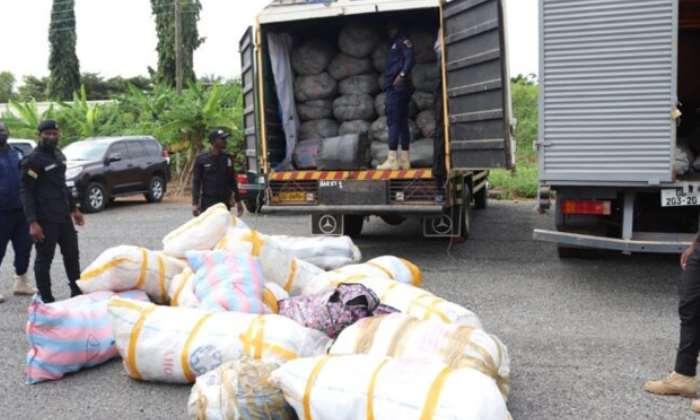
The Customs Division of the Ghana Revenue Authority has intercepted 560.4 kilogrammes of suspected cannabis at Torve near Akatsi in the Volta Region following an intelligence-led operation by the Aflao Sector Command. Officers recovered 1,065 compressed parcels from a black Lexus after the driver abandoned the vehicle and fled when it developed a mechanical fault. The suspected cannabis has an estimated street value of about GH¢11.2 million, while the vehicle was found with falsified registration plates and a Ghana Card that investigators are now seeking to verify. The seized substances and the Lexus have been handed over to NACOC for further investigation and laboratory confirmation.
The Customs Division of the Ghana Revenue Authority has intercepted 560.4 kilogrammes of suspected cannabis at Torve near Akatsi in the Volta Region after an intelligence-led operation involving officers from the Aflao Sector Command. The seizure was made at about 9:35 p.m. on Thursday, October 15, 2026, when officers from the Preventive Monitoring Unit moved on a suspicious black Lexus vehicle believed to be transporting illicit substances. According to the GRA, the driver attempted to evade the officers but abandoned the vehicle after it developed a mechanical fault, leaving Customs personnel to secure the car and carry out a search that uncovered more than half a tonne of compressed parcels suspected to contain cannabis.
Customs said officers recovered 1,065 compressed parcels from the Lexus, with the entire consignment weighing 560.4 kilogrammes and carrying an estimated street value of approximately GH¢11.2 million. The size of the haul places it among the more significant recent narcotics interceptions reported in the Volta Region, particularly because the operation involved a vehicle allegedly fitted with falsified registration plates and a driver who escaped before officers could make an arrest. The seizure adds to a wider pattern of intelligence-led interdictions by Ghanaian security agencies targeting the movement of suspected narcotics through border corridors and inland routes.
The incident occurred at Torve, a location near Akatsi that falls within the operational area of the Aflao Sector Command. GRA records identify Torve as one of the locations associated with Customs activity in the Aflao Collection area, reflecting the importance of the corridor for monitoring the movement of goods and vehicles between the eastern border zone and the rest of the country. The location is strategically relevant because the Aflao axis remains one of Ghana’s busiest land-border routes, and Customs maintains both formal border operations and preventive units intended to detect smuggling, contraband and other cross-border offences away from official entry points.
According to the GRA account, the operation began after Customs officers received intelligence about a black Lexus suspected of carrying prohibited substances. The Preventive Monitoring Unit subsequently tracked the vehicle and moved to intercept it, but the driver reportedly attempted to flee once he realised officers were closing in. Customs said the vehicle eventually developed a mechanical fault, forcing the driver to abandon it and escape on foot, meaning no arrest was made at the scene.
A subsequent search of the Lexus led officers to the 1,065 compressed parcels. The packaging and weight immediately raised suspicion that the material was cannabis, but the GRA continued to describe the substance as suspected cannabis pending full laboratory confirmation. That wording is important because the seized material has been examined by security and regulatory agencies, but formal laboratory testing remains part of the evidential process required before the substance can be treated conclusively in a criminal prosecution.
The vehicle itself has also become a significant part of the investigation. Customs said the Lexus was carrying falsified Ghanaian registration plates, complicating immediate efforts to determine its true ownership and trace the individuals responsible for moving the consignment. The use of false registration details is consistent with methods often associated with smuggling operations, where traffickers attempt to make vehicles harder to trace if they are intercepted or abandoned during an operation.
Officers also recovered a Ghana Card bearing the name Kunuhor Gidsway from inside the vehicle. The discovery gives investigators an additional lead, but authorities have not publicly established that the person named on the card was the driver or owner of the Lexus. Customs has therefore recommended that the identity be verified with the National Identification Authority as part of the investigation, rather than treating possession of the card as proof of criminal involvement.
The suspected narcotics were jointly examined by personnel from several state agencies, including the National Intelligence Bureau, Defence Intelligence, the Narcotics Control Commission, the Food and Drugs Authority and National Security. Their involvement reflects the multi-agency nature of narcotics enforcement in Ghana, where Customs may make an initial interception but specialised institutions are then brought in to authenticate, document, test and investigate the seized material.
Customs said the consignment was documented and secured for laboratory confirmation and evidential purposes before the suspected drugs and the vehicle were handed over to the Narcotics Control Commission for further investigation. NACOC is expected to take the lead in the criminal investigation into the suspected drug trafficking aspect of the case, while other agencies may continue supporting efforts to identify the driver, determine the ownership history of the vehicle and establish where the consignment originated and where it was intended to go.
The transfer to NACOC is an important stage because seizures of this scale often require much more than the simple recovery of the substances themselves. Investigators may need to examine fingerprints, vehicle records, telephone data, identification documents, financial links and intelligence information to reconstruct the network behind a consignment. In this case, the fact that the driver escaped and the Lexus carried falsified registration plates means authorities will likely rely heavily on forensic and intelligence work to move beyond the seizure and identify those responsible.
Customs has already recommended several follow-up steps, including tracing and apprehending the suspect who fled, verifying the Ghana Card recovered from the vehicle, conducting laboratory testing on the substances and strengthening intelligence networks to help prevent future trafficking attempts. These recommendations show that the current operation is being treated as the beginning of a wider investigation rather than a completed case.
The estimated GH¢11.2 million street value gives the seizure significant financial weight, although such estimates should be understood as indicative rather than exact. Street values can vary depending on location, packaging, purity, distribution level and the price assumptions used by enforcement agencies. What is not in dispute is the quantity recovered, which Customs placed at 560.4 kilogrammes spread across 1,065 compressed parcels.
The interception also highlights the role of the Customs Preventive Department, which is responsible not only for revenue protection but also for suppressing smuggling and other forms of illicit trade. GRA describes the department as part of Ghana’s first line of border defence and says its responsibilities include patrols, ambushes, snap checks, intelligence gathering, searches and joint operations targeting offences such as narcotics trafficking, arms smuggling, money laundering and terrorism-related activity.
The Aflao corridor is particularly important to that mission because it links Ghana to Togo and serves as one of the country’s major land-border routes. Formal trade, passenger traffic and transit cargo move through the area every day, but the same transport network can also be exploited by smugglers seeking to move prohibited goods through official or unofficial routes. Customs therefore operates both at recognised entry points and at inland checkpoints or monitoring locations intended to detect suspicious movements after vehicles have crossed or approached the border region.
Torve’s location near Akatsi makes it relevant to inland monitoring along the eastern corridor. GRA’s own operational records have historically listed Torve as an outpost associated with the Aflao Collection, while road transport records identify the Torve-Akatsi section as part of the broader coastal corridor linking Aflao with western Ghana. That makes the area strategically useful for intercepting suspicious vehicles that may be attempting to move contraband away from the border before blending into domestic traffic.
The latest seizure comes as Ghanaian authorities continue to face concerns about the country’s role as both a transit point and destination for illicit drugs. Ghana’s location on the Gulf of Guinea and its transport links with neighbouring countries make it vulnerable to various forms of trafficking, ranging from cannabis and pharmaceutical products to cocaine and other narcotics moving through maritime, air and land routes. The challenge for security agencies is not only preventing drugs from entering Ghana but also stopping locally produced or regionally sourced substances from being transported across borders.
Cannabis remains one of the most commonly intercepted illicit substances in West Africa because it is cultivated in parts of the region and can be transported relatively easily by road. Large consignments are frequently compressed into parcels or slabs to make them easier to conceal in vehicles and commercial shipments. The 1,065 parcels recovered from the Lexus are consistent with that trafficking pattern, although investigators still need to determine the specific origin and intended destination of the Torve consignment.
The fact that the driver abandoned the Lexus rather than remaining with the vehicle could indicate that the individuals behind the shipment prioritised avoiding arrest over preserving the cargo. Such behaviour is common in interdiction cases where suspects believe escape offers a better chance of avoiding prosecution than attempting to recover a seized vehicle or consignment. The abandoned vehicle then becomes a major source of evidence, particularly if investigators can identify ownership records, prior movements or links to other suspects.
The falsified registration plates may make that process more difficult but not impossible. Vehicle identification numbers, chassis records, import documentation and insurance information can sometimes be used to establish a vehicle’s true history even when number plates have been altered. Investigators may also examine road surveillance footage or checkpoint records to trace the Lexus’s movement before the interception.
The Ghana Card recovered inside the car creates another potential investigative route. Authorities will need to determine whether the card is genuine, whether it belongs to the person whose name appears on it and whether that individual has any connection to the Lexus or the suspected consignment. The presence of an identification card inside a vehicle does not by itself establish criminal responsibility, which is why Customs has appropriately recommended verification before drawing conclusions.
The involvement of the National Intelligence Bureau and Defence Intelligence suggests authorities are also considering the possibility that the seizure may form part of a wider trafficking network rather than a single isolated journey. Intelligence agencies can assist by examining patterns, communications and known trafficking routes that may not be visible from the physical evidence inside the vehicle alone.
NACOC’s role becomes particularly important after the handover because the commission is Ghana’s principal specialised agency for narcotics control. Its investigators can pursue criminal intelligence, coordinate laboratory testing and work with prosecutors if evidence supports charges against identified suspects. The agency can also collaborate with foreign counterparts if the investigation eventually reveals cross-border links.
The Food and Drugs Authority’s participation in examining the seized material also reflects the need for technical confirmation. Visual appearance may strongly suggest cannabis, but formal evidential processes require testing and documentation that can withstand scrutiny in court. The GRA has therefore continued to use the term suspected cannabis rather than declaring the material conclusively identified before laboratory confirmation.
That caution is important in responsible reporting. A seizure may look straightforward at the scene, but criminal cases depend on proving the nature of the substance, linking it to particular suspects and demonstrating knowledge or intent. The current public information confirms the recovery of 560.4 kilogrammes of suspected cannabis from an abandoned Lexus, but it does not yet establish who owned the drugs or whether the person named on the recovered Ghana Card was involved.
No arrest had been publicly announced in connection with the interception at the time of the latest reports. Customs specifically said the driver escaped after abandoning the Lexus, making the search for the suspect one of the main priorities of the follow-up investigation. Any future arrest would therefore represent a new development rather than something already established by the initial seizure.
The seizure also comes against the background of other narcotics interceptions involving Customs and NACOC. Ghanaian authorities have repeatedly announced joint operations targeting large consignments moving through ports, border points and inland transport corridors. These cases have reinforced official calls for stronger intelligence sharing because traffickers often exploit gaps between agencies or shift routes when enforcement increases in one area.
In October 2025, for example, Customs and NACOC intercepted 84 bags of dried leaves suspected to be cannabis concealed in a shipment at one of Ghana’s entry points. Officials cited that operation as part of ongoing efforts to disrupt illicit drug movements through inter-agency cooperation and intelligence gathering.
The Torve case demonstrates the same model of enforcement. Customs received intelligence, deployed officers from the Aflao Sector Command, intercepted the vehicle and then brought in additional agencies to authenticate and investigate the seized material. The operation did not end with the physical seizure because the larger objective is to identify and dismantle the network responsible for moving the drugs.
Emmanuel Reginald Duh, Sector Commander for the Aflao Collection, described the interception as a significant disruption to the illegal drug trade in the region and reaffirmed Customs’ commitment to protecting Ghana’s borders from contraband. His comments reflect the preventive role Customs increasingly emphasises alongside its traditional revenue-collection responsibilities.
The seizure could also have broader implications for security along Ghana’s eastern corridor because successful intelligence-led operations may prompt traffickers to alter routes or methods. Enforcement agencies therefore have to remain flexible, monitoring not only recognised checkpoints but also secondary roads and unapproved routes that can be used to bypass formal controls.
Trafficking networks typically adapt quickly to enforcement pressure. When a particular route becomes risky, smugglers may use different vehicles, travel at unusual hours, divide consignments into smaller loads or recruit drivers unfamiliar to security agencies. The fight against narcotics trafficking therefore depends on intelligence networks capable of identifying behaviour and connections rather than relying only on routine road checks.
The timing of the Torve interception at about 9:35 p.m. also illustrates how trafficking operations often attempt to exploit reduced visibility or lighter traffic. Night-time movement can make surveillance more difficult, although modern intelligence and monitoring tools allow security agencies to target vehicles regardless of the hour.
The driver’s decision to flee after the Lexus developed a mechanical fault may ultimately help investigators because the abandoned vehicle preserved the full consignment and any documents or forensic evidence inside it. Had the driver continued successfully, the suspected drugs might have reached another location and been divided into smaller quantities that would have been much harder to trace.
The interception prevented more than half a tonne of suspected cannabis from continuing along its intended route. Even without knowing the final destination, the size of the consignment suggests it was unlikely to have been intended for casual individual use and instead formed part of a commercial trafficking operation.
The economic value attached to the seizure reinforces that conclusion. A street estimate of approximately GH¢11.2 million indicates a consignment capable of generating substantial proceeds once distributed, creating a strong financial incentive for organised networks to continue attempting similar movements despite the risk of arrest.
Drug trafficking also intersects with other forms of organised crime because proceeds can be used to finance additional illegal activity, while trafficking networks may rely on document fraud, corruption, money laundering and weapons to protect their operations. This is one reason Customs describes narcotics interdiction as part of border and public security rather than simply a matter of enforcing import and export regulations.
The GRA’s Preventive Department is specifically mandated to combat external threats and cross-border crimes including narcotics trafficking, arms smuggling, terrorism-related activity and money laundering. Its officers can conduct searches, patrols, ambushes and joint operations with other security agencies, making units such as the Aflao Preventive Monitoring Unit central to enforcement away from ordinary customs clearance points.
The Torve seizure therefore demonstrates how Customs’ security responsibilities extend beyond collecting duties at border posts. Officers operating inland can use intelligence to intercept vehicles suspected of moving contraband even when the goods are not passing through a formal customs terminal at the moment of interception.
The operation also reinforces the importance of collaboration among agencies. Customs alone can intercept a vehicle, but successful prosecution may require narcotics investigators, intelligence officers, forensic specialists, regulators and prosecutors working together. Weak coordination can allow cases to collapse if evidence is not properly documented or suspects are not connected clearly to the seized substances.
By jointly examining the Torve consignment, the participating agencies appear to have attempted to preserve a common evidential record from an early stage. That can become important later if suspects challenge the chain of custody or dispute what was recovered from the vehicle.
Laboratory confirmation will be one of the next major steps. The GRA Customs Laboratory itself has capabilities for preliminary narcotics detection and other scientific testing, while specialised agencies can also carry out confirmatory analysis. Formal results would provide the evidential basis for describing the substance conclusively rather than as suspected cannabis.
Investigators will then need to connect the drugs to identifiable individuals. That may prove more difficult than establishing the substance itself because the driver escaped and the registration plates were false. The recovered Ghana Card, vehicle identification details and any surveillance or telecommunications evidence could therefore become central to the case.
Authorities may also investigate whether the Lexus had travelled the same route previously or whether it is linked to other interceptions. Organised trafficking operations often reuse vehicles, drivers or storage locations until one part of the network is exposed.
Financial investigations could become equally important if suspects are eventually identified. Large narcotics consignments usually require money for procurement, transport and distribution, creating financial trails that can help investigators identify organisers beyond the person physically driving the vehicle.
For residents of the Volta Region, the operation highlights the continuing security challenges associated with major transport corridors. Aflao and surrounding areas facilitate legitimate commerce with Togo and other West African markets, and that trade is economically important to communities on both sides of the border.
Security agencies therefore face the challenge of disrupting illegal movements without unnecessarily obstructing legitimate trade. Intelligence-led targeting can help strike that balance because officers focus on suspicious vehicles or individuals rather than treating every trader or traveller as a potential offender.
The Torve operation appears to fit that model. Customs said it acted on intelligence about a specific black Lexus rather than carrying out a random mass search. If the intelligence proves accurate through laboratory and investigative confirmation, the case will provide another example of how targeted enforcement can intercept significant contraband without shutting down ordinary movement.
The long-term measure of success, however, will be whether investigators can identify the network behind the vehicle. Seizing drugs prevents one consignment from reaching the market, but arrests and prosecutions are needed if authorities want to dismantle the organisation that financed and arranged the shipment.
The driver remains at large according to the latest confirmed information, and there is no public indication yet that Customs or NACOC has identified additional suspects. Authorities have therefore appropriately described tracing and apprehending the fleeing suspect as a priority.
Further developments may also clarify whether the suspected cannabis was being transported toward Aflao, away from the border or simply through the Akatsi area. The public statement identifies the location of the interception but does not disclose the intended destination.
That detail could become important in understanding whether the consignment was meant for domestic distribution, export or transit through Ghana. Until investigators establish that route, reporting should avoid assuming where the drugs were headed.
The seizure has nevertheless removed a substantial quantity of suspected narcotics from circulation and provided investigators with a vehicle and physical evidence that may help identify those involved. The GH¢11.2 million estimated street value gives the case obvious public interest, but the deeper significance lies in what investigators may learn from the abandoned Lexus and the documents recovered inside it.
The case now moves from interception to investigation. Customs has completed the initial seizure and transferred the suspected cannabis and vehicle to NACOC, while laboratory testing, identity verification and efforts to trace the fleeing driver are expected to continue.
If those steps lead to arrests, authorities may be able to determine whether the Torve operation was part of a larger trafficking network operating along Ghana’s eastern border corridor. If they do not, the seizure will still represent the removal of more than half a tonne of suspected cannabis from circulation but may leave the organisers behind the shipment unidentified.
For now, the confirmed facts are substantial enough. Customs officers from the Aflao Sector Command intercepted a black Lexus at Torve after receiving intelligence, the driver escaped when the vehicle developed a mechanical fault, officers recovered 1,065 compressed parcels weighing 560.4 kilogrammes, the consignment was valued at about GH¢11.2 million, several security agencies jointly examined the material and the drugs and vehicle were subsequently handed to NACOC for further investigation. The next stage will determine whether that successful interception can be converted into arrests, prosecutions and the wider disruption of the trafficking network behind the haul.