NYSC KIDNAP TRIAL: DRIVER IDENTIFIES DSS-ARRESTED SUSPECTS, SAYS GUNMAN MARCHED CORPS MEMBERS INTO BUSH
A bus driver who transported 20 prospective NYSC members abducted in Imo State on October 1 has identified five defendants standing trial as men he says participated in the attack. Testifying before the Imo State High Court in Mgbidi, he said the first defendant approached his bus carrying an AK-47 and later marched the prospective corps members into the bush. Another witness, Light Timothy, said he saw the first and second defendants carrying rifles and later identified them during a DSS identification parade. Justice Emeka Orafu admitted the testimonies and the driver’s identity card into evidence and adjourned proceedings to November 3–6. The defendants remain accused persons and have not been convicted.
A bus driver who was transporting 20 prospective National Youth Service Corps members when armed men intercepted their vehicle in Imo State on Independence Day has identified five defendants standing trial over the kidnapping as men he says participated in the attack, telling an Imo State High Court that the first defendant approached his vehicle carrying an AK-47 rifle before later marching the abducted passengers into a nearby bush. The testimony, delivered on Friday during the resumed trial before Justice Emeka Orafu at the High Court sitting in Mgbidi, has become one of the prosecution’s most significant pieces of eyewitness evidence so far in a case involving allegations of conspiracy, hostage-taking and unlawful possession of firearms. The five defendants were arrested by the Department of State Services following security operations after the October 1 abduction and remain accused persons entitled to the presumption of innocence until the charges against them are determined by the court.
The driver appeared as the third prosecution witness and told the court that he was able to recognise the men who allegedly attacked the bus, placing particular emphasis on the first defendant. According to his testimony, the first defendant was the armed man who initially approached the vehicle while holding an AK-47 rifle and later directed the prospective corps members away from the roadway and into the bush after they were taken hostage. The witness maintained his identification during cross-examination, giving prosecutors direct testimony from a person who says he was present when the passengers were forcibly removed from the vehicle. His evidence is expected to be closely scrutinised by defence lawyers because eyewitness identification can become a decisive issue in criminal trials where defendants dispute their presence or participation in an attack.
Another prosecution witness, Light Timothy, also testified that he saw the first and second defendants carrying what he described as AK-47 rifles shortly after the abduction along the Owerri-Mgbidi-Onitsha Expressway. Timothy told the court that he subsequently identified both men during an identification parade conducted at the Imo State office of the Department of State Services. During both examination-in-chief and cross-examination, he maintained that the men he identified were connected to the armed group involved in the incident. The prosecution is relying on those identifications to connect individual defendants to the kidnapping rather than merely establishing that an abduction occurred.
The court proceedings arise from the October 1 kidnapping of prospective corps members travelling from Ibadan, Oyo State, to National Youth Service Corps orientation camps in Abia and Akwa Ibom states. Reports from the case indicate that the victims were travelling in two 18-seater buses when gunmen intercepted them at about 6:30 a.m. near Umunoha in Mbaitoli Local Government Area along the Owerri-Onitsha corridor. The attackers allegedly forced passengers from the vehicles and moved them into surrounding bushland, setting off an intensive security operation involving the DSS, military and police.
Security agencies subsequently rescued some of the victims shortly after the attack, while the remaining abductees were recovered on October 7 during a joint operation around the Amakohia-Ubi forest area. The rescue ended the immediate hostage crisis, but intelligence operations continued as security personnel attempted to identify and apprehend the people responsible for the attack. Five suspects were later arrested in Rivers and Abia states between October 10 and 14, while security reports indicated that other suspected members of the group escaped during the operations.
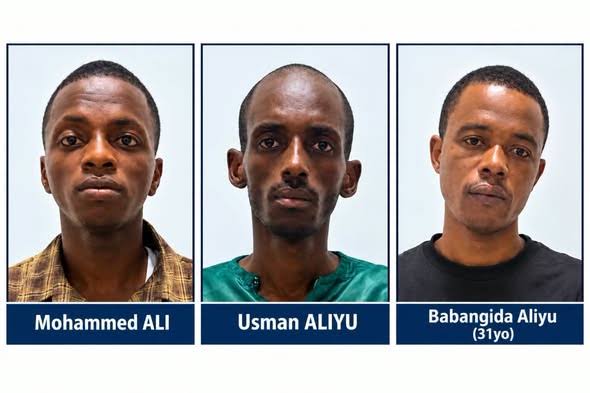
The five men now before the Imo State High Court have been identified in current court reporting as Mohammed Ali, Usman Aliyu, Babangida Aliyu, Ibrahim Jiji and Aminu Haliru. Prosecutors have alleged that three of them — Usman Aliyu, Babangida Aliyu and Mohammed Ali — were specifically involved in the kidnapping of the prospective corps members, while the wider proceedings also include allegations against other defendants relating to hostage-taking and firearms offences. The DSS has accused the defendants of involvement in offences under the Imo State Prohibition of Hostage Taking and Related Offences Law, but none of those allegations has yet resulted in a conviction.
Prosecutors have also alleged that the defendants were unlawfully in possession of three AK-47 rifles, four magazines, a pistol and 81 rounds of live ammunition. Those allegations are likely to form an important part of the evidentiary case as the trial progresses because the prosecution will need to connect any recovered weapons not simply to the defendants generally but, where relevant, to the offences charged. Defence counsel will have an opportunity to challenge the circumstances under which weapons were allegedly recovered, the chain of custody, forensic evidence and any statements relied upon by the prosecution.
Friday’s testimony focused heavily on visual identification. During cross-examination, defence counsel requested that the bus driver produce an identity card in an apparent effort to establish or test his own identity before the court. Justice Orafu examined the document and observed that the colour photograph on the card bore a strong resemblance to the witness. The court subsequently admitted the driver’s identity card and the testimonies of both prosecution witnesses into evidence, allowing prosecutors to rely on those materials as the trial continues.
The admission of evidence does not mean the court has accepted the prosecution’s case as proven. It means the material has been formally received for consideration alongside other evidence that will be presented by prosecutors and, ultimately, by the defence if the defendants choose to call witnesses or present other material. Justice Orafu will have to determine the reliability and weight to attach to eyewitness identification after hearing the complete case.
Eyewitness evidence can be particularly powerful in kidnapping prosecutions because witnesses may be able to identify people they encountered directly during the crime. It can also be contested where an incident was frightening, fast-moving or occurred under difficult visual conditions. Defence lawyers may examine how long a witness observed an attacker, the distance between them, lighting conditions, whether faces were covered, whether the witness had previously seen photographs of suspects and how identification procedures were conducted.
Timothy’s reference to a DSS identification parade is therefore likely to attract close legal attention. Identification parades are intended to test whether a witness can recognise a suspect independently rather than simply confirm a person already shown to them by investigators. The defence may seek details about how the parade was organised, how many people participated, whether the suspects stood alongside individuals of similar appearance and whether officers gave any information capable of influencing the witness.
The driver’s testimony concerning the first defendant may be equally important because he says his identification was based on a direct encounter beginning when the armed man approached his bus. If the court accepts that the witness had sufficient opportunity to observe the attacker and finds his testimony credible, the identification could significantly strengthen the prosecution case against that defendant. The defence, however, remains entitled to challenge his recollection and test whether the identification is reliable beyond reasonable doubt.
The October 1 abduction attracted national attention because the victims were prospective corps members travelling to begin compulsory national service. NYSC participants routinely travel across state lines to report to orientation camps, and the kidnapping once again drew attention to the risks young Nigerians can face while travelling on major inter-state highways. Families expecting their children to begin national service instead found themselves waiting for news from security agencies after gunmen forced the passengers into the bush.
The incident also renewed security concerns surrounding the Owerri-Onitsha corridor and parts of Imo State where kidnappings and armed attacks have periodically disrupted movement. Highway kidnappings can be particularly difficult to prevent because attackers may strike quickly at isolated points and retreat into forested terrain before security teams arrive. Victims can then be moved between camps or communities, making rescue operations dependent on intelligence, surveillance and information from local residents.
The eventual rescue of the prospective corps members demonstrated the importance of cooperation among the DSS, military and police, but the prosecution now faces a different challenge: proving in court that the men arrested after the operation were among those legally responsible for the kidnapping. Criminal investigations and criminal trials operate under different standards. Security agencies may arrest individuals based on intelligence or reasonable suspicion, but prosecutors must present admissible evidence capable of proving criminal responsibility to the standard required by law.
This is why Friday’s eyewitness evidence matters. The prosecution is moving beyond the fact of arrest and attempting to establish direct links between specific defendants and specific actions during the kidnapping. The driver’s claim that the first defendant approached the bus armed and later marched victims into the bush provides one such alleged connection. Timothy’s identification of the first and second defendants provides another.
The defence will have the opportunity to challenge those accounts and present its own version of events. The defendants remain presumed innocent, and the fact that they were arrested by the DSS or identified by witnesses does not determine the ultimate verdict. Justice Orafu must weigh the credibility of each witness, inconsistencies that emerge under cross-examination, physical evidence, investigative procedures and any defence evidence before reaching conclusions on guilt.
Court reporting is therefore required to use careful language. The defendants can accurately be described as suspects, accused persons or defendants, but not as convicted kidnappers. The witnesses have alleged that they recognised them from the attack, but those allegations remain part of the prosecution case until the court rules on them.
The names and specific allegations also need to be distinguished carefully because current reporting indicates that different defendants face different aspects of the wider prosecution. Three defendants are specifically accused in connection with the NYSC kidnapping, while two others have been linked in reporting to a separate October 4 kidnapping of four people around Owerri and Mgbidi in which prosecutors allege an ₦8 million ransom was collected. The cases appear to have been brought together for an accelerated series of hearings, but the prosecution must still establish each defendant’s alleged role individually.
Justice Orafu has already ordered an accelerated trial and directed that the defendants remain in DSS custody pending the conclusion of the proceedings. The judge adjourned the case at the end of Friday’s session to November 3, 4, 5 and 6, creating four consecutive dates for the continuation of evidence. That schedule suggests the court intends to move through the prosecution case quickly rather than allow lengthy intervals between witnesses.
Additional witnesses may provide evidence concerning the rescue operation, the arrest of the defendants, alleged weapons recoveries, identification procedures and statements obtained during investigation. Prosecutors may also rely on documentary or forensic evidence if available. Defence counsel will then have the opportunity to cross-examine each witness and challenge the prosecution’s theory.
The alleged weapons will likely require particularly careful evidentiary handling. Prosecutors would normally need to establish where the firearms were found, who recovered them, how they were secured and whether they can be connected to the defendants or to the original kidnapping. Where ammunition and magazines are part of the charge, investigators may also need to demonstrate that the items were functional or fell within categories prohibited without lawful authorisation.
The NYSC dimension of the case makes the proceedings especially significant for public confidence because national service depends heavily on young Nigerians travelling to states far from their homes. Families must trust that routes to orientation camps and places of primary assignment can be travelled with reasonable security. Each high-profile abduction risks increasing anxiety among prospective corps members and parents.
The government has repeatedly defended the NYSC programme as an important institution for national integration, but insecurity has complicated that mission. Corps members have previously been kidnapped while travelling or serving in different parts of the country, leading to repeated calls for improved route security, stronger coordination with transport operators and more flexible deployment policies in high-risk areas.
The October incident demonstrates the limits of relying solely on emergency rescue after an abduction has occurred. Preventive security requires intelligence on kidnapping networks, patrols around known hotspots and rapid information-sharing when armed groups are seen near major roads. Transport companies carrying prospective corps members also need clear security guidance when travelling through routes with recent kidnapping incidents.
For the victims themselves, the court case may reopen traumatic memories of their time in captivity. Hostage victims can be called to give evidence about armed attacks, forced movement and conditions in the bush, sometimes months after they have returned home. The justice system must balance the need for reliable testimony with the psychological welfare of people who have already experienced serious trauma.
Witness protection can also become important where defendants are alleged members of armed kidnapping groups. People who testify may fear retaliation from suspects still at large or from associates who have not been arrested. Security agencies therefore have a responsibility to protect witnesses while ensuring that protective measures do not interfere with the defendants’ rights to challenge evidence.
Current reporting indicates that more suspects connected to the kidnapping may remain at large. That means the prosecution of the five defendants does not necessarily represent the end of the investigation. Intelligence operations could continue alongside the trial, potentially producing additional arrests or evidence that affects existing charges.
The escape of suspects during earlier security operations also demonstrates why the kidnapping network may extend beyond the individuals currently before the court. Criminal groups involved in highway kidnapping often operate through several roles, including armed attackers, informants, guards, ransom negotiators and logistical supporters. Establishing who performed each role can require extensive investigation.
The prosecution’s theory will therefore need to show how the individual defendants fit into the larger alleged conspiracy. Under conspiracy charges, prosecutors can rely on evidence showing a common agreement or coordinated conduct, but they must still prove that each accused person intentionally participated in the criminal plan rather than merely knowing or associating with other suspects.
The hostage-taking charges similarly require proof of the defendants’ involvement in unlawfully seizing and detaining victims. The driver’s allegation that the first defendant personally marched the corps members into the bush directly addresses that element if the court ultimately accepts his identification.
Friday’s hearing represents an important stage precisely because the prosecution has now placed eyewitnesses before the court rather than relying only on investigative summaries. The defence has begun testing those witnesses under cross-examination, giving the judge the opportunity to observe their responses and assess credibility directly.
The driver’s identity card episode may seem unusual, but it reflects the adversarial nature of criminal proceedings. Defence counsel is entitled to test the identity and credibility of witnesses, while the court determines whether documentary materials should be received in evidence. Justice Orafu’s observation that the photograph resembled the witness established the immediate issue raised in court, and the card was subsequently admitted.
The case will now return on November 3, with proceedings scheduled to continue through November 6. Those hearings could provide further clarity on the alleged weapons, the identities of the defendants and how security agencies connected them to the Independence Day kidnapping.
Until then, the strongest established development is that two prosecution witnesses have given sworn evidence identifying defendants they say were connected to the attack. One of those witnesses, the bus driver who was present when the prospective corps members were abducted, says the first defendant approached his vehicle carrying an AK-47 and later took the group into the bush.
That allegation is serious, but it remains exactly that until the court completes the trial. The prosecution has begun placing its evidence before Justice Orafu, the defence is challenging it, and the five accused men remain entitled to a fair hearing.
For the 20 young Nigerians whose journey to NYSC orientation camps turned into a kidnapping ordeal, the trial now represents the next stage of a case that began with their rescue. Security agencies succeeded in bringing them out of captivity; the courts must now determine whether prosecutors have arrested and charged the people legally responsible for putting them there.