ELON MUSK’S SPACEX MOVES TO CHALLENGE AT&T, VERIZON AND T-MOBILE WITH NATIONWIDE STARLINK MOBILE SPECTRUM DEAL
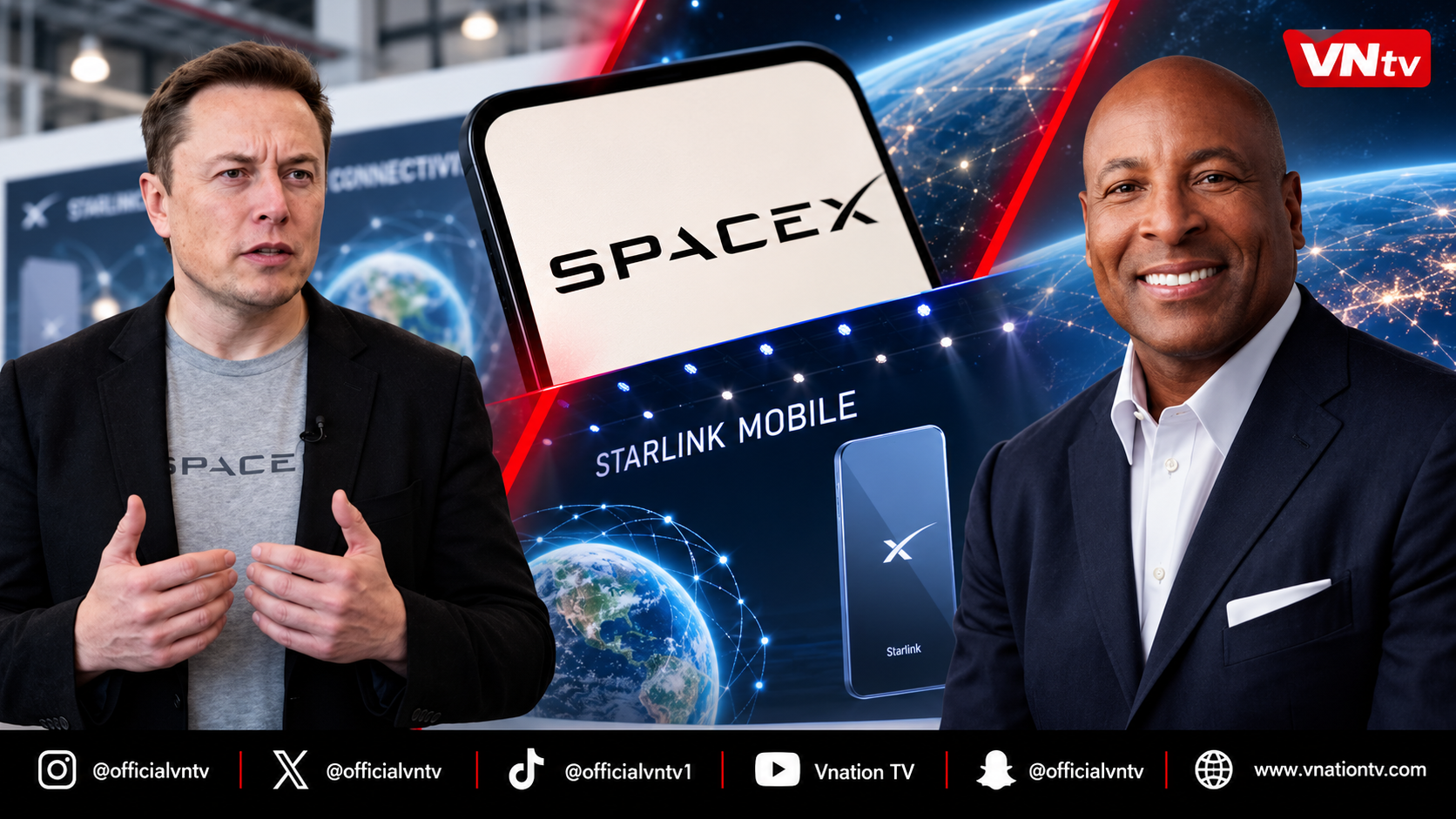
SpaceX has agreed to acquire Grain Management’s nationwide 800 MHz wireless spectrum portfolio as Elon Musk pushes Starlink Mobile toward becoming a major U.S. cellular provider. The portfolio includes up to approximately 14 MHz of low-band spectrum capable of traveling long distances and penetrating buildings. Grain acquired the frequencies from T-Mobile in August 2026. SpaceX plans to combine the spectrum with its satellite and future terrestrial infrastructure, potentially placing Starlink Mobile in direct competition with AT&T, Verizon and T-Mobile. The transaction remains subject to FCC approval, while the companies have not officially disclosed its financial terms.
Elon Musk’s SpaceX has struck a deal to acquire a nationwide portfolio of valuable 800 MHz wireless spectrum from Grain Management, giving the Starlink operator one of the critical assets it needs to move beyond satellite internet and build Starlink Mobile into a potentially serious competitor to AT&T, Verizon and T-Mobile in the United States.
The agreement, announced October 8 by Washington-based investment firm Grain Management, would transfer 100 percent of Grain’s nationwide 800 MHz spectrum portfolio to SpaceX. The transaction remains subject to Federal Communications Commission approval and customary closing conditions, meaning ownership of the licenses has not yet formally transferred.
The spectrum includes up to approximately 14 MHz of paired frequencies in the 800 MHz band covering the United States. Low-band spectrum is particularly valuable to wireless carriers because radio signals at those frequencies can travel relatively long distances and penetrate buildings, walls and other obstacles more effectively than many higher-frequency signals.
That capability addresses one of the most important technical limitations facing SpaceX as it attempts to transform Starlink’s direct-to-device technology from a service designed primarily for areas without conventional cellular coverage into something closer to a full national mobile network.
Starlink Mobile already has access to 2 GHz mid-band spectrum that can provide higher-capacity connections through SpaceX satellites. The addition of 800 MHz spectrum would give the company a complementary low-band coverage layer better suited to reaching phones inside buildings and providing broader geographic coverage.
SpaceX has said the combination could allow Starlink Mobile to serve customers both from space and through terrestrial infrastructure. That is a significant shift from the original conception of direct-to-cell satellite technology as an emergency or rural coverage supplement.
Instead, SpaceX is increasingly signaling that it wants to build an integrated satellite and ground-based wireless system capable of competing for mainstream mobile customers.
The company described the 800 MHz acquisition as an important step toward becoming a major mobile carrier in the United States. If regulators approve the deal and SpaceX builds the necessary ground network, Starlink Mobile could eventually challenge the traditional division between satellite operators and conventional cellphone companies.
The transaction is also notable because of how recently Grain acquired the spectrum.
Grain Management completed its purchase of the nationwide portfolio from T-Mobile on August 11, only about two months before announcing the agreement to sell it to SpaceX. Grain acquired the licenses through a transaction involving cash and the exchange of some of its own 600 MHz spectrum.
The 800 MHz frequencies had previously belonged to T-Mobile after its acquisition of Sprint. Regulatory conditions connected to that merger required T-Mobile to divest the spectrum, creating the opportunity for Grain to acquire it.
Grain initially said the frequencies could be used for several purposes, including private communications networks for electric utilities, critical infrastructure operators and direct-to-device satellite services. Their nationwide footprint and existing compatibility with widely used cellular technologies made them particularly attractive.
SpaceX’s interest effectively puts that spectrum at the center of its wider mobile strategy.
Grain founder and Chief Executive Officer David Grain said the transaction demonstrated the firm’s ability to identify strategic uses for scarce communications assets and connect them with companies capable of deploying them at national scale. Grain Management, founded in 2007, specializes in communications and digital infrastructure, including wireless spectrum, fiber networks, data centers, cell towers and managed network services.
The firm says it manages more than $12 billion in assets, though that figure refers to assets under management and should not be confused with David Grain’s personal wealth.
Financial terms were not disclosed by either SpaceX or Grain Management. Reuters reported that The Wall Street Journal, citing people familiar with the matter, valued the deal at approximately $8 billion in cash. Until either company formally confirms the consideration or regulatory filings reveal it, that figure remains a reported valuation rather than an officially announced purchase price.
Even without a disclosed price, the strategic value is clear.
Wireless spectrum is a finite resource and one of the most expensive and important assets in the telecommunications industry. Traditional mobile operators have spent tens of billions of dollars at government auctions and private transactions to secure frequencies capable of carrying voice and data traffic.
Different spectrum bands offer different advantages. Higher-frequency bands can deliver substantial capacity and high data speeds but generally travel shorter distances and have more difficulty penetrating buildings. Lower-frequency spectrum such as 800 MHz offers broader coverage and better indoor performance, making it valuable for a nationwide mobile network.
SpaceX’s existing direct-to-cell strategy has relied heavily on partnerships with mobile operators and frequencies associated with those partners. Acquiring its own nationwide low-band portfolio gives the company greater independence and potentially allows it to control more of the customer connection itself.
That could eventually place Starlink Mobile in more direct competition with the very telecommunications companies whose networks and spectrum helped demonstrate satellite-to-phone technology.
The implications were immediately noticed on Wall Street. Shares of major U.S. telecommunications companies came under significant pressure following the announcement as investors reassessed the possibility that SpaceX could become a meaningful fourth force in the American wireless market.
Financial Times reporting estimated that roughly $62 billion in combined market value was wiped from AT&T, Verizon and T-Mobile following the announcement and broader investor concerns about SpaceX’s mobile ambitions.
The reaction does not mean SpaceX is immediately capable of replacing the three major carriers. Traditional mobile operators have enormous advantages, including hundreds of thousands of terrestrial cell sites, extensive fiber networks, retail operations, customer-service systems, billing infrastructure and decades of experience operating nationwide mobile networks.
SpaceX would still need substantial terrestrial infrastructure if it intends to provide the same type of continuous, high-capacity indoor and urban service that customers receive from conventional carriers.
Satellite service alone cannot efficiently handle every mobile connection in densely populated cities. Space-based networks are particularly useful where terrestrial towers are unavailable, but urban environments produce far greater demand within relatively small geographic areas.
That explains why SpaceX is discussing a hybrid system rather than simply replacing cellular towers with satellites.
Under such a model, phones could connect to terrestrial Starlink Mobile infrastructure where available and transition to satellites in rural communities, remote highways, wilderness areas, disaster zones and other places where traditional cellular coverage becomes weak or disappears completely.
The ability to make that transition seamlessly using ordinary consumer smartphones could fundamentally change expectations about mobile coverage.
One of Starlink Mobile’s biggest advantages is the existing scale of SpaceX’s satellite network. Starlink already operates thousands of satellites in low Earth orbit and has become the world’s largest satellite broadband constellation.
The FCC has recently authorized SpaceX to deploy up to 15,000 next-generation satellites associated with its direct-to-device plans. That authorization should not be interpreted as meaning 15,000 new mobile satellites are already operational. Rather, it gives SpaceX regulatory permission to build toward a substantially larger constellation.
The newer satellites are designed to provide far greater direct-to-device capacity than early versions of the technology.
SpaceX has described its long-term objective as providing connectivity to standard mobile phones without requiring customers to carry specialized satellite handsets or large external antennas.
The company’s existing direct-to-cell deployments have already demonstrated text messaging and other basic services through partnerships with mobile operators. Higher-capacity service, including broadband data, requires significantly more spectrum, satellite capacity and ground infrastructure.
That is why the Grain transaction carries greater significance than a routine spectrum purchase.
It follows another enormous spectrum move involving EchoStar. SpaceX previously agreed to acquire spectrum assets from EchoStar in a transaction reportedly valued at approximately $17 billion, giving the company access to additional frequencies that can support its direct-to-device ambitions.
The combination of those assets with Grain’s low-band frequencies points toward a deliberate strategy of building a vertically integrated wireless network rather than permanently relying on carrier partnerships.
SpaceX already controls several layers of the communications system that would be difficult for a new wireless entrant to reproduce.
It builds its own satellites, manufactures many of the antennas and systems used by Starlink, operates the rockets that launch those satellites and controls much of the software that manages the network. Starship, if it becomes fully operational at scale, could substantially reduce the cost of placing even larger and more capable satellites into orbit.
Adding owned spectrum closes another part of that chain.
A mobile carrier typically depends on spectrum licenses, towers, fiber backhaul, software systems and customer devices. SpaceX’s advantage is that it can combine satellites, launch vehicles, spectrum and terrestrial infrastructure within one organization.
That integration has led analysts to take the possibility of a major Starlink Mobile service increasingly seriously.
However, the company still faces major regulatory, technical and financial hurdles.
The Grain transaction cannot close without FCC approval. Regulators will examine whether transferring the nationwide licenses to SpaceX serves the public interest, complies with ownership rules and creates any competition concerns.
The FCC has already shown significant interest in satellite-to-device services because they could expand connectivity in areas that traditional networks struggle to reach.
The Commission’s previous approval of Grain’s acquisition from T-Mobile established pathways for putting the 800 MHz spectrum into productive use, including direct-to-device applications. Grain said its deal with SpaceX is consistent with those federal connectivity goals.
SpaceX will nevertheless need additional approvals as it deploys specific services and integrates its satellite and terrestrial systems.
The major wireless carriers are also unlikely to stand still.
AT&T, Verizon and T-Mobile continue investing heavily in their 5G networks, fiber backhaul and spectrum holdings. They are also developing their own satellite strategies through partnerships with companies capable of filling terrestrial coverage gaps.
T-Mobile already works with SpaceX on satellite-to-phone connectivity, creating an unusual situation in which a current technology partner could eventually become a direct competitor.
That relationship could become more complicated if Starlink Mobile develops into a standalone nationwide service.
Verizon and AT&T have also explored satellite partnerships, while AST SpaceMobile is building a competing space-based broadband network designed to connect ordinary smartphones directly to satellites.
SpaceX’s latest acquisition therefore intensifies a broader competition over what the next generation of cellular service will look like.
The emerging market is no longer simply a contest between three traditional wireless carriers. Satellite companies, infrastructure providers and technology groups are increasingly attempting to blur the distinction between networks on Earth and networks in orbit.
For customers, the potential benefit is greater coverage.
Large parts of the United States still contain cellular dead zones, particularly in mountainous areas, deserts, national parks, remote highways and sparsely populated rural communities where building conventional towers may not be economically attractive.
A satellite-terrestrial network could extend communication into those areas without requiring the same density of ground infrastructure.
The 800 MHz frequencies add another important element because they improve coverage in areas where satellite signals can struggle, particularly indoors.
Satellite direct-to-phone signals must travel hundreds of miles between orbit and a small handset antenna. Buildings and other obstacles can significantly weaken those connections. Low-band terrestrial spectrum could allow SpaceX to provide ordinary ground-based service inside homes, offices and commercial buildings while relying on satellites where ground infrastructure disappears.
That architecture would give Starlink Mobile a potentially distinctive selling point. Instead of asking customers to choose between a terrestrial mobile network and satellite connectivity, SpaceX could attempt to provide both through the same service.
The challenge will be capacity.
A satellite beam covering a large geographic area cannot currently provide the same amount of data capacity as dense networks of terrestrial cell towers serving city neighborhoods. SpaceX will therefore need a major ground infrastructure buildout if it wants to compete for high-usage smartphone customers in places such as New York, Los Angeles, Chicago, Houston and Miami.
That could mean acquiring or leasing tower sites, deploying radios, securing fiber connections and negotiating infrastructure arrangements with existing operators.
The costs would be substantial even for a company with SpaceX’s resources.
There are also questions over pricing and distribution. Starlink is best known for selling satellite broadband directly to consumers, but the U.S. wireless market includes complex family plans, device financing, roaming agreements, business customers and bundled services.
Building a mobile network is therefore not simply a matter of acquiring spectrum and launching satellites.
Still, SpaceX has repeatedly demonstrated a willingness to enter industries dominated by established companies and absorb heavy upfront costs to build infrastructure.
Starlink itself began as an ambitious attempt to create a global satellite broadband network at a scale that many analysts initially questioned. It now serves millions of customers around the world and generates a growing share of SpaceX’s revenue.
Starlink Mobile represents an attempt to push that model into the much larger cellular market.
For Grain Management, the transaction also illustrates how valuable spectrum trading can be.
The firm specializes in telecommunications infrastructure and has spent years investing in networks, towers, fiber and spectrum assets. Its August acquisition from T-Mobile gave it control of one of the largest privately held low-band spectrum portfolios in the United States.
Less than two months later, it reached an agreement to sell that entire portfolio to one of the most aggressive technology companies in global telecommunications.
David Grain said the agreement could help reshape where and how Americans connect as terrestrial and space-based networks increasingly converge.
The transaction has also drawn attention because Grain is one of the most prominent Black-founded investment firms operating in U.S. digital infrastructure. David Grain has spent decades in telecommunications and built the firm around investments in assets underlying modern communications networks.
The significance of the transaction, however, lies primarily in the spectrum itself and what SpaceX intends to do with it.
If the FCC approves the transfer, SpaceX would gain nationwide access to scarce low-band frequencies at the same time it is expanding Starlink Mobile’s satellite capacity.
The company would then face the more difficult stage of turning those assets into a commercially competitive national service.
That process is unlikely to happen overnight. Building terrestrial infrastructure, expanding the satellite constellation, integrating handsets and ensuring reliable transitions between space and ground networks will take time.
Traditional carriers therefore retain enormous advantages in coverage density, capacity, customer scale and infrastructure.
What has changed is the credibility of the threat.
Until recently, Starlink’s mobile ambitions could largely be viewed as an extension of satellite emergency coverage and a complement to existing carriers. SpaceX’s acquisition of nationwide cellular spectrum makes that explanation increasingly incomplete.
The company is accumulating the spectrum, satellites and regulatory approvals needed to behave more like a carrier in its own right.
That does not guarantee that Starlink Mobile will displace AT&T, Verizon or T-Mobile, but it means those companies now have to consider SpaceX as something more than a satellite partner operating at the edges of their networks.
The next decisive step is regulatory approval. The FCC will determine whether the Grain spectrum transfer can proceed, after which attention will shift toward SpaceX’s deployment plans, network architecture and expected launch timetable for broader Starlink Mobile service.
Until then, the deal remains an agreement rather than a completed acquisition.
But strategically, SpaceX has made its direction increasingly difficult to misunderstand. Musk’s company wants Starlink to connect more than homes, businesses and remote terminals. It is positioning the network to connect ordinary phones from satellites and terrestrial infrastructure, potentially bringing SpaceX into direct competition with companies that have dominated American wireless communications for decades.