JAMESTOWN FISHERMEN THREATEN PROTEST OVER NON-FUNCTIONING COLD STORAGE FACILITY
Fishermen at Jamestown Fishing Harbour in Accra have threatened to wear red bands in protest if the harbour’s cold storage facility is not operational by December 31, 2026. Chief Fisherman Nii Armah Wulu says the facility has remained non-functional since the harbour opened, leaving fishermen unable to preserve excess catches and contributing to substantial post-harvest losses. Government ministers inspected the cold store and other harbour facilities in March and acknowledged the need to improve operations, but the latest reports do not provide a confirmed date for the facility to begin working. The threatened action remains a proposed symbolic protest rather than an ongoing demonstration. CitiNewsroom.com
Fishermen operating at the Jamestown Fishing Harbour in Accra have threatened to launch a symbolic protest if authorities fail to make the harbour’s cold storage facility operational by December 31, 2026, deepening frustration over infrastructure that they say is urgently needed to protect their catches and livelihoods. The fishermen say the prolonged failure to bring the cold store into use has left them without an adequate means of preserving excess fish, particularly during periods of increased landings, resulting in significant post-harvest losses and forcing some members of the community to rely on less effective preservation methods.
Chief Fisherman of Jamestown, Nii Armah Wulu, said the cold storage facility has remained non-functional since the fishing harbour was opened to the public, despite repeated assurances from management that work was underway to make it operational. He said the fishermen have become increasingly frustrated because the facility was expected to form an important part of the modern harbour infrastructure and help solve one of the longstanding challenges facing artisanal fishing communities: how to preserve catches safely when supply temporarily exceeds immediate market demand.
According to Wulu, some fishermen have experienced periods of relatively strong catches but have struggled to store surplus fish before it deteriorates. Fresh fish is highly perishable, particularly in Ghana’s coastal climate, and without reliable refrigeration or access to ice and cold-chain facilities, fishermen and traders can lose part of their catch within a relatively short period. Those losses reduce income for fishing crews and fish processors while also weakening the economic benefit that should come from periods of improved fishing activity.
The fishermen say some members of the community previously attempted to preserve excess fish by drying it along streets and other available spaces around Jamestown when they could not access adequate cold storage. That approach, however, was halted after city authorities raised concerns about sanitation and public health, further narrowing the options available to the fishing community. The dispute therefore involves both economic and food-safety concerns because authorities have legitimate reasons to prevent fish from being processed in unhygienic conditions, while fishermen argue that the modern preservation facility intended to provide a safer alternative remains unavailable.
Wulu said repeated assurances from harbour management that efforts were being made to operationalise the cold store have not resolved the problem. After months of waiting, the fishing community has now set the end of the year as a deadline and says fishermen will begin wearing red bands if the facility remains non-operational after December 31. In Ghana, red bands are widely used as a visible symbol of protest, anger or resistance, and the fishermen’s announcement is intended to signal increasing pressure on the authorities without yet declaring a strike or disruption of fishing activities.
The threatened action comes more than two years after the Jamestown Fishing Harbour was commissioned as a major infrastructure investment intended to modernise artisanal fishing operations in one of Accra’s oldest coastal communities. The facility was commissioned in September 2024 after being developed with Chinese support and was presented as a project that would improve fish handling, provide safer landing facilities and support the livelihoods of fishermen, processors and traders who have depended on the Jamestown coastline for generations.
The harbour includes facilities intended to address many of the problems traditionally associated with artisanal landing beaches, including a fish market, fish-processing areas, cold storage infrastructure and improved landing facilities. Its construction was therefore expected to reduce post-harvest losses, improve hygiene and allow fishing businesses to capture more value from catches instead of being forced to sell immediately at reduced prices because fish could not be preserved.
The continued inability to use the cold store undermines part of that objective. Cold storage gives fishermen greater flexibility in deciding when and how to sell their catch because fish can be kept at safe temperatures while buyers are found or market conditions improve. Without that option, fishermen may be forced to accept lower prices immediately after landing, particularly when several canoes arrive with large catches at the same time and local demand cannot absorb all the fish available.
This problem affects more than the canoe owners themselves. Jamestown’s fishing economy supports fishmongers, processors, traders, transporters, net makers, fuel suppliers and many other workers whose income depends on the movement of fish from sea to market. When catches spoil or fishermen are forced to reduce activity because preservation is inadequate, losses spread through the wider community and can undermine the economic purpose of investing in a modern fishing harbour.
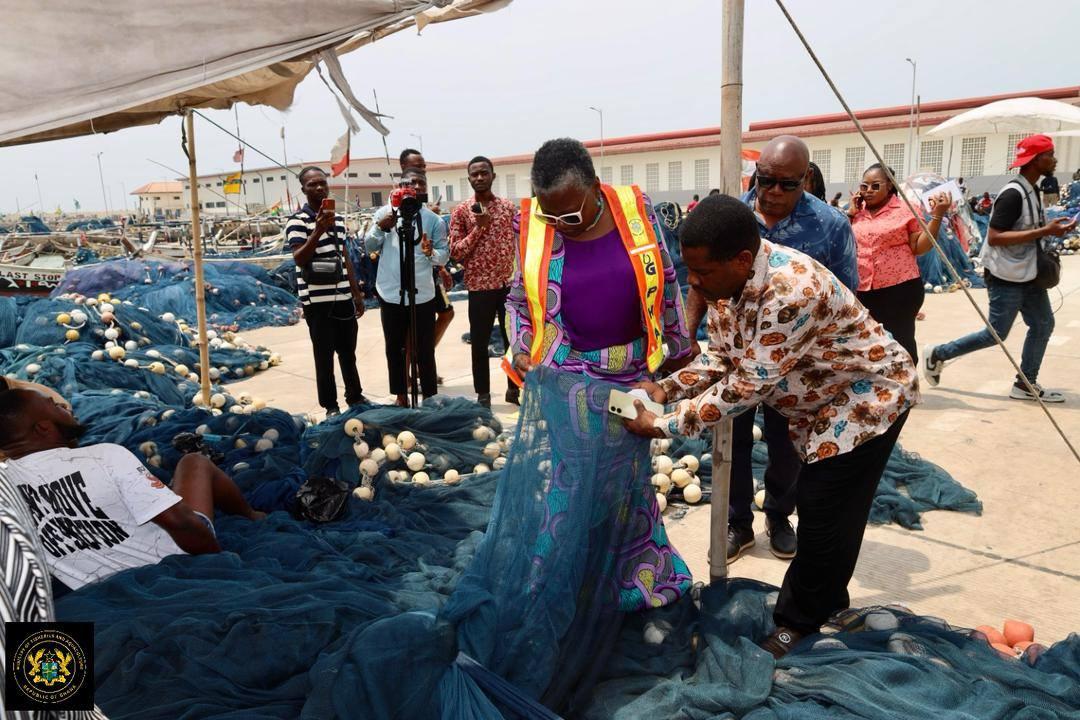
The present complaint is also not the first indication that Jamestown Fishing Harbour has faced operational challenges since its commissioning. In March 2026, Fisheries and Aquaculture Minister Emelia Arthur and Transport Minister Joseph Bukari Nikpe led a joint government inspection of the harbour to assess problems affecting its operations. The ministers were accompanied by senior officials from both ministries and the Ghana Ports and Harbours Authority and met traditional fishing leaders and harbour management to review areas requiring intervention.
During that inspection, officials examined the cold storage facility, fish market and fish-processing centre and discussed wider challenges affecting the harbour. Concerns raised included water supply, the condition of the breakwater, the need for dredging and the effective use of facilities designed to support fishermen and fish processors. The government said at the time that improving the harbour’s operational efficiency was important for reducing post-harvest losses and strengthening the livelihoods of coastal communities.
The March inspection demonstrates that government authorities were already aware that parts of the harbour required additional work months before the latest protest threat. It also means the fishermen’s frustration is rooted in a problem that has been publicly acknowledged rather than one emerging suddenly in October. The fishermen now appear to be demanding a firm operational outcome rather than further assurances that technical work is continuing.
The Ghana Ports and Harbours Authority has a central role in the management of the facility, while the Ministries of Transport and Fisheries and Aquaculture have policy responsibilities relevant to its operation and the livelihoods of the fishing community. During the March inspection, the two ministers stressed the need for inter-agency cooperation to improve the harbour and ensure that facilities built for the fishing sector were being properly utilised.
However, the latest reports do not contain a new detailed response from the harbour management, the Ghana Ports and Harbours Authority, the Fisheries Ministry or the Transport Ministry explaining precisely why the cold store remains unavailable or giving a definite date for its operation. Wulu said fishermen continue to receive assurances that efforts are underway, but the community wants the facility functioning before the end of the year.
That absence of a confirmed completion timetable is likely to become increasingly important as the December deadline approaches. The fishermen have not threatened to abandon the harbour or stop fishing altogether, and there is no indication that operations at the facility have been disrupted by demonstrations. Their current plan is to wear red bands as a symbolic protest if the cold store remains unavailable, but frustration could intensify if authorities fail to communicate clear progress.
The cold storage dispute also highlights the difference between completing major infrastructure projects physically and ensuring that they work effectively after commissioning. A harbour can contain modern buildings, equipment and processing areas, but those assets provide limited value to users if essential systems are not operational. Long-term project success therefore depends on maintenance, management, utility connections, technical commissioning and reliable access to all major facilities rather than on construction alone.
For Jamestown, that issue is particularly sensitive because the fishing community has previously raised concerns about whether local fishermen would benefit fully from the new harbour. Before the facility was commissioned in 2024, fishing leaders sought assurances that artisanal fishermen would remain central to its operation and would not be marginalised after the substantial investment was completed. Wulu himself publicly called for greater consultation with the community during that period, stressing that fishing remained the principal livelihood for many local families.
The present complaint suggests that access to the harbour is no longer the only issue. Fishermen now want the infrastructure within the facility to perform the functions for which it was built. Their argument is essentially that a modern fishing harbour cannot fully achieve its purpose if fishermen continue losing catches because one of its key preservation systems is unavailable.
Post-harvest losses remain a significant concern throughout Ghana’s fisheries sector because fish that is not stored or processed properly can lose quality rapidly. These losses reduce income for producers and traders, contribute to food waste and can create food-safety risks when poorly preserved fish reaches consumers. Improving cold-chain infrastructure is therefore an important part of fisheries development, particularly at heavily used landing sites.
Cold storage can also improve fishermen’s bargaining position in the market. When fish must be sold immediately, buyers know that fishermen have limited options and may be able to negotiate lower prices. The ability to preserve a catch allows fishermen and traders more time to find buyers, distribute products to other markets or process fish under better conditions, potentially increasing the value earned from each fishing trip.
This economic dimension explains why Wulu has described the problem in terms of losses rather than convenience. Fuel, crew payments, food, nets, maintenance and outboard motors all contribute to the cost of a fishing expedition. When part of a successful catch spoils after reaching shore, fishermen lose revenue after already absorbing those operational costs, making the absence of preservation facilities particularly damaging.
The current controversy also intersects with recent public-health concerns around fish processing in Jamestown. Earlier in 2026, the Accra Metropolitan Assembly took action against fish drying in areas exposed to vehicular emissions and unsanitary conditions, arguing that such practices created risks for consumers. Fishermen and fish processors affected by those interventions complained about the effect on their livelihoods, but public-health officials maintained that food sold to the public must be handled under safe conditions.
The existence of a functioning cold store would not eliminate the need for traditional smoking and drying, which remain important parts of Ghana’s fish-processing culture, but it would provide an additional preservation option and could reduce the pressure to use unsuitable public spaces during periods of excess supply. The fishermen’s demand therefore aligns in part with the city’s objective of improving the hygiene and safety of fish handling, even though the two sides have previously disagreed over enforcement.
Jamestown also occupies a particularly important place in Ghana’s artisanal fishing history. The coastal community has long depended on canoe fishing, and generations of families have built livelihoods around the sea, fish processing and trading. Modernising the harbour was intended not to replace that traditional economy but to provide better infrastructure that could support it under changing urban, environmental and economic conditions.
The harbour project was therefore promoted as both an infrastructure investment and a livelihoods intervention. Its success cannot be measured only by the physical appearance of the harbour but by whether fishermen, processors and traders experience safer operations, lower losses and higher economic returns. A cold storage facility that remains unused weakens that measure of success.
Other operational challenges at the harbour have also attracted attention. Government inspections have raised concerns over the breakwater and dredging requirements, while reports have indicated that silting can affect navigability. These technical problems underline the need for continuing investment and maintenance after commissioning and show that fishing infrastructure exposed to coastal conditions requires active management.
The breakwater issue is particularly important because sediment can accumulate within harbour areas and affect the ability of vessels to move safely. If dredging is required frequently, operational costs can increase and access can become more difficult during certain periods. Authorities have therefore been examining broader measures needed to keep the harbour functioning effectively.
The cold store, however, has become the immediate focus of fishermen because its impact is felt directly after catches arrive ashore. While breakwater design and dredging are complex engineering matters, fishermen see refrigeration as a practical facility that should already be available to protect the fish they have caught.
The December 31 deadline gives authorities approximately two months to address the issue or provide a clearer explanation of what remains outstanding. The fishermen’s decision to set a specific date may also help move the dispute from general frustration toward a measurable demand: either the facility is operating by the end of the year or they begin their symbolic action.
It remains unclear whether technical faults, power requirements, contractual matters, management arrangements or another problem is responsible for the delay. None of the latest reports reviewed by VNTV provides enough evidence to attribute the non-operational facility to a specific agency failure or contractor problem. Any explanation of responsibility should therefore wait for an official technical account rather than be inferred from the fishermen’s complaints alone.
That distinction is important because the fishing community can accurately describe the consequences it experiences without necessarily knowing every technical or administrative reason behind the delay. Likewise, authorities may have legitimate commissioning or safety requirements to complete before the facility can operate, but those reasons need to be communicated clearly if fishermen are expected to accept continued delays.
Greater transparency could therefore reduce some of the tension. A public timetable explaining what work remains, who is responsible and when testing or commissioning will be completed would give the fishing community something more concrete than repeated assurances. If the facility cannot realistically be operational by December 31, authorities would also need to explain what temporary preservation alternatives are being offered to reduce losses.
The issue has wider policy relevance because Ghana continues to invest in fisheries infrastructure as part of efforts to improve food security, coastal livelihoods and sustainable fishing. Modern landing sites and harbours can help improve sanitation, reduce waste and formalise parts of the fisheries value chain, but their effectiveness depends heavily on operational management after construction.
Projects that remain partly functional can generate public frustration because communities compare what was promised with what they can actually use. In Jamestown, the fishermen are not arguing that the entire harbour is useless; their specific complaint concerns a critical facility they believe would directly reduce losses from excess catch.
The fishermen’s threatened red-band protest should therefore be viewed as an escalating demand for operational infrastructure rather than as opposition to the harbour project itself. Their statements suggest they want the facility to work as intended and believe completing the cold store would improve the economic benefits they receive from the harbour.
For government, resolving the problem could provide an opportunity to demonstrate that concerns raised during the March ministerial inspection are being addressed. The Fisheries and Transport ministries said at the time that government intended to revitalise the facility and improve efficiency, while officials acknowledged the importance of reducing post-harvest losses.
If the cold store becomes operational before the deadline, the threatened protest may be avoided and one of the most visible complaints surrounding the harbour could be resolved. If it remains closed, the fishermen have made clear that they intend to use red bands to signal their dissatisfaction publicly.
The coming weeks will therefore be important for relations between the Jamestown fishing community and the authorities managing the harbour. Fishermen will be watching for practical progress rather than further assurances, while officials will need to demonstrate whether the technical and administrative obstacles preventing use of the facility can be resolved within the timeframe demanded by the community.
For now, the situation remains a threatened protest rather than an active demonstration. Fishing continues at Jamestown Harbour, and there is no report of fishermen blocking access, refusing to work or beginning industrial action. The significance of the October 27 development is that the fishing community has now attached a clear deadline and a defined form of protest to a problem that has persisted since the harbour began operating.
The underlying economic complaint is also clear. Fishermen say they are catching fish that they cannot adequately preserve, resulting in avoidable losses despite the presence of a modern cold storage facility inside the harbour complex. Their demand is that the infrastructure be made functional so the harbour can fulfil one of the central purposes for which it was built.
Whether authorities can meet the December 31 deadline will determine whether the dispute is resolved quietly or develops into a more visible confrontation at one of Accra’s most historic fishing communities. Until then, the fishermen say they will continue working while waiting for the cold store to become operational, but they have warned that their patience is running out.