NORTH KOREA FIRES BARRAGE OF BALLISTIC MISSILES AS TENSIONS WITH SOUTH KOREA SURGE
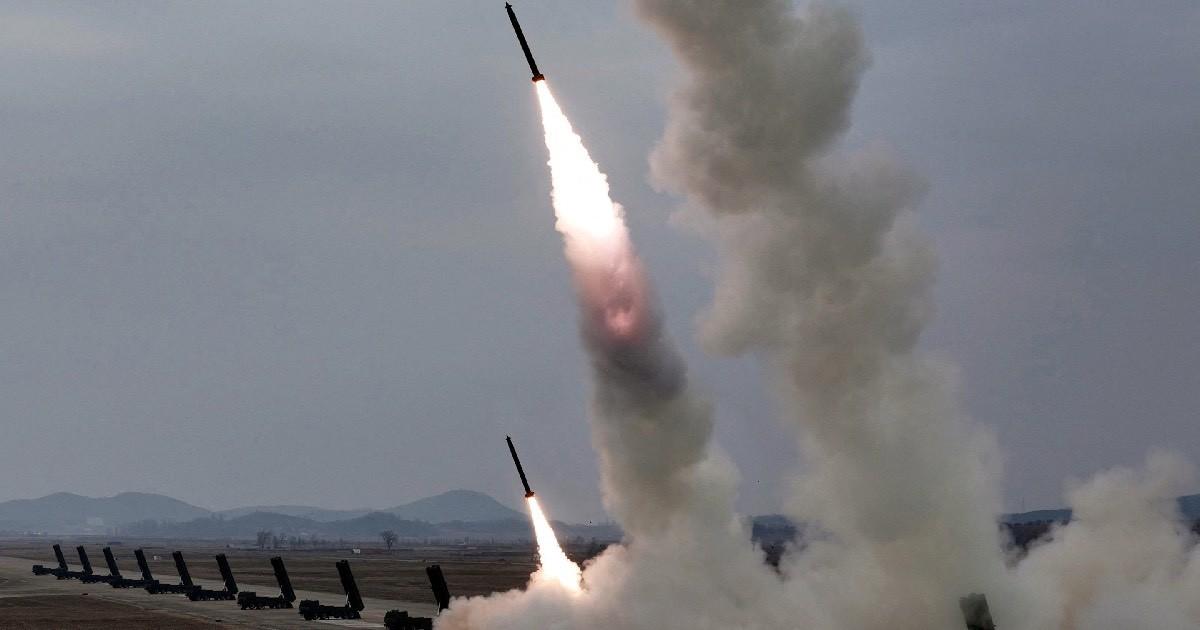
North Korea fired around 10 short-range ballistic missiles from near Wonsan toward the sea off its east coast on October 29, according to South Korea’s Joint Chiefs of Staff. Japan said the missiles appeared to have fallen outside its Exclusive Economic Zone, with no immediate reports of damage. The launch comes amid heightened tensions following a September 21 landmine explosion in the DMZ that injured three South Korean soldiers, two seriously. Seoul says North Korean mines caused the blast, while Pyongyang denies responsibility.
North Korea fired around 10 short-range ballistic missiles toward the sea off its eastern coast on Thursday, prompting South Korea to raise surveillance levels and coordinate closely with the United States and Japan as tensions on the Korean Peninsula intensify following a disputed landmine explosion along the heavily fortified inter-Korean border.
South Korea’s Joint Chiefs of Staff said the missiles were launched from the Wonsan area at approximately 12:30 p.m. local time on October 29 and traveled eastward toward the sea. Military authorities said they were conducting further analysis of the missiles’ flight distances, trajectories and technical characteristics while maintaining readiness for possible additional launches.
Japan’s Defence Ministry separately reported detecting what appeared to be a ballistic missile launch from North Korea, while the Japan Coast Guard later said the projectile or projectiles appeared to have already fallen into the sea. Japanese authorities said the missiles were believed to have landed outside Japan’s Exclusive Economic Zone, and no immediate damage to ships or aircraft had been reported.
The launch initially emerged as an alert from South Korea’s military stating only that North Korea had fired an unidentified projectile toward the East Sea, also known as the Sea of Japan. Within roughly an hour, however, Seoul provided a more detailed assessment and said approximately a dozen short-range ballistic missiles had been detected, while Reuters reported the figure as around 10.
The discrepancy between the early figures reflects the preliminary nature of missile tracking immediately after a launch and does not necessarily indicate conflicting assessments. South Korean military authorities often release an initial alert before later providing more detailed information after radar, satellite and allied tracking data are reviewed.
The latest launch marks another significant weapons test by Pyongyang during an already tense period. North Korea last fired ballistic missiles on October 12, when it launched multiple weapons from the Pyongyang area toward the eastern sea. Pyongyang later described those weapons as tactical ballistic missiles connected to the development and testing of military systems.
South Korea said Thursday’s launch had triggered increased surveillance and readiness measures. The Joint Chiefs of Staff said the military was closely sharing information with the United States and Japan, reflecting a trilateral security arrangement that has expanded significantly as North Korea has accelerated its missile and nuclear weapons programs.
The three countries routinely exchange missile-warning information and conduct joint exercises intended to improve their ability to detect and track North Korean launches. Tokyo and Seoul have both emphasized the need for rapid information sharing because missiles fired from North Korea can reach targets in either country within a relatively short period.
The latest launch comes against a particularly volatile background on the Korean Peninsula following a landmine explosion inside the Demilitarized Zone on September 21 that injured three South Korean soldiers, two of them seriously.
South Korea’s military initially said it was highly likely that a North Korean mine caused the explosions and later announced that a joint investigation with the United Nations Command had concluded that the mine had been planted by North Korea south of the Military Demarcation Line.
South Korean Defence Minister Kang Shin-chul said the incident violated the 1953 Korean War armistice and placed responsibility on Pyongyang. Seoul has said the mine appeared to have been installed as part of North Korea’s ongoing fortification work along the border.
North Korea has strongly denied that accusation and accused Seoul of fabricating the incident to create a justification for confrontation. Pyongyang has described South Korea’s claims as politically motivated and warned that it would retaliate if South Korean forces took what it considered hostile action against North Korean personnel working near the border.
The dispute has become one of the most serious border confrontations between the two Koreas in recent months because both sides are operating troops, weapons and engineering units in close proximity within and around the Demilitarized Zone.
North Korea has been expanding fortifications along the border since 2024, including fences, mines, roads and anti-tank barriers. South Korea says North Korean troops have repeatedly crossed the Military Demarcation Line during that work, often prompting warning broadcasts and warning shots from South Korean forces.
Pyongyang has disputed Seoul’s interpretation of some of those incidents and has accused South Korea of creating unnecessary confrontation around routine construction and defensive work.
The situation became even more sensitive this month when North Korean artillery vehicles were observed near the frontier. Reuters journalists viewing the border from South Korea saw several North Korean armored vehicles positioned close to the dividing line, while South Korean media identified them as self-propelled 122-millimeter howitzers.
Their gun barrels were reportedly directed southward, adding to concern that Pyongyang was deliberately displaying military force during a period of heightened confrontation.
South Korea has attempted to prevent escalation by proposing military talks with North Korea aimed at clarifying border arrangements and restoring communications. Seoul has said direct dialogue could reduce the risk of accidental clashes as both sides continue operating troops in a zone filled with mines, fortifications and weapons.
Pyongyang has not responded positively to those proposals and has increasingly described South Korea as a hostile state rather than a partner for eventual reunification.
North Korean leader Kim Jong Un has in recent years abandoned much of the traditional language surrounding peaceful Korean reunification and ordered constitutional and political changes reflecting the view that South Korea should be treated as a separate and hostile country.
That shift has fundamentally changed the political environment on the peninsula. Previous governments in both countries often maintained at least a formal commitment to eventual reunification even during periods of severe tension. North Korea’s newer position suggests a more permanent separation accompanied by an increased emphasis on military deterrence.
Thursday’s missile barrage adds another layer to that deteriorating relationship. Ballistic missile launches have long been used by Pyongyang to demonstrate military capability, test new weapons and send political signals during periods of diplomatic or military tension.
Short-range ballistic missiles are especially important to North Korea’s strategy because they can threaten South Korean military bases, ports, command centers and infrastructure as well as U.S. forces stationed on the peninsula.
North Korea has developed a wide range of short-range missile systems in recent years, including solid-fuel weapons capable of being launched from mobile platforms. Such systems are harder to detect before launch than older liquid-fueled missiles and can be moved between prepared positions, making them more difficult to target preemptively.
Some North Korean tactical ballistic missiles have also been designed to maneuver during flight or follow lower trajectories intended to complicate interception by missile-defense systems.
South Korea operates Patriot and other missile-defense systems, while the United States has deployed the THAAD missile-defense system on the peninsula. Japan maintains its own layered missile defenses and regularly activates emergency monitoring procedures after North Korean launches.
Japan’s Defence Ministry confirmed Thursday that North Korea had fired what could be a ballistic missile and later said the object was believed to have fallen. Japanese authorities established emergency monitoring procedures and checked whether ships or aircraft had been affected.
The Japan Coast Guard said no damage had been identified in the immediate aftermath of the launch.
The missiles were not believed to have entered Japan’s Exclusive Economic Zone, reducing the immediate risk to Japanese territory or maritime activity. However, Tokyo routinely condemns North Korean ballistic missile launches as threats to regional security and violations of United Nations Security Council resolutions.
North Korea rejects those resolutions and maintains that its missile and nuclear programs are legitimate self-defense measures. Pyongyang argues that U.S. military deployments, joint exercises involving South Korea and Japan and Washington’s extended nuclear deterrence commitments create a security environment in which North Korea requires increasingly powerful weapons.
The United States, South Korea and Japan reject that argument and say North Korea’s weapons development is itself a major source of instability.
Pyongyang has continued missile testing throughout 2026. Reuters reports that North Korea has conducted missile tests on more than 10 occasions this year, including short-range, intermediate-range and other systems.
Earlier this month, North Korean leader Kim Jong Un oversaw an intermediate-range hypersonic missile drill, while state media has continued to highlight developments involving tactical nuclear weapons and long-range missile technology.
North Korea’s expanding arsenal has increased concern that the country is moving beyond experimental weapons development toward a more mature and operationally diverse missile force.
Pyongyang has also strengthened military ties with Russia in recent years, while maintaining its long-standing relationship with China. Western and South Korean officials have accused North Korea of supplying Russia with artillery shells, missiles and other military equipment related to the war in Ukraine.
Russia and North Korea have expanded defense cooperation and signed a strategic partnership agreement that includes mutual defense commitments.
Those ties have complicated diplomatic efforts aimed at isolating North Korea over its nuclear and missile programs. Russia and China, both permanent members of the United Nations Security Council, have increasingly resisted additional sanctions against Pyongyang and have criticized U.S.-led military activity in the region.
The diplomatic environment with Washington is also uncertain. President Donald Trump has repeatedly expressed interest in renewed engagement with Kim Jong Un after holding unprecedented summits with him during Trump’s first term.
Trump and Kim met in Singapore in 2018 and Hanoi in 2019, followed by a brief encounter at the Korean Demilitarized Zone later that year. The talks produced high-profile diplomacy but failed to reach a lasting agreement on North Korean denuclearization or significant sanctions relief.
Trump has suggested he remains open to another meeting, but Pyongyang has shown limited enthusiasm for negotiations centered on giving up nuclear weapons.
North Korea now describes its nuclear status as permanent and has embedded nuclear weapons more deeply into its military strategy. That position makes a return to negotiations significantly more difficult because Washington has historically maintained denuclearization as a central objective.
The latest missile launches could therefore serve several purposes simultaneously. They allow North Korea to test military systems, demonstrate readiness during tensions with Seoul and reinforce its negotiating position toward Washington and other governments.
The timing also matters because the launch followed weeks of increasingly confrontational exchanges over the DMZ landmine incident.
South Korea says the September 21 explosion was caused by a North Korean anti-personnel mine installed south of the Military Demarcation Line. Three South Korean soldiers were injured during a reconnaissance operation, with two suffering serious injuries.
A joint investigation involving South Korean forces and the United Nations Command subsequently examined the site. Seoul later said the evidence established that North Korean mines were responsible and accused Pyongyang of violating the armistice agreement.
North Korea rejected the conclusion and accused South Korea of constructing a false narrative intended to justify hostile actions.
The disagreement has since moved beyond military statements. North Korea sent a letter to the United Nations Security Council repeating its accusations against Seoul, while South Korea has sought international support for its position.
The dispute is particularly dangerous because the two Koreas remain technically at war. The Korean War ended in 1953 with an armistice rather than a peace treaty, meaning the border remains one of the most heavily militarized areas in the world.
The Demilitarized Zone is approximately four kilometers wide and contains fences, mines, observation posts and heavily armed forces on both sides.
Even small incidents can therefore carry the risk of wider escalation if warning shots, troop movements or misunderstandings produce casualties.
The South Korean government has emphasized that its military will respond to threats while attempting to avoid uncontrolled escalation. Seoul has proposed talks specifically because increasing fortification activity has brought North Korean personnel closer to sensitive parts of the boundary.
Pyongyang has instead continued emphasizing military readiness and has threatened retaliation against what it describes as South Korean provocations.
Thursday’s missile launch is therefore not occurring in isolation. It is part of a broader pattern involving missile testing, border fortification, competing accusations, visible artillery deployments and increasingly hostile political rhetoric.
The immediate military significance of the launch will depend on the final assessment of the missiles’ flight distances, altitude, type and performance. South Korean and Japanese authorities were still analyzing those characteristics in the hours after the launch.
There was no immediate evidence that any of the missiles struck territory or caused casualties.
North Korea had also not immediately issued its own account of the launch at the time of the first reports. Pyongyang often waits until the following day before releasing photographs, technical descriptions or statements from Kim Jong Un about major weapons tests.
If North Korean state media provides additional information, it could clarify whether the missiles were part of a planned weapons test, a military drill or a demonstration linked directly to the confrontation with South Korea.
Until then, the most reliable current assessment comes from South Korea and Japan: North Korea launched around 10 short-range ballistic missiles from near Wonsan toward the sea, the missiles appear to have fallen outside Japan’s Exclusive Economic Zone, and regional militaries remain on heightened alert for possible additional launches.
The latest escalation reinforces the growing danger that tensions around the DMZ could intersect with North Korea’s expanding missile program and produce a wider military confrontation. No direct exchange of fire followed Thursday’s launch, but the combination of unresolved landmine accusations, border troop movements and repeated missile tests has reduced the margin for miscalculation between the two Koreas.
For Seoul, Tokyo and Washington, the immediate focus will be on determining exactly what North Korea launched and whether additional tests follow. For Pyongyang, the barrage once again demonstrates that its missile forces remain active and capable of quickly increasing pressure during a regional confrontation.
The next major development may come from North Korean state media, which could provide the first official explanation of the purpose of the launch. Until then, South Korea is maintaining increased surveillance, Japan is monitoring the region for further missile activity, and the peninsula remains under heightened military tension following one of North Korea’s largest short-range missile barrages in recent weeks.