
WTO DOUBLES 2026 GLOBAL GOODS TRADE GROWTH FORECAST AS AI BOOM OFFSETS WAR DISRUPTIONS
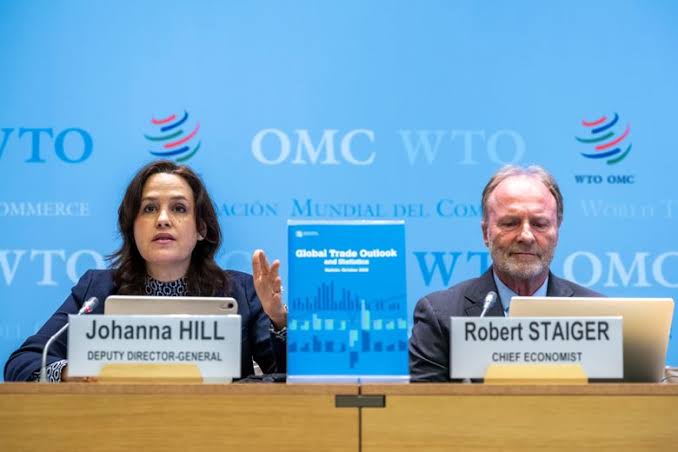
The World Trade Organization has raised its forecast for global merchandise trade growth in 2026 to 3.9% from 1.9% and lifted its 2027 projection to 4.1% from 2.6%. The WTO says exceptional demand for AI-enabling products is the main reason for the upgrade, with trade in semiconductors and other related goods rising about 67% year-on-year and accounting for nearly half of the increase in the value of merchandise trade during the first half of 2026. The organization simultaneously cut its services-trade forecast because higher aviation fuel costs and disruption from the Middle East conflict are weighing on transport and travel.
The World Trade Organization has more than doubled its forecast for global merchandise trade growth in 2026, saying an extraordinary surge in demand for semiconductors, data-center equipment and other artificial intelligence-related products has outweighed significant disruption from the conflict in the Middle East and higher energy costs.
In a new global trade outlook released Thursday in Geneva, the WTO said it now expects the volume of world merchandise trade to expand by 3.9 percent in 2026, up sharply from the 1.9 percent growth it had projected previously. The organization also raised its forecast for 2027 to 4.1 percent from 2.6 percent, bringing the projected pace of goods-trade expansion close to the 4.2 percent growth recorded in 2025.
The revisions are forecasts rather than measures of completed trade activity, and the WTO cautioned that the outlook remains exposed to major geopolitical and economic risks. The organization said the most important positive force behind the upgrade is the rapid buildout of artificial intelligence infrastructure, which has triggered exceptionally strong cross-border demand for advanced semiconductors, servers, data-center equipment and other technology products required to train and operate increasingly large AI systems.
Trade in AI-enabling products increased by about 67 percent year-on-year, according to the WTO, and those products accounted for nearly half of the increase in the value of global merchandise trade during the first half of 2026. That concentration means the technology boom is now playing a disproportionately large role in supporting international goods flows even as other parts of the global economy face slower demand, higher energy prices and political uncertainty.
The upgrade highlights how rapidly artificial intelligence investment is beginning to reshape global trade patterns. Massive spending by technology companies, cloud providers, data-center operators and semiconductor manufacturers has created a new cycle of capital-goods demand stretching across East Asia, the United States and Europe. High-bandwidth memory chips, graphics processors, networking equipment, cooling systems and specialized power infrastructure have all become increasingly important components of international trade.
The WTO said Asia is expected to remain the strongest regional contributor to goods-trade growth, reflecting the region’s central position in semiconductor manufacturing, electronics assembly and supply chains linked to AI infrastructure. Economies including Taiwan, South Korea, China, Japan and parts of Southeast Asia occupy different stages of those supply chains, while the United States has become one of the largest destinations for high-value AI-related imports as technology companies race to expand computing capacity.
That demand has intensified throughout 2026. Taiwan’s exports, for example, have repeatedly set records as international orders for advanced chips and electronic components surged. South Korean semiconductor producers have also benefited from strong demand for memory products used in AI systems, while global chipmakers have increased investment in fabrication, packaging and specialized components.
The result is a trade environment increasingly divided between sectors directly connected to the AI investment cycle and industries more exposed to weak consumer demand or geopolitical disruption.
The WTO’s revision is especially striking because its earlier outlook had been significantly more cautious. In March, the organization warned that Middle East conflict, higher oil prices and supply disruptions could materially weaken trade growth during 2026. Energy markets had become increasingly volatile, while uncertainty surrounding shipping routes, fuel costs and global investment conditions was weighing on the outlook.
Those risks have not disappeared.
The conflict involving the United States, Israel and Iran has pushed energy and transportation costs higher and disrupted regional trade flows. The Persian Gulf remains one of the world’s most important energy corridors, and restrictions on oil shipments through the region have contributed to significantly higher crude prices.
The WTO has warned that disruptions around the Strait of Hormuz could have far-reaching consequences because the route carries a major share of global petroleum and liquefied natural gas shipments. Higher energy costs affect not only oil-importing countries but also virtually every internationally traded product through manufacturing, freight and logistics expenses.
Despite those pressures, the AI investment surge has been strong enough to push the overall goods forecast substantially higher.
That divergence is visible in the difference between merchandise and services trade.
While the WTO raised its outlook for goods, it lowered its forecast for commercial services trade growth in 2026 to 3.3 percent. The organization cited higher aviation fuel costs and disruption linked to the Middle East conflict as important reasons for the downgrade.
Services are more directly exposed to transportation and travel costs in some categories. Airlines face rising fuel expenses, while conflict can reduce passenger traffic, disrupt routes and force carriers to avoid certain airspace. International tourism, logistics and other transport-linked services can therefore weaken even when manufactured goods continue moving through alternative routes.
The WTO expects services growth to rebound strongly to around 6.4 percent in 2027 if current disruptions ease.
The contrast underscores an increasingly unusual feature of the current global economy: goods trade is being accelerated by a narrow but extremely powerful technology-investment cycle at the same time that energy and geopolitical shocks are weighing on other sectors.
That means the headline 3.9 percent growth forecast should not be interpreted as evidence that all parts of global trade are expanding evenly.
AI-enabling products have become central to the projection because their value, trade intensity and investment requirements are exceptionally high. Building a modern AI data center involves far more than purchasing ordinary computer servers. Operators require large quantities of advanced processors, high-bandwidth memory, networking systems, power-management equipment, storage devices and sophisticated cooling infrastructure.
Many of those components cross multiple borders before a completed system becomes operational.
A chip can be designed in the United States, fabricated in Taiwan or South Korea, packaged elsewhere in Asia and incorporated into servers that are later shipped to data centers in North America, Europe or the Middle East. Each stage generates international trade flows.
As AI investment accelerates, that network produces a multiplier effect across global merchandise trade.
The concentration also creates vulnerability.
If capital spending on AI slows significantly, the same sector currently lifting world trade could become a source of weakness. The WTO explicitly identified a slowdown in AI-related investment as one of the risks to its upgraded forecast.
Technology companies have committed enormous sums to data centers and computing infrastructure, often through debt issuance and long-term supplier agreements. That has raised concerns about whether current spending can continue at the same pace indefinitely.
There is also a question about how much of the investment is driven by genuine end-user demand versus expectations of future AI adoption.
If companies begin reducing capital expenditure because returns fail to justify the scale of investment, demand for chips and related equipment could cool rapidly.
The WTO’s forecast therefore rests partly on the assumption that the AI infrastructure cycle remains strong enough through the remainder of 2026 and into 2027 to sustain current trade momentum.
The organization also warned that energy and fertilizer costs could become more damaging if the Middle East conflict worsens.
Higher oil prices affect global trade through several channels. They raise freight costs, increase manufacturing expenses and reduce disposable income in oil-importing economies. Fertilizer prices can also rise because natural gas is a critical input in agricultural production.
Those effects can weaken both trade volumes and economic growth.
The WTO expects global GDP growth of around 2.6 percent in 2026, with Asia contributing a significant share of the expansion.
Trade can grow faster than GDP when industries with complex cross-border supply chains expand more rapidly than domestic services. AI infrastructure fits that pattern because semiconductor and electronics supply chains are highly internationalized.
The current cycle is therefore particularly favorable to merchandise trade.
The 3.9 percent forecast nevertheless comes against a broader backdrop of increasing trade fragmentation.
The United States and China remain locked in a long-running strategic and commercial rivalry, while governments around the world are introducing more industrial subsidies, export controls and local-content requirements.
Washington has tightened restrictions on exports of advanced technology to China while investing heavily in domestic semiconductor manufacturing. China has responded by accelerating its own efforts to build self-sufficiency in chips, batteries and other strategic industries.
The WTO has repeatedly warned that fragmentation of the global trading system could reduce long-term efficiency even if individual sectors are experiencing rapid short-term growth.
The latest forecast illustrates that tension.
Technology demand is currently pushing trade volumes higher, but many governments are simultaneously trying to reduce dependence on foreign suppliers in the very industries driving that growth.
Semiconductors are the clearest example.
Countries are investing billions of dollars to establish domestic fabrication capacity because chips are now viewed as strategically important to artificial intelligence, defense, telecommunications and advanced manufacturing.
Those policies could initially increase trade because construction of new plants requires imported equipment and materials. Over time, however, successful localization could reduce some cross-border flows.
The same dynamic applies to data centers, batteries and clean-energy manufacturing.
The WTO therefore faces the challenge of assessing trade growth during a period when governments increasingly treat supply chains as national-security assets rather than purely commercial networks.
Thursday’s report suggests that technology investment is, for now, overpowering those structural headwinds.
The organization’s revised 2027 forecast of 4.1 percent suggests officials believe momentum can remain relatively strong beyond the current year.
That projection is significantly higher than the previous 2.6 percent forecast and implies that the organization expects a combination of continued technology demand and eventual easing of some geopolitical disruptions.
The WTO did not present the outlook as risk-free.
Its economists warned that the Middle East conflict remains capable of causing larger damage if oil and shipping disruptions worsen.
The global economy has already experienced several episodes since 2020 in which sudden supply shocks radically altered trade forecasts, including the COVID-19 pandemic, the Russia-Ukraine war and Red Sea shipping disruptions.
That history has made trade projections unusually sensitive to geopolitical developments.
Artificial intelligence adds a different kind of uncertainty.
Rather than suppressing trade, the technology boom is currently generating exceptional demand.
AI-related imports are not evenly distributed, however. Advanced economies and large technology markets account for a substantial proportion of the investment, while many lower-income economies have limited participation in the highest-value parts of the supply chain.
That raises questions about how broadly the benefits of the current trade boom will be distributed.
Countries with semiconductor manufacturing capacity, electronics industries or major data-center investment stand to gain disproportionately.
Economies dependent on commodities or sectors less connected to technology may see weaker benefits while still facing higher energy and transportation costs.
The WTO has previously argued that artificial intelligence could eventually increase global trade substantially by lowering costs, improving logistics and making it easier for firms to participate in international markets.
The immediate impact, however, is much more concentrated in hardware.
AI-enabling products are driving physical trade before the longer-term productivity effects of the technology have been fully realized.
That distinction matters because the present boom could eventually evolve.
If AI adoption improves productivity across manufacturing, logistics, professional services and agriculture, the technology could support broader trade expansion.
If investment remains concentrated mostly in chips and data centers, the benefits may remain narrower.
The WTO’s current data show that the hardware phase is already large enough to alter global trade forecasts dramatically.
A 67 percent year-on-year increase in trade in AI-related products is exceptional by the standards of mature global supply chains.
Nearly half of the first-half increase in the value of merchandise trade coming from AI-enabling goods illustrates the scale of that effect.
It also means that weaker performance in the technology sector could have an outsized impact on future revisions.
The WTO will therefore be watching semiconductor orders, data-center capital expenditure and technology investment closely as it updates its projections.
The revised outlook also provides a counterpoint to concerns that rising trade barriers would automatically lead to an immediate contraction in global commerce.
Tariffs, export restrictions and industrial policies are increasing, but companies continue to invest heavily across borders when commercial demand is strong enough.
That does not mean protectionism has no effect.
Trade restrictions can redirect supply chains, increase costs and reduce efficiency even when overall trade volumes continue rising.
The current AI cycle may simply be strong enough to obscure some of those negative effects temporarily.
Regional performance will remain uneven.
Asia is expected to lead trade growth because of its role in manufacturing and technology supply chains.
The Middle East is expected to experience much weaker trade performance because of conflict and energy disruptions.
European growth is likely to remain more moderate, while the United States continues to absorb large quantities of technology-related imports.
That divergence reinforces the need to look beyond the global headline figure.
A 3.9 percent increase in world merchandise trade does not imply equivalent gains for every country.
For policymakers, the WTO’s revised forecast presents both an opportunity and a warning.
The opportunity is that technological investment is sustaining global trade despite an unusually unstable geopolitical environment.
The warning is that growth is becoming heavily dependent on one powerful investment cycle while other sectors face rising costs and conflict-related disruption.
The services downgrade reinforces that concern.
Aviation, tourism and transport are more exposed to fuel prices and regional instability, demonstrating that the same geopolitical conditions can produce very different outcomes across the global economy.
If oil prices remain elevated, those sectors could continue underperforming even as electronics and semiconductor trade expands.
The broader outlook will therefore depend on the balance between technology investment and geopolitical disruption.
For now, the technology side is stronger.
The WTO’s new 3.9 percent forecast is more than twice the previous 1.9 percent estimate, while the 2027 projection has risen to 4.1 percent.
Those revisions mark a substantial change in the organization’s assessment of global trade conditions.
The update does not mean the WTO expects geopolitical risks to disappear.
Instead, it reflects how much stronger AI-related demand has become than previously anticipated.
That distinction is important when interpreting the forecast.
World trade is not being upgraded because the international environment has suddenly become more stable. It is being upgraded because the AI investment boom has become large enough to offset some of the damage from conflict, energy costs and policy uncertainty.
Whether that remains true through 2027 will depend heavily on continued spending on semiconductors and data-center infrastructure, the trajectory of oil prices and the evolution of the Middle East conflict.
The next WTO revisions will therefore provide an important indication of whether the current trade acceleration is broadening into a more durable global expansion or remains dependent on one exceptionally strong technology cycle. For now, the official outlook is significantly more optimistic than it was only months ago, with artificial intelligence emerging not merely as a technological trend but as one of the most important drivers of global goods trade in 2026.