
GHANA’S CYBER SECURITY AUTHORITY REJECTS FBI CLAIMS, SAYS GHANA LED “OPERATION BLACKOUT
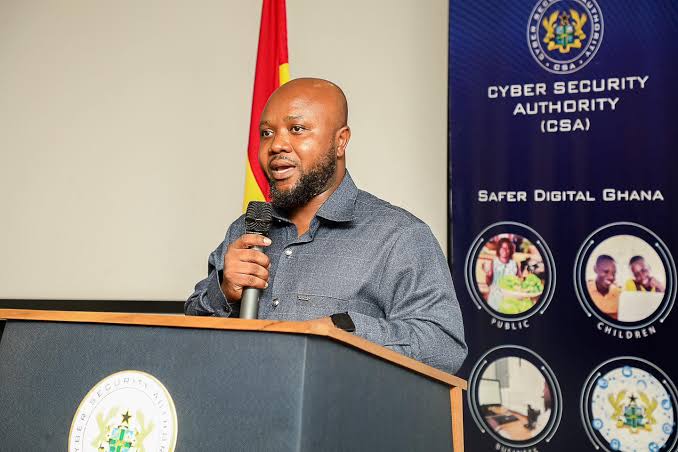
Ghana’s Cyber Security Authority has formally rejected the portrayal of the recent scam-centre crackdown as an FBI-led raid, saying Ghanaian agencies conceived, planned, coordinated and executed the operation with support from the FBI, UK NCA and other partners. The CSA says eight suspects were arrested while about 120 people, largely Nigerians, were rescued as suspected trafficking victims. Authorities seized 136 phones, 130 laptops, four vehicles, jewellery and 10 Nigerian passports, while investigations and repatriation arrangements continue.
Ghana’s Cyber Security Authority has formally challenged the United States Federal Bureau of Investigation over how a major cybercrime crackdown in the Greater Accra Region was presented to the public, insisting that the operation was conceived, planned, coordinated and executed by Ghanaian authorities and was not an FBI-led raid on Ghanaian soil. The clarification follows a high-profile announcement by FBI Director Kash Patel, who described the Ghana operation as part of the bureau’s global “Operation Blackout” campaign against international scam centres and said more than 130 people had been arrested or detained, more than 300 electronic devices seized, 89 victims identified and nearly $10 million in losses connected to the suspected fraud network. Ghanaian authorities are not disputing the importance of the FBI’s intelligence contribution or the scale of the suspected criminal activity, but they are strongly rejecting any suggestion that a foreign agency independently exercised operational command or police powers inside Ghana.
In a statement issued after the FBI announcement, the CSA said the Ghana operation, also referred to locally as Operation Cyber Hunt, was led and coordinated within Ghana’s legal and institutional framework. The authority said Ghanaian agencies were responsible for planning the operation, coordinating intelligence, carrying out searches, making arrests and securing evidence, while international partners including the FBI and the United Kingdom’s National Crime Agency provided support. It emphasized that Ghana remains a sovereign state governed by its Constitution and laws and that foreign law-enforcement agencies do not possess independent authority to conduct arrests or exercise ordinary police powers in the country without the authorization and participation of Ghanaian institutions.
The statement reinforces an earlier intervention by Minister for Communication, Digital Technology and Innovations Samuel Nartey George, who had already challenged Patel’s public description of the operation and warned that failing to properly acknowledge Ghana’s role could undermine future security cooperation. George said Ghanaian law-enforcement and intelligence agencies led the exercise, with assistance from the UK National Crime Agency and the FBI, and argued that cross-border cybercrime can only be effectively fought through partnerships built on mutual respect. The CSA’s intervention is significant because it moves the issue beyond a political disagreement between a Ghanaian minister and an American official and places the country’s main cybersecurity regulator formally on record disputing the impression that the FBI independently commanded the operation.
According to the CSA, the operation involved a broad network of Ghanaian and international institutions. Those identified as participants included Ghana’s National Security Council, the Criminal Investigations Department of the Ghana Police Service, the Ghana Immigration Service, the Office of the Attorney-General, the United Kingdom’s National Crime Agency, the FBI, Nigeria’s Economic and Financial Crimes Commission and the Joint Case Team on Cybercrime. The authority said the multinational nature of the investigation reflected the fact that suspected cybercrime networks increasingly operate across several countries at once, with victims, financial accounts, digital platforms, suspects and support networks often located in different jurisdictions. However, it said the involvement of foreign partners did not change the basic principle that law-enforcement actions taking place inside Ghana must remain under Ghanaian legal authority.
The disagreement became more serious because Patel’s original announcement was quickly interpreted by media outlets as evidence that the FBI itself had raided and dismantled a large scam compound in Ghana. Patel described the operation as another “takedown” under the FBI’s global anti-scam campaign and said more than 130 people had been arrested or detained. That framing was repeated internationally, with some reports referring to an “FBI raid” and describing the entire group as suspected scammers. Ghana’s version is substantially different. The CSA says only eight people were arrested as suspects, while approximately 120 others were rescued because authorities believe they may have been trafficked and exploited to carry out online fraud. That distinction is critical because it changes the public understanding of the operation from a mass arrest of more than 130 alleged criminals to an investigation in which most of the people encountered may themselves be victims.
The CSA said the investigation began after intelligence received on August 26, 2026, suggested that several apartments in parts of the Greater Accra Region were being used as bases for organized cybercrime. The targeted locations included properties at Ubuntu Haven Estate in Kpone Katamanso, Franko Estate in Ga North and additional sites in Ga West. Investigators suspected the facilities were being used to conduct online fraud, including romance scams and other schemes targeting people abroad, and the subsequent operation led to the recovery of a substantial amount of digital equipment and other items that authorities believe could contain evidence of how the suspected network functioned.
During the searches, officers recovered 136 mobile phones, 130 laptops, internet connection equipment and four vehicles, one of which the CSA said had been reported stolen from Canada. Investigators also found jewellery, 10 Nigerian passports and other digital material now undergoing forensic examination. The large number of electronic devices is likely to become central to the case because phones and laptops could contain communications with victims, fraudulent identities, payment instructions, cryptocurrency information, banking records, recruitment messages and links between individual operators and the people allegedly controlling the network. The devices may also help investigators determine which people were directing the operation and which were being forced or manipulated into carrying out scams.
The presence of about 120 suspected trafficking victims introduces a much more complicated criminal dimension than the initial headlines suggested. Large-scale cyberfraud operations in other parts of the world have increasingly been linked to human trafficking, with workers recruited through false job advertisements, moved across borders and then compelled to participate in romance scams, investment fraud and other online schemes. Ghanaian authorities have not yet established publicly whether every person rescued in the Greater Accra operation was trafficked under those circumstances, but the CSA says the majority are believed to be Nigerians and arrangements are being made for their repatriation while individual assessments continue. The discovery of Nigerian passports and the involvement of Nigeria’s EFCC suggest investigators are also examining possible recruitment and cross-border movement networks.
This distinction between suspects and victims is particularly important for responsible reporting. Patel himself acknowledged that some of those detained were trafficking victims, but the headline figure of more than 130 arrests or detentions created the impression that the entire group represented a single body of alleged offenders. The CSA’s account is more precise, identifying eight suspects and about 120 people who were rescued. Those classifications could still evolve as the investigation proceeds because digital evidence may show that some people had different levels of involvement, but Ghanaian authorities are making clear that being found inside a suspected scam centre does not automatically make someone a criminal.
The FBI’s financial figures also remain important but should be distinguished from Ghana’s operational account. Patel said American investigators had identified 89 victims and nearly $10 million in losses connected to the suspected network, while more than 300 electronic devices had been seized. The CSA has not publicly rejected those figures, suggesting the disagreement is less about whether substantial fraud occurred and more about who directed the enforcement action and how the individuals found at the sites should be categorized. American investigators may hold victim statements, bank transfers, payment-platform records and other evidence connecting the Ghana-based operation to people in the United States, while Ghanaian agencies control the local searches, arrests and prosecution process.
That division of responsibility is typical in major transnational cybercrime cases. The FBI can trace American victims, request financial records from U.S.-based companies, identify fraudulent accounts and provide intelligence to foreign partners, while Ghanaian authorities can obtain local warrants, execute searches, seize property and arrest suspects under Ghanaian law. The United Kingdom’s NCA may contribute separate intelligence where British victims, companies or financial channels are involved, while Nigeria’s EFCC may assist where Nigerian nationals, accounts or recruitment networks form part of the case. The Ghana operation therefore appears to have required substantial international cooperation, but that is different from saying a foreign agency independently conducted a police raid inside Ghana.
For Ghanaian officials, the issue is fundamentally about sovereignty and legal authority. An FBI Legal Attaché operating in Accra can work closely with Ghanaian security agencies, but American officers cannot simply enter a private property, arrest people or seize evidence as though Ghana were an extension of U.S. jurisdiction. Those powers belong to Ghanaian institutions and must be exercised under Ghanaian law. The CSA’s statement therefore serves not only as a correction of publicity but also as a reaffirmation of the legal boundaries governing foreign law-enforcement cooperation.
The disagreement also reflects the sensitivity surrounding public credit in joint security operations. International investigations often depend on years of intelligence sharing between agencies, but the public announcement at the end can become politically important because it affects how citizens view the capacity of their own institutions. If an operation carried out by Ghanaian officers is presented internationally as an FBI takedown, Ghanaian agencies can appear secondary in an enforcement action that they say they actually led. That perception matters domestically because the government has been investing in cybercrime enforcement, digital forensics and intelligence coordination and wants to demonstrate that local institutions are capable of responding to complex criminal networks.
At the same time, Ghana has an interest in preserving strong relations with the FBI, NCA and other international partners because cybercrime cannot be tackled effectively through national efforts alone. Fraud networks can target an American retiree from a laptop in Accra, route money through an account in another country, use cryptocurrency services hosted elsewhere and recruit workers from Nigeria or another neighboring state. Evidence can therefore be fragmented across several jurisdictions, and a successful prosecution may depend on cooperation between police, immigration authorities, prosecutors, financial institutions and technology companies in multiple countries.
The CSA’s statement therefore stops well short of rejecting foreign cooperation. On the contrary, it acknowledges the important intelligence contributions made by international agencies and says those partnerships remain essential. What it wants corrected is the suggestion that assistance from foreign partners amounted to operational command. The authority has asked the FBI to clarify the public record and properly acknowledge the roles of Ghanaian institutions and the other agencies involved.
That request follows similar language from Sam George, who said the fight against cybercrime requires collaboration and warned that presenting joint operations as though one partner acted alone could harm future cooperation. His concern appears to be that Ghana should not be treated as merely the location of a foreign raid when its own agencies provided the legal authority and operational capability needed to conduct the searches and arrests. The CSA’s statement now provides institutional backing for that argument and places pressure on the FBI to explain whether Patel’s description was intended only to identify the case as part of the broader Operation Blackout campaign or to suggest that the bureau itself led the raid.
The two descriptions may not be entirely incompatible. From the FBI’s perspective, the Ghana case may form one component of a larger global campaign known as Operation Blackout, which targets scam centres linked to American victims. From Ghana’s perspective, the specific local enforcement exercise was Operation Cyber Hunt, led and executed by Ghanaian agencies under domestic law. It is therefore possible for the same case to sit within an international FBI initiative while still remaining a Ghana-led operation on the ground. The controversy arose because Patel’s language appears to have blurred that distinction and created the impression that the FBI itself carried out the takedown.
Further clarification will be particularly important because the investigation is still ongoing. The eight suspects identified by the CSA could ultimately face charges in Ghana, while U.S. authorities could seek extradition of individuals accused of directly targeting American victims if sufficient evidence exists. Any extradition request would still have to pass through Ghanaian legal procedures, reinforcing the same sovereignty issue now at the centre of the public dispute. Ghana has cooperated with U.S. authorities in previous fraud cases, but those cases have involved formal judicial and executive processes rather than unilateral removal by foreign agents.
Investigators will also have to determine who controlled the suspected scam centres, who rented or owned the properties, who acquired the equipment, who managed payments and who recruited the people working inside. The recovery of 10 Nigerian passports and the involvement of Nigeria’s EFCC could provide important leads, particularly if recruiters or organizers operated across borders. The four vehicles and other seized property may also help trace financial links, and the Canadian vehicle could open another line of inquiry if its stolen status is confirmed and connected to the network.
The digital evidence will likely require months of analysis. With more than 260 phones and laptops recovered, investigators could be examining thousands of messages, email accounts, social-media conversations, bank transfers, cryptocurrency transactions and identity documents. The most important evidence may not be the devices themselves but the relationships they reveal between alleged organizers, workers, victims and financial intermediaries. That process could also help distinguish trafficked individuals from people who knowingly participated in the fraud.
The case has wider implications for Ghana’s reputation as a regional digital economy. The country has invested heavily in mobile money, fintech, e-government services and digital infrastructure, but greater connectivity also creates opportunities for organized cybercrime. Major scam-centre cases can therefore damage confidence if they create the impression that Ghana is becoming a base for international fraud. The government’s response has been to emphasize intelligence-led enforcement and international cooperation while also insisting that Ghanaian agencies retain control of operations taking place within the country.
The CSA said Ghana will continue strengthening digital-forensics capability, inter-agency coordination and partnerships with foreign law-enforcement organizations while protecting victims, preserving evidence and prosecuting offenders through due process. That approach will be tested by how the current case develops. The credibility of Ghana’s account will depend partly on transparent prosecution of the eight suspects where evidence supports charges, proper treatment of trafficking victims and a clear explanation of how the international investigation was structured.
The FBI’s account will also face scrutiny because its loss figures and victim numbers could become important evidence in any eventual prosecution. If nearly $10 million was lost by 89 victims, investigators will need to show how those losses connect to the individuals and devices seized in Ghana. That evidence may come from American bank records, electronic communications and financial platforms, making FBI participation crucial even if the local operation was Ghana-led.
What has become clear is that the dispute is not over whether international cooperation occurred. Both sides acknowledge that it did. The disagreement concerns how that cooperation is described and who exercised command on Ghanaian territory. The FBI presented the case as part of a global takedown campaign, while Ghana’s Cyber Security Authority says the local action was planned, coordinated and executed by Ghanaian institutions with international assistance.
That distinction matters both legally and politically. Ghana has an interest in demonstrating that foreign agencies cannot independently exercise police authority within its borders, while the United States has an interest in showing American victims that the FBI is aggressively pursuing scam networks wherever they operate. Those goals are not mutually exclusive, but careless public messaging can make them appear contradictory.
For now, the most authoritative local account is that eight suspects were arrested, about 120 suspected trafficking victims were rescued and substantial digital evidence was seized from several suspected cybercrime centres in the Greater Accra Region. The FBI contributed intelligence and considers the case part of its wider Operation Blackout campaign, but the CSA says Ghanaian authorities retained control of the operation and carried it out under Ghanaian law.
The investigation is far from complete. Authorities must still analyse the seized devices, determine the exact roles of those involved, complete trafficking assessments, repatriate victims where appropriate and decide whether prosecutions will take place in Ghana, the United States or both. The FBI may also need to respond formally to the CSA’s demand for clarification if the two countries want to prevent a disagreement over public credit from becoming a wider diplomatic problem.
The broader significance of the case will therefore depend on more than the argument over who gets credit for the raid. If the operation ultimately dismantles a sophisticated fraud network, protects trafficked workers and leads to successful prosecutions, it could become an important example of effective multinational cybercrime enforcement. But Ghana’s government has also made clear that such partnerships must respect local sovereignty and accurately acknowledge the institutions that exercise legal authority on the ground.
The CSA’s message is ultimately straightforward: Ghana welcomes international assistance, intelligence sharing and cooperation against cybercrime, but it rejects any suggestion that foreign agencies can independently command enforcement operations inside the country. Until the FBI provides a fuller clarification, the public record now contains two different descriptions of the same operation, with Ghana insisting that Operation Cyber Hunt was its own intelligence-led crackdown supported by international partners rather than an FBI raid carried out on Ghanaian soil.