EUROPE HIT BY SECOND WEEKEND OF MASS PROTESTS AS LIVING COSTS, HOUSING AND PUBLIC SERVICES FUEL ANGER
Europe has experienced a second consecutive weekend of major demonstrations as protesters in France, Italy, Albania, Portugal and Spain mobilized over a range of grievances including living costs, housing, education, pensions, corruption and public services. France recorded the largest protests, with the government estimating 410,000 participants nationwide and unions claiming nearly 800,000, while clashes resulted in almost 1,000 arrests. Italy saw renewed demonstrations and violence in several cities, Portugal police cleared a Lisbon housing camp, and Albania’s student-led anti-government movement continued into Sunday.
A second consecutive weekend of large demonstrations has swept across several European countries as frustration over the rising cost of living, unaffordable housing, strained public services, education funding, pensions, corruption and government economic policies continues to spill onto the streets. From hundreds of thousands marching across France to clashes in Italian cities, renewed anti-government protests in Albania and housing demonstrations in Portugal and Spain, the continent is experiencing a broad period of social unrest whose causes differ from country to country but increasingly share a common theme: younger and working-class Europeans say wages and public institutions are failing to keep pace with the cost and pressures of everyday life.
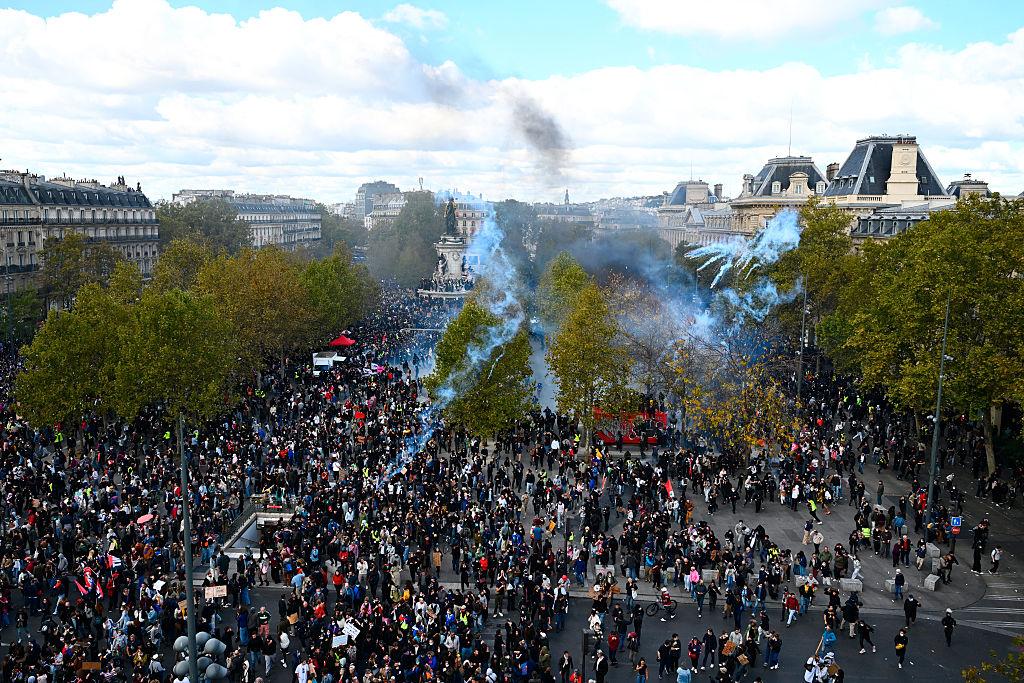
France remained the largest center of unrest on Saturday, October 24, with the Interior Ministry estimating that about 410,000 people participated nationwide while the CGT trade union put the figure substantially higher at close to 800,000. Authorities said approximately 110,000 demonstrators marched in Paris alone as protests that initially grew out of student anger over school conditions expanded into a much broader campaign involving workers, unions, young people and citizens protesting living costs, inequality and public-service pressures.
The demonstrations marked the second consecutive weekend of large-scale French protests after serious disturbances on October 17 produced rioting, fires, property damage, looting and confrontations with police. The government consequently mounted an enormous security operation for Saturday’s rallies, deploying roughly 70,000 police and security personnel across the country in an effort to prevent a repeat of the previous weekend’s violence.
Much of the main Paris demonstration passed peacefully, but clashes erupted as sections of the crowd dispersed. Masked protesters threw objects and fireworks at officers, while police responded with tear gas, water cannons and other crowd-control measures. Similar confrontations were reported in cities including Marseille, Lyon, Bordeaux, Lille and Nantes, and French authorities said nearly 1,000 arrests had been made during the latest demonstrations.
The figures underline the scale of the political and security challenge facing the French government. What began as student protests over shortages of teachers, aging schools, overcrowded classrooms and inadequate educational resources has increasingly merged with a wider anger over household expenses, fuel and energy costs, housing affordability and the condition of public services.
Students have demanded more education funding, additional teachers, improved facilities and higher grants, while trade unions and other protesters have added calls for wage improvements, stronger social protections and measures to reduce household costs. Rent freezes and stronger action against poverty have also appeared among demonstrators’ demands.
The movement has become particularly potent because it brings together grievances that affect different parts of French society. High school and university students may be primarily concerned with education and housing, while workers focus on wages and public services and farmers and other groups have raised concerns about fuel prices and economic pressure. Those demands do not necessarily form a single political program, but their convergence has produced large demonstrations capable of placing sustained pressure on the government.
The violence associated with portions of the French protests has also complicated public debate. Many of those participating have marched peacefully, while smaller groups have attacked property or fought police. Government officials have argued that security forces must distinguish between legitimate protest and organized violence, while civil-rights groups and some opposition politicians have questioned whether the policing response has itself become excessively aggressive.
Saturday’s turnout showed that the deployment of additional police did not significantly reduce the willingness of people to demonstrate. Shops in some cities boarded windows or closed in anticipation of potential unrest, and authorities imposed restrictions on certain gatherings in locations considered particularly vulnerable.
The French protests have become a major political challenge in the closing period of President Emmanuel Macron’s presidency, particularly as parties across the political spectrum attempt to interpret the unrest through their own agendas. Opposition politicians have blamed the government for deteriorating living standards and public services, while government supporters have argued that political groups are attempting to exploit legitimate grievances for electoral advantage.
France is not alone. Italy experienced another weekend of demonstrations after violent unrest the previous week, with protesters gathering in Milan, Rome, Turin, Bologna, Naples, Florence and other cities over living costs, wages, public services and opposition to war.
Italian authorities significantly strengthened security after clashes, vandalism and looting during the previous weekend. Large numbers of police were deployed, additional soldiers were placed in key locations and some major shops closed voluntarily as a precaution.
Saturday’s Milan demonstration remained largely peaceful. Around 10,000 people marched through the city against rising living costs while approximately 1,400 law-enforcement officers and armored vehicles were deployed. Protesters moved from the area around Sforza Castle toward the Polytechnic University, with Reuters witnesses reporting no significant looting or property destruction during the march.
The situation was more confrontational elsewhere. Police and protesters clashed in Turin, Rome and Bologna, where officers faced bottles, stones, firecrackers and other projectiles. Riot units responded as demonstrations became tense, although the overall level of destruction appeared lower than during the previous weekend.
Italian police said they had conducted extensive searches and detained people in connection with both the latest demonstrations and the October 17 unrest. One person allegedly linked to organizing the so-called October 17 Movement was taken to police headquarters in Milan for questioning.
Italy’s protests combine several different currents. Some demonstrators are campaigning primarily against high living costs, low wages, rising rents and weaknesses in public health and education. Others are mobilizing against military spending and Italy’s involvement in international conflicts. Students and younger protesters have also focused on employment prospects and the difficulty of securing affordable housing.
That broad mixture resembles the movement taking shape elsewhere in Europe, where frustration is often not centered on one tax, one government measure or one political party but on a belief that the basic economic bargain is no longer working for a growing part of the population.
Housing has become one of the most powerful common grievances. Portugal witnessed renewed protests this weekend as demonstrators in Lisbon demanded affordable homes and accused the government of failing to address a severe property-price and rental crisis.
Portuguese police cleared a protest encampment from Lisbon’s central Rossio Square in the early hours of Sunday, October 25, after demonstrators refused orders to remove tents. Officers, including some accompanied by police dogs, moved into the square and baton-charged sections of the crowd, with authorities later reporting 25 arrests.
Minor injuries were reported during the operation. The clearance followed a much larger demonstration the previous weekend when tens of thousands marched through Lisbon over rising housing and general living costs.
Portugal has one of Europe’s sharpest housing-affordability problems. Property prices have more than doubled since 2017, while rents on new contracts have risen dramatically. Young adults have been particularly affected because salaries have not increased at the same pace, leaving many unable to afford independent accommodation in Lisbon, Porto and other major cities.
Housing campaigners argue that property speculation, tourism demand and investment have pushed residents out of central areas while governments have failed to build enough affordable housing. They are demanding stronger tenant protections, more public housing and measures to prevent speculative price increases.
Portugal’s housing protests increasingly overlap with anger about inequality and wages. Demonstrators say many young people are being forced either to remain living with their parents well into adulthood or leave the country entirely in search of better economic opportunities.
Similar frustrations have been visible in Spain. Demonstrators in Madrid marched this weekend to defend public pensions, calling for retirement payments to rise with inflation, the minimum pension to be aligned more closely with the minimum wage and the public pension system to be protected from privatization.
Spain has also experienced separate housing demonstrations and tent encampments in recent weeks, particularly in Madrid and Barcelona, where rapidly rising rents and shortages of affordable accommodation have become major political issues.
Teachers and education workers have joined protest activity in parts of Spain, adding another layer to a broader debate over how European governments are financing social services after years of inflation, pandemic-era expenditure and increased defense commitments.
The continent’s education crisis is particularly visible among younger protesters. Students in France, Greece, Albania and other countries have demonstrated over deteriorating facilities, teacher shortages, university funding, tuition fees and concerns that education systems are no longer providing the pathway to stable employment they were once promised.
In Greece, thousands of teachers, public-sector employees and students marched in Athens earlier in the week demanding increased school funding and measures to address living costs. Their demonstration forms part of the broader wave of youth-led protests taking place across the continent.
For younger Europeans, education complaints frequently intersect with housing and employment pressures. Students face rising rents while studying, graduate into expensive housing markets and then encounter salaries that often fail to match the cost of living. That combination helps explain why a movement beginning with school conditions can quickly expand into a wider economic protest.
Albania presents one of the clearest examples of protests moving beyond economic grievance into direct anti-government confrontation. Demonstrators returned to the streets of Tirana on Sunday after several days of unrest demanding improvements in education, action against corruption, better economic opportunities and, among some groups, the resignation of Prime Minister Edi Rama.
Student-led demonstrations have spread in Tirana and other Albanian cities, with participants criticizing unemployment, education standards and what they see as entrenched corruption. The protests have increasingly drawn artists, opposition parties and other groups dissatisfied with the government.
Violence has escalated sharply during some Albanian demonstrations. Protesters have attacked government buildings, banks and shops, while riot police have deployed water cannons and tear gas. Fires have been set at public buildings, and hundreds of protesters and officers have been reported injured over the course of the unrest.
On Sunday, protesters gathered outside the Education Ministry before moving toward the prime minister’s office. Demonstrators burned chairs that Rama had placed outside as a symbolic invitation to dialogue, illustrating the extent to which distrust between protesters and the government has deepened.
Rama has rejected demands that he resign as a result of street violence while acknowledging that some of the grievances being expressed by demonstrators are legitimate. His government has introduced tough new penalties aimed at discouraging violent demonstrations, including heavy fines for participants in protests that turn violent.
Critics argue those measures risk punishing people who participate peacefully in demonstrations where others commit offenses. The government says stronger rules are necessary because public buildings and private businesses have been attacked.
The Albanian movement predates the current European protest wave in some respects, having grown from earlier campaigns over development projects, corruption and government accountability. But its expansion into education and economic grievances has placed it increasingly within the wider pattern of dissatisfaction now visible across the continent.
The protests should therefore not be described as one centrally coordinated European uprising. Demonstrators in Paris, Milan, Lisbon, Madrid and Tirana are not participating in a single organization or pursuing identical demands. Each country has its own political circumstances, institutions and immediate triggers.
What links them is the broader economic and generational environment in which the movements are developing.
Housing has become increasingly unaffordable in major European cities. Energy and fuel costs remain politically sensitive. Wages have struggled to match cumulative price increases. Governments face pressure to reduce deficits even as citizens demand more spending on schools, hospitals and public services.
At the same time, European countries are spending more on defense as security concerns involving Russia and other global conflicts grow. Protesters on the left in Italy and elsewhere have explicitly questioned why governments can find additional money for military commitments while claiming limited resources are available for education, housing and healthcare.
That debate is likely to intensify as national budgets become tighter. European governments emerged from the COVID-19 pandemic with elevated debt levels before facing an energy crisis following Russia’s invasion of Ukraine, and many are now attempting to balance fiscal consolidation with demands for greater social spending.
Ordinary households experience that debate much more directly. To them, the policy question can mean whether a rent payment consumes half a salary, whether a child has enough teachers at school or whether public transportation, healthcare and pensions remain affordable.
The result has been a growing sense that economic statistics showing moderate inflation or employment growth do not always reflect lived experience. Even when inflation rates decline, prices generally remain much higher than before the inflationary surge, meaning purchasing power can stay weak for years unless wages catch up.
That distinction has become politically explosive. Governments can point to slowing inflation while voters continue paying permanently higher rents, food prices and energy bills. Protest movements thrive in that gap between macroeconomic improvement and household frustration.
Young people face an especially difficult version of that problem. Many entered adulthood during a sequence of disruptions including the global financial crisis, the pandemic, inflation, housing shortages and geopolitical conflict. Home ownership has become increasingly remote in major cities, while temporary employment and high rents make long-term financial planning difficult.
Education protests therefore carry significance beyond school budgets. They express concern about whether public institutions can still provide upward mobility and social security.
The demonstrations also create opportunities for political movements on both the left and right. In France, parties are competing to channel anger over fuel prices and living costs, while in Italy and elsewhere politicians have attempted to associate themselves with particular parts of the protest agenda.
There is a risk, however, that violence could shift public opinion away from the protesters’ underlying concerns. Images of burning buildings, looted shops and confrontations with police can dominate coverage even when most demonstrators remain peaceful.
Governments have repeatedly emphasized that distinction. They say citizens have a right to protest but that violent groups cannot be allowed to destroy businesses or attack police.
Protest organizers, meanwhile, often argue that aggressive policing can itself escalate tensions and that governments sometimes use isolated violence to discredit much larger peaceful movements.
France provides perhaps the clearest example of that battle over public perception. Hundreds of thousands marched this weekend, but dramatic scenes of tear gas, arrests and clashes competed with the economic demands that brought most people onto the streets.
The same dynamic appeared in Italy. Milan’s march was largely peaceful, while clashes in Bologna, Turin and Rome created a more dramatic national picture.
Portugal’s confrontation over the Rossio Square encampment similarly illustrates how disputes can escalate when police move to dismantle protest sites that activists see as symbols of a broader social crisis.
The spread of encampments is itself significant. Housing protesters in Spain and Portugal have used tents to represent the impossibility of securing affordable homes, borrowing tactics associated with previous social movements and student occupations.
Such protests can be difficult for authorities to manage because they are designed to remain in public spaces rather than end after a conventional march. Removing them can produce confrontations that generate additional media attention and potentially strengthen the campaign.
Europe’s governments are therefore facing a difficult balancing act. They need to maintain public order while addressing economic complaints that cannot simply be solved through policing.
Additional security forces can prevent looting, but they cannot lower rent. Arresting violent protesters can restore control to a street, but it does not solve teacher shortages or stagnant wages.
The durability of the current unrest will consequently depend partly on whether governments provide political or economic responses that protesters consider meaningful.
In France, unions are already discussing additional mobilizations and industrial action. Italy’s labor movement has also signaled further demonstrations and strike activity. Housing activists in Iberia show little indication that they intend to abandon their campaigns.
Albania’s protesters are openly challenging the political leadership itself, meaning the confrontation there could persist even if the government offers limited economic concessions.
The coming weeks will therefore determine whether Europe’s autumn of protests remains a collection of separate national movements or increasingly produces a broader political narrative about generational insecurity and declining confidence in governments.
There is already evidence of cross-border inspiration. Demonstrators and organizers monitor protest tactics in other countries through social media, and movements in Italy have openly referenced unrest elsewhere in Europe.
That does not mean they are centrally directed, but digital communication allows grievances and protest strategies to travel quickly.
Images from Paris can inspire activists in Milan. Housing camps in Spain can influence demonstrations in Portugal. Student activism in France can resonate with young people in Albania and Greece who believe their own education systems are underfunded.
The political consequences could extend beyond immediate policy concessions. Several European countries face important elections, and dissatisfaction over living standards can reshape voter behavior even where protests themselves do not produce legislative change.
Economic insecurity has historically benefited both populist left-wing and right-wing movements, depending on which parties voters believe are most capable of challenging established institutions.
This makes the government response particularly consequential. Heavy-handed security tactics can deepen anger, while promises without visible improvements may reinforce mistrust.
At the same time, governments face legitimate security concerns where demonstrations involve arson, looting or attacks on police.
The continent is therefore entering a politically delicate period in which economic frustration, generational anxiety and questions about public order are increasingly intertwined.
What should not be lost in the images of burning barricades and riot police is the range of demands underlying the unrest. In France, protesters are talking about schools, wages, public services and living costs. In Italy, the agenda includes household expenses, jobs and opposition to war. Portugal’s central issue is housing. Spanish demonstrations have emphasized pensions and housing. Albanian protesters combine education complaints with corruption and demands for political accountability.
The protests are different, but they share dissatisfaction with the ability of existing institutions to provide economic security and functioning public services.
That is what makes the second weekend significant.
One weekend of unrest can be dismissed as a temporary eruption. Repeated demonstrations across several countries suggest deeper grievances that governments may need to address over a longer period.
France’s more than 400,000 protesters, Italy’s repeated demonstrations, Portugal’s housing encampments and Albania’s continuing anti-government mobilization indicate that the anger has not disappeared after an initial burst of attention.
The scale of violence varies dramatically. Much of the protesting remains peaceful, particularly in Spain, Portugal and sections of Italy, while France, Albania and some Italian cities have experienced serious confrontations.
It would therefore be inaccurate to describe all of Europe as descending into riots.
What Europe is experiencing is a broad and increasingly visible period of social protest, with violent unrest emerging in particular cities and movements.
That distinction matters because governments must respond to both realities: the criminal conduct of people who attack buildings or police and the much larger political dissatisfaction driving peaceful citizens into the streets.
By Sunday evening, those two realities remained visible across the continent. Police were clearing protest camps in Lisbon, demonstrators were again gathering in Tirana, French authorities were processing hundreds of arrests, and Italian cities were assessing another weekend of marches.
The unrest may subside, or it may evolve into strikes, additional demonstrations and electoral backlash.
For now, however, the message coming from streets across several European capitals is increasingly difficult for governments to ignore: many citizens believe that housing, education, wages, pensions and public services are failing to keep pace with the economic demands being placed on them.
The protests are not one movement, but together they represent a warning that Europe’s cost-of-living and public-service pressures are becoming not only economic problems but major political ones.