
FBI ANNOUNCES MAJOR GHANA SCAM-COMPOUND TAKEDOWN AS 130-PLUS ARE DETAINED AND 300 DEVICES SEIZED
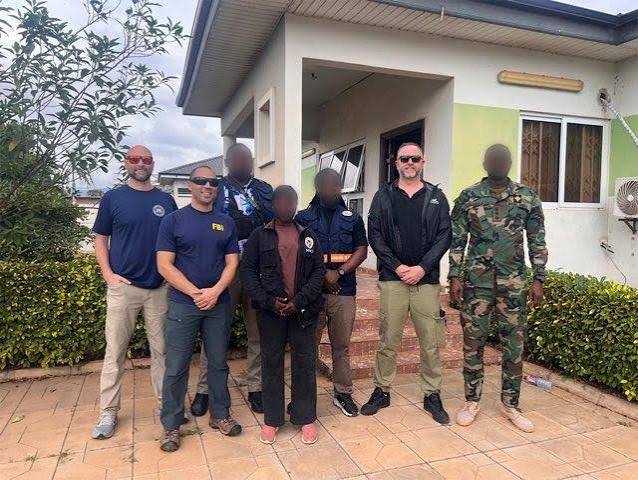
FBI Director Kash Patel says an Operation Blackout action in Ghana has resulted in more than 130 people being arrested or detained, 89 victims identified, nearly $10 million in losses linked to the operation and more than 300 devices seized. Crucially, the 130-plus total includes trafficking victims who are expected to be repatriated, meaning not everyone detained should be described as a fraud suspect. The FBI has not yet disclosed the raid location, nationalities involved, the Ghanaian agencies that participated or whether any suspects will face prosecution in Ghana or extradition to the United States. Ghanaian news organizations also reported Thursday that the Ghana-specific figures had not yet been independently confirmed by local authorities.
The United States Federal Bureau of Investigation has announced a major crackdown on an alleged transnational scam operation in Ghana, saying more than 130 people were arrested or detained, more than 300 electronic devices were seized and investigators have so far linked the network to nearly $10 million in identified losses suffered by at least 89 victims.
FBI Director Kash Patel disclosed the operation on Thursday as part of what the bureau calls Operation Blackout, an international campaign targeting large scam compounds and organized cyber-enabled fraud networks that prey primarily on victims in the United States. Patel said the Ghana action occurred this week and remains under investigation, but the FBI has not yet publicly identified the location of the compound, the nationalities of those detained, the Ghanaian agencies involved or how many of those taken into custody are suspected operators rather than trafficking victims.
That distinction is especially important because Patel said the figure of more than 130 people arrested or detained includes victims who are expected to be repatriated to their home countries. It would therefore be inaccurate at this stage to describe all of those detained as fraud suspects. The FBI’s own account indicates that at least some of the people found inside the operation may themselves have been trafficked or coerced into participating in online scams, a pattern increasingly documented in criminal compounds across Southeast Asia, the Middle East and parts of Africa.
According to Patel, investigators have identified 89 victims connected to the Ghana operation and losses approaching $10 million. More than 300 phones, computers or other electronic devices were also seized and are expected to become a major source of evidence as investigators reconstruct communications, financial transfers, account access, victim lists and possible links to additional criminal networks. The FBI has not yet released a detailed breakdown of the fraud methods involved in the Ghana case, and it has not identified the 89 victims or disclosed whether the losses represent money already transferred, attempted theft or a combination of both.
The operation represents one of the largest publicly announced fraud-compound enforcement actions in Ghana this year and comes amid growing cooperation between Ghanaian and American authorities over online fraud, romance scams, money laundering and other forms of transnational cybercrime. Ghanaian agencies have carried out several raids on suspected cybercrime centers over the past two years, in some cases discovering foreign nationals who authorities said had been lured into Ghana with promises of legitimate employment and then forced to conduct online fraud.
By Thursday afternoon, however, key details surrounding the latest action remained undisclosed. The Ghana Police Service, Economic and Organised Crime Office, Cyber Security Authority and National Intelligence Bureau had not publicly issued detailed statements identifying their roles in the operation. The FBI director’s announcement similarly did not state which Ghanaian agencies executed arrests, where the compound was located or whether any suspects are expected to face charges in Ghana, extradition requests from the United States or prosecution in another jurisdiction.
That lack of detail matters because the FBI does not ordinarily exercise independent arrest powers on Ghanaian territory in the same way it does inside the United States. International operations generally depend on cooperation with the host country’s law-enforcement authorities, and Ghana has previously worked with American investigators in arresting suspects, gathering evidence and executing extradition proceedings. Until Ghanaian authorities publish their own account, the exact operational structure behind this week’s raid remains unclear.
The FBI’s description of the site as a scam compound also places the Ghana operation within a broader and increasingly disturbing international criminal model. Large fraud networks have developed facilities where groups of workers are housed and directed to conduct online investment scams, cryptocurrency fraud, romance scams, business email compromise, sextortion and other schemes against people in wealthier countries. In some cases, workers participate knowingly, while in others they are recruited through deceptive job advertisements, trafficked across borders, confined and threatened if they fail to meet fraud targets.
The distinction between perpetrator and victim can therefore become complicated. Law-enforcement agencies investigating these compounds increasingly have to determine who organized the operation, who supervised the fraud, who moved the stolen money and who may have been forced to work under coercive conditions. Patel’s statement that some of the Ghana detainees will be repatriated strongly suggests that investigators have identified at least some people they do not regard primarily as criminal defendants.
Ghana has confronted similar cases before. In April 2025, the Economic and Organised Crime Office announced the arrest of 219 people in Oyarifa in an operation involving National Security, the Criminal Investigations Department and the Ghana Armed Forces. EOCO said only 35 were being treated as suspects, while the others were believed to have been trafficked into Ghana and forced to engage in cybercrime. Most of those detained were Nigerian nationals, including minors, and authorities recovered laptops, phones and internet equipment.
Other raids have followed. Ghanaian security agencies have targeted suspected fraud operations in Greater Accra and other parts of the country, sometimes finding dozens or even hundreds of people living and working together in rented residential properties. Those cases have drawn attention to the possibility that international scam networks are using Ghana not only as a base for individual internet fraudsters but also as a location for more organized operations involving recruitment, trafficking, accommodation and centralized control.
That emerging model differs significantly from the traditional image of isolated online scammers working individually from homes or internet cafés. Large compounds can function more like criminal businesses, with specialized roles for recruitment, communications, technical support, financial transfers and management. Workers may be instructed on how to create false online identities, cultivate relationships with victims and move stolen funds through cryptocurrency accounts, bank accounts or money-mule networks.
American authorities have become increasingly focused on those operations because fraud losses in the United States have risen sharply. Older Americans are particularly vulnerable to romance, investment and cryptocurrency schemes in which criminals spend weeks or months building trust before persuading victims to transfer large amounts of money. The psychological consequences can be as severe as the financial losses, especially when victims lose retirement savings or borrow money to continue sending funds to people they believe they know.
Patel has made international scam compounds a major focus of his leadership of the FBI. In previous public statements, he has said the bureau is increasingly working with foreign law-enforcement agencies to disrupt fraud networks at their physical source rather than limiting investigations to recovering funds after American victims have already been defrauded. He has described enforcement actions in Southeast Asia and the Middle East involving large numbers of arrests, trafficked workers and seized electronic devices.
Operation Blackout is the name the FBI is using for that wider effort. Patel said Thursday that the operation has produced roughly $17 billion in seized assets or fraud-related funds, hundreds of arrests and the freeing of thousands of trafficked workers. He also said more than 10,000 Americans have been warned before losing money and estimated that approximately $670 million in potential losses has been prevented.
Those figures are FBI claims and should be understood with some caution until more detailed accounting is available. The bureau has not publicly released a comprehensive audited breakdown explaining how the entire $17 billion total is calculated. Earlier large figures associated with the campaign have included enormous cryptocurrency forfeiture actions, including assets tied to alleged scam networks in Southeast Asia, meaning the headline amount does not necessarily represent cash physically recovered from individual compounds.
The Ghana-specific figures are also based primarily on Patel’s public statement and have not yet been independently verified in full by Ghanaian authorities. Local news organizations reporting the operation have similarly noted that no detailed Ghana government account had been published by the time of reporting. The FBI’s announcement should therefore be treated as the authoritative American account of an ongoing investigation rather than as a complete final case record.
What can be established is that the operation comes during a period of significantly closer cooperation between Ghana and the United States on fraud investigations. In July, Ghanaian national Frederick Kumi, widely known as Abu Trica, was extradited to the United States to face charges connected to an alleged romance-fraud network. U.S. prosecutors said the network targeted more than 80 elderly Americans and caused losses exceeding $8 million.
Kumi was arrested in Ghana in December 2025 and extradited in July 2026. American authorities specifically acknowledged assistance from Ghana’s Attorney-General’s Office, EOCO, the Ghana Police Service, the Cyber Security Authority, the National Intelligence Bureau and the FBI Legal Attaché Office in Accra. His case demonstrates the legal and operational infrastructure that already exists for Ghanaian agencies and the FBI to work together on cases involving American victims.
The latest raid could produce similar extradition questions if investigators identify alleged organizers accused of committing offenses prosecutable under U.S. federal law. Wire fraud, money laundering and conspiracy charges are frequently used in American cases involving overseas fraud networks that target victims or financial institutions in the United States. Extradition would still require formal legal proceedings in Ghana, and no announcement has yet been made that any individual from the current operation is being sought for transfer to U.S. custody.
Ghana could also prosecute suspects domestically. EOCO has statutory authority to investigate economic and organized crime, including money laundering, human trafficking and prohibited cyber activity, while the Ghana Police Service and Cyber Security Authority have roles in investigating cybercrime and digital offenses. Which path is ultimately taken may depend on the nationality of the suspects, the location of the victims, where criminal proceeds moved and which authorities possess the strongest admissible evidence.
The more than 300 seized devices will be important in answering those questions. Modern fraud investigations are heavily dependent on digital forensics because computers and phones can contain messaging accounts, victim databases, cryptocurrency wallet information, bank credentials, scripts used to manipulate victims and communications between organizers and workers. Devices can also establish whether people inside a compound were operating independently or under centralized instructions.
Financial records will be equally important. Fraud networks frequently move money through multiple accounts and countries to make recovery difficult. Some rely on money mules who receive transfers on behalf of criminals, while others convert funds into cryptocurrency before moving them across wallets or exchanges. Investigators will need to trace whether the nearly $10 million attributed to the Ghana operation remained inside the country, moved elsewhere in Africa or was transferred into international financial networks.
The investigation may also determine whether the identified $10 million represents the full scope of the operation. Large cybercrime cases frequently expand as authorities review seized devices and uncover additional victims who had not previously reported their losses. Many fraud victims initially remain silent because they are embarrassed, believe the money can still be recovered or do not immediately understand that the person they trusted online was part of a criminal scheme.
Patel’s statement that there is “more to come” suggests the FBI expects the Ghana investigation or the broader Operation Blackout campaign to produce additional developments. That could include more arrests, identification of additional victims, financial seizures or action in other countries connected to the same networks.
For Ghana, the case creates an important reputational and law-enforcement challenge. The country has developed one of West Africa’s more advanced digital economies, with strong growth in mobile money, financial technology and online services. That expansion has produced significant economic benefits but has also increased exposure to cybercrime and financial fraud. Ghanaian authorities have repeatedly stressed that organized online crime threatens the country’s international reputation and can undermine confidence in legitimate digital businesses.
The emergence of large fraud compounds adds another dimension because the issue is no longer only cybercrime. Where people are trafficked into Ghana and forced to work in scam operations, the same network can involve immigration offenses, unlawful confinement, labor exploitation and human trafficking alongside financial crime. That requires coordination among multiple agencies rather than a narrow cybercrime investigation.
The treatment of those detained will therefore become one of the most important unresolved issues in the current case. Authorities must determine which individuals are suspected organizers or willing participants and which should instead be treated as trafficking victims. Patel’s statement confirms that some detainees fall into the second category, but no official number has been released.
It is also not yet known from which countries those victims came or how they were recruited. Previous Ghana cases have involved large numbers of Nigerians, but authorities have not publicly disclosed the nationality of the people detained this week. It would therefore be premature to characterize the current operation as involving any particular national group.
That caution is especially important because fraud-compound reporting can easily blur nationality and criminal responsibility. The presence of foreign nationals at a crime scene does not mean all are suspects, just as the presence of Ghanaian residents does not establish they organized the operation. The ongoing investigation will have to establish individual roles based on evidence.
The case may also prompt renewed scrutiny of landlords and property owners. Large scam operations typically require houses, offices or compounds capable of accommodating dozens of people and large numbers of computers. Ghanaian authorities have previously arrested or questioned property owners in cases where premises were allegedly used for organized cybercrime, raising questions about how much landlords knew about the activities taking place on their properties.
Telecommunications companies and financial institutions may also be asked to cooperate as investigators trace SIM cards, internet connections, mobile-money accounts and bank transfers linked to the seized devices. Ghana’s SIM-registration and financial-monitoring systems are designed partly to make such tracing easier, although criminals often attempt to circumvent identity controls using third-party accounts or fraudulently obtained documents.
The broader Operation Blackout campaign reflects a major shift in how U.S. authorities are approaching online fraud. Rather than treating each American victim as an isolated case, investigators increasingly view scam compounds as part of transnational organized-crime structures that combine technology, trafficking and financial laundering. That approach can make international partnerships more important than traditional domestic investigations because many of the people sending fraudulent messages may never enter the United States.
For Ghana, cooperation with the FBI gives authorities access to victim reports, financial intelligence and technical evidence from the United States while Ghanaian agencies provide the legal authority and operational capacity to act locally. The effectiveness of that partnership will ultimately be judged by whether organizers are identified and prosecuted, victims are safely repatriated and criminal proceeds are recovered rather than by arrest numbers alone.
Thursday’s announcement is therefore significant but still incomplete. The FBI says more than 130 people have been arrested or detained, 89 victims have been identified, nearly $10 million in losses have been traced and more than 300 devices have been seized. It also says an unknown number of the people found in the operation are trafficking victims who will be returned to their home countries.
What remains unknown is substantial: the precise location of the operation, the identities and nationalities of those detained, the number of suspected perpetrators compared with victims, the Ghanaian agencies that participated, the fraud schemes used, the destination of the stolen money and whether any suspects will face prosecution or extradition.
Those details will determine the true scale and significance of the case. The FBI has presented the Ghana takedown as part of a worldwide offensive against scam compounds, while Ghana’s own recent history shows that cybercrime operations can overlap with serious human-trafficking networks. The investigation is now expected to move from the dramatic figures announced Thursday into the slower work of digital forensics, financial tracing and individual case assessment needed to establish who committed crimes, who was exploited and how far the network extended beyond Ghana.