ADELEKE SWORN IN FOR SECOND TERM AS OSUN GOVERNOR, CALLS FOR POLITICAL RECONCILIATION AND ECONOMIC TRANSFORMATION
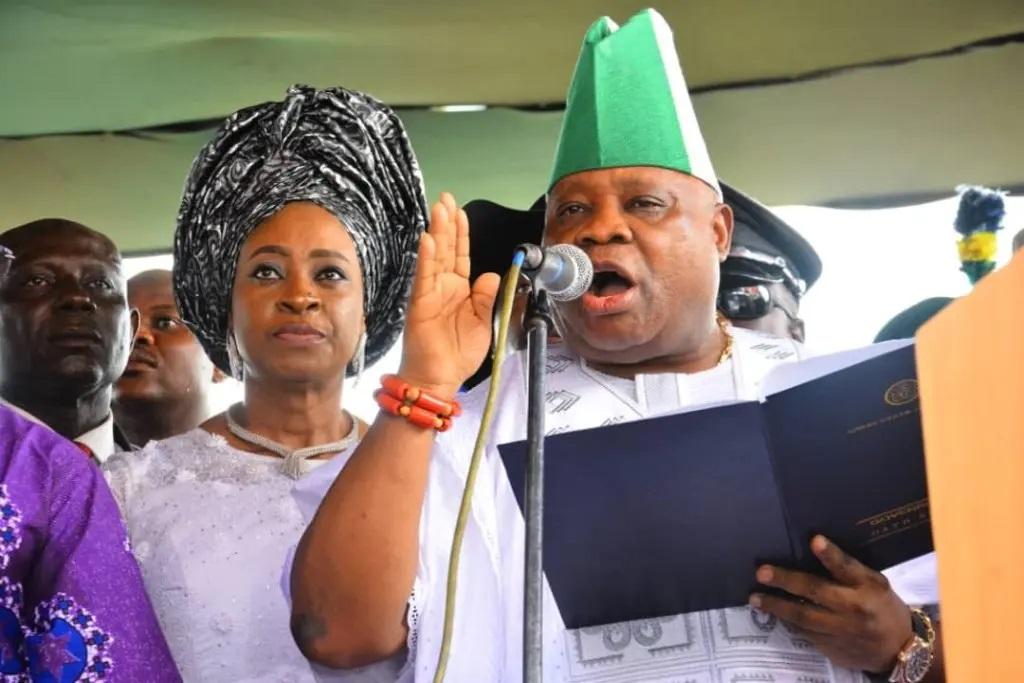
Osun State Governor Ademola Adeleke and his deputy, Kola Adewusi, were sworn in for a second term on Friday, November 27, 2026, during a ceremony at the Osogbo Township Stadium attended by Vice President Kashim Shettima, former Senate President Bukola Saraki and other prominent political figures. Adeleke called for reconciliation among political leaders, urging them to put past disagreements aside and collaborate toward the state's development. The governor announced plans to strengthen electricity regulation, create employment, expand healthcare services and transform Osun into an industrial economy through agro-processing, industrial parks, free trade zones, tourism and sports development. He also expressed confidence that the longstanding local government crisis would be resolved within one week following President Bola Tinubu's intervention.
Osun State Governor Ademola Adeleke was sworn in for a second term on Friday, November 27, 2026, calling on political leaders, opposition figures and residents to put aside past disagreements and work collectively toward the development of the southwestern Nigerian state. Speaking before a gathering of political leaders, traditional rulers, government officials and supporters at the Osogbo Township Stadium, Adeleke outlined an ambitious development agenda centered on industrialization, electricity generation, employment creation, affordable healthcare and economic diversification, while expressing optimism that a prolonged dispute affecting local government administration would soon be resolved following the intervention of President Bola Ahmed Tinubu.
Adeleke and his deputy, Kola Adewusi, took their oaths of office and allegiance before the Chief Judge of Osun State, Justice Adepele Ojo, formally commencing another four-year administration following their victory in the August 15, 2026, governorship election. The ceremony attracted several prominent national political figures, including Vice President Kashim Shettima, former Senate President Bukola Saraki, former Osun State Governor Bisi Akande and Ondo State Governor Lucky Aiyedatiwa, reflecting the wider political significance of an inauguration that brought together representatives from different political parties.
The governor used his inaugural address to emphasize the importance of reconciliation following a period of intense political competition and institutional disagreements within the state. He called on members of the political establishment to demonstrate greater cooperation, transparency and commitment to public welfare, arguing that the development of Osun should take precedence over disagreements arising from previous electoral contests and political confrontations.
Adeleke also paid tribute to individuals who lost their lives during incidents of political violence, observing a minute of silence in their memory. The gesture introduced a solemn dimension to an otherwise celebratory occasion and underscored the challenges confronting political leaders as the state attempts to move beyond a contentious period marked by disputes over electoral processes, local government administration and control of public institutions.
“Fellow citizens, we must heal the wounds of the past and unite for our collective good,” Adeleke declared during his address. The governor subsequently called for greater cooperation among political leaders and stakeholders, emphasizing that sustainable development would require participation extending beyond the boundaries of individual political organizations.
His appeal came more than three months after the Independent National Electoral Commission declared him the winner of the August 15 governorship election, in which he contested under the platform of the Accord Party. Adeleke secured 511,067 votes, defeating his closest challenger, Bola Oyebamiji of the All Progressives Congress, who received 444,815 votes. The victory provided Adeleke with a renewed electoral mandate after a politically eventful first term that included significant changes in his party affiliation and disagreements involving opposition-controlled political structures.
The election result was particularly significant because Adeleke had originally assumed the governorship in November 2022 as a member of the Peoples Democratic Party. His subsequent reelection on a different political platform represented a notable development in Osun's political history and illustrated the changing relationships among political parties and influential figures ahead of Nigeria's 2027 general elections.
Adeleke entered his first term after defeating then-incumbent Governor Adegboyega Oyetola in the July 16, 2022, governorship election. That victory ended the immediate period of APC control over the state executive and established a new political environment characterized by competition over administrative authority, public policy and the direction of Osun's development.
The 2022 election was followed by legal challenges concerning the validity of Adeleke's victory. An election petition tribunal initially ruled against him, but the Court of Appeal subsequently overturned that decision, and the Supreme Court affirmed his election in May 2023. The proceedings highlighted the importance of judicial institutions in resolving electoral disputes and reinforced the competitive nature of politics in Osun.
Four years later, Adeleke's second-term inauguration has provided another opportunity for political leaders to reassess their relationships following prolonged electoral competition. The attendance of figures associated with the APC, PDP and other political organizations demonstrated that representatives of competing parties could participate in a common constitutional ceremony, even though their broader political disagreements remain unresolved.
Vice President Shettima's presence was especially notable given the longstanding disagreements involving the Osun State government and political figures associated with the APC. His attendance on behalf of the federal administration placed renewed attention on the relationship between the state and federal governments, particularly as Adeleke seeks assistance in resolving administrative disputes and advancing economic development initiatives.
Former Governor Bisi Akande, a prominent figure within the APC and a longstanding participant in Osun politics, was also among the dignitaries present. Other attendees included former Senate President Bukola Saraki, former APC National Secretary Iyiola Omisore, Speaker of the Osun State House of Assembly Wale Egbedun and Secretary to the State Government Teslim Igbalaiye.
The participation of these political figures should not automatically be interpreted as an endorsement of every aspect of Adeleke's administration or a permanent reconciliation between their respective parties. However, their presence provided a significant setting for the governor's appeal for cooperation and demonstrated the possibility of maintaining institutional relationships despite continuing political competition.
One of the most consequential announcements in Adeleke's inaugural address concerned the prolonged controversy surrounding local government administration in Osun State. The governor said President Tinubu had intervened in the dispute and expressed confidence that the outstanding issues could be resolved within approximately one week.
The announcement has generated considerable interest because the local government controversy has affected the administration of public institutions and the availability of resources for essential services across the state's communities. Disagreements surrounding council leadership, electoral legitimacy and access to statutory allocations have remained contentious, creating uncertainty over the operation of the third tier of government.
Osun's local government crisis developed against a background of competing interpretations of court judgments and disputes arising from elections conducted during different administrations. Political parties have advanced conflicting positions concerning the legitimacy of council officials and the authority responsible for administering local government institutions.
The disagreements have consequences extending beyond the political interests of individual officeholders. Local governments are involved in the administration of primary healthcare facilities, community infrastructure, environmental sanitation, local markets and other services directly affecting residents. Disruptions to their operations can consequently undermine the delivery of essential public services, particularly in rural communities that depend heavily on local administrative structures.
Adeleke's announcement concerning Tinubu's intervention suggests that discussions involving the federal administration could provide a mechanism for addressing outstanding disagreements. However, the governor did not establish through his inaugural remarks that every legal and administrative issue had already been resolved. His expectation of a settlement within one week remains a stated objective rather than a confirmed outcome.
Any lasting resolution will need to address the legal questions surrounding local government leadership while ensuring that public resources are administered in accordance with applicable constitutional requirements. The involvement of federal authorities may facilitate dialogue, but the implementation of an agreement could still depend on court decisions, administrative procedures and cooperation among the institutions involved.
The controversy also intersects with Nigeria's wider debate over local government financial autonomy. In July 2024, the Supreme Court delivered a landmark judgment affirming important principles concerning the financial independence of democratically elected local government councils and the payment of their statutory allocations.
The judgment was widely regarded as a significant development in discussions about accountability and the distribution of public resources among Nigeria's federal, state and local governments. Its implementation, however, has involved practical and legal challenges, particularly in jurisdictions where disagreements persist concerning the legitimacy of elected council officials.
Osun has become one of the states where those broader questions have acquired considerable political significance. Resolving its local government dispute could provide greater administrative certainty for council employees and residents, while allowing officials to concentrate more effectively on the responsibilities assigned to local government institutions.
Adeleke told the inauguration gathering that his administration had continued supporting primary school teachers, healthcare workers and retired local government employees despite the difficulties associated with the dispute. The governor presented those interventions as part of his government's efforts to protect essential services and the welfare of public employees during a period of administrative uncertainty.
The restoration of normal local government operations would also have implications for several of the healthcare commitments announced in his second-term address. Adeleke indicated that his administration intends to rehabilitate the remaining 102 primary healthcare centers once the outstanding council issues are resolved.
Primary healthcare facilities represent an essential component of Osun's public health system, particularly for residents living outside major urban centers. These institutions provide services including maternal healthcare, childhood immunization, basic medical treatment and preventive health education, reducing the need for patients to travel considerable distances to larger hospitals.
The effectiveness of primary healthcare facilities depends on more than the physical condition of their buildings. Reliable electricity, clean water, medical equipment, medicines and qualified personnel are also necessary to provide dependable services. Rehabilitating existing centers could consequently require sustained investment extending beyond initial construction and renovation expenditure.
Adeleke also announced plans to improve general hospitals, recruit additional healthcare professionals and expand the availability of medicines. Those commitments form part of a broader effort to improve access to affordable medical care while addressing the operational limitations confronting public healthcare institutions.
For residents managing chronic medical conditions, improvements in public healthcare could reduce financial pressures associated with obtaining treatment from private facilities. However, the extent of those benefits will depend on the availability of medicines, staffing levels, the geographical distribution of healthcare resources and the affordability of services once the proposed improvements are implemented.
Healthcare recruitment presents another important challenge because Nigeria has experienced substantial migration among medical professionals seeking employment opportunities abroad. State governments attempting to strengthen public healthcare systems must consider remuneration, professional development, working conditions and other factors influencing the ability to attract and retain qualified personnel.
The administration's plans to recruit additional health workers will therefore need to be supported by appropriate budgetary provisions and sustainable employment arrangements. Recruiting personnel without maintaining adequate facilities, equipment and professional support could limit the effectiveness of the proposed reforms.
Beyond healthcare and local government administration, Adeleke placed considerable emphasis on transforming Osun's economic structure. He expressed a determination to reduce the state's longstanding dependence on public-sector employment and develop an industrial economy capable of generating opportunities through private investment, agricultural processing, manufacturing, tourism and other productive activities.
Osun's economy has historically relied substantially on agriculture, commerce, public administration and small-scale enterprise. Government employment and expenditure remain important sources of income across numerous communities, making the state's economic performance sensitive to fluctuations in public revenue and the ability of the administration to meet its financial obligations.
The governor's industrialization proposals are intended to broaden that economic foundation by creating conditions in which private businesses can establish productive operations and employ additional workers. His address identified agro-processing facilities, industrial parks, free trade zones and improvements to the general business environment as important components of the strategy.
Adeleke's emphasis on agro-processing reflects the economic opportunities associated with Osun's agricultural resources. The state produces crops including cocoa, cassava, maize, oil palm and other agricultural commodities that could support processing industries if appropriate infrastructure, financing and commercial partnerships are established.
Agricultural processing can enable producers to capture a greater share of the economic value associated with their products. Rather than selling raw commodities for processing elsewhere, farmers and businesses may benefit from local facilities capable of converting agricultural produce into finished or intermediate goods suitable for domestic consumption and export.
However, developing such industries requires dependable agricultural supply networks, affordable energy, transportation infrastructure, storage facilities and access to markets. Processing businesses must also maintain appropriate quality standards and operate at commercially sustainable levels if they are to generate long-term employment and contribute meaningfully to government revenue.
The proposed establishment of industrial parks across different districts could provide another mechanism for encouraging private-sector investment. Industrial parks generally offer businesses access to designated land, shared infrastructure and administrative arrangements that can reduce some of the costs associated with establishing manufacturing operations.
For Osun, developing industrial parks could create opportunities to distribute economic activity beyond Osogbo and other established urban centers. Communities situated near viable production facilities may benefit from employment, increased demand for local services and commercial opportunities associated with supplying industrial businesses.
Nevertheless, industrial parks do not automatically produce economic development merely because land has been designated or infrastructure constructed. Their effectiveness depends heavily on attracting businesses capable of operating competitively, ensuring reliable utilities and maintaining transparent arrangements governing investment and property access.
Adeleke's proposal to establish free trade zones presents comparable opportunities and challenges. Such zones can provide investment incentives and administrative arrangements intended to facilitate manufacturing, logistics and export-oriented activities. Their successful operation generally requires cooperation with relevant federal regulatory institutions and sufficient commercial demand from prospective investors.
The governor indicated that his administration remains open to partnerships with private companies and economic advisory organizations. That commitment reflects the reality that establishing a diversified industrial economy would require resources and expertise extending beyond those available through ordinary state government expenditure.
Public-private partnerships could provide mechanisms for financing infrastructure and developing commercially viable projects without requiring the state to fund every component directly. However, those arrangements must be structured transparently to ensure that public assets are protected, contractual obligations are clearly defined and financial risks are appropriately distributed.
The ability of Osun to attract investors will depend partly on whether the administration can provide predictable policies and reliable administrative procedures. Businesses considering long-term commitments generally evaluate taxation, land acquisition processes, infrastructure availability, access to finance and the stability of applicable regulatory requirements.
Political reconciliation could therefore have direct economic significance if it contributes to greater institutional stability. Prolonged administrative disputes and uncertainty surrounding government decisions can discourage investment, particularly when projects require cooperation among state agencies, local councils and federal institutions.
Adeleke's call for cooperation among members of Osun's political establishment should be understood partly within that economic context. Implementing major infrastructure and industrial projects frequently requires decisions that extend beyond individual administrations or electoral cycles. Sustained institutional cooperation can help ensure that commercially viable projects are not unnecessarily disrupted whenever political leadership changes.
Electricity supply emerged as one of the principal issues identified by the governor as essential to Osun's industrial ambitions. Adeleke announced plans to operationalize the state's electricity regulatory framework, including the establishment of the Osun State Electricity Regulatory Commission.
The announcement follows broader changes in Nigeria's electricity sector that have expanded opportunities for state governments to participate in the regulation and development of electricity markets within their territories. The Electricity Act of 2023 established an important framework for such participation, allowing states to develop electricity legislation and regulatory institutions under specified arrangements.
For Osun, establishing a functioning state electricity regulator could provide an institutional foundation for attracting investment in power generation, distribution and other electricity services. The commission's effectiveness would depend on its technical capacity, operational independence, regulatory clarity and ability to coordinate with existing electricity market participants.
Reliable electricity remains one of the most important considerations for businesses operating across Nigeria. Manufacturers frequently require uninterrupted power for production equipment, refrigeration, lighting and other industrial processes. Unreliable electricity can increase operating expenses by forcing companies to rely on diesel generators or alternative energy arrangements.
Small and medium-sized enterprises are particularly sensitive to those costs because they may lack the financial resources available to larger industrial companies. Businesses operating in food processing, welding, tailoring, refrigeration and technology services can experience significant reductions in productivity when electricity interruptions become frequent.
Improving electricity supply could therefore have consequences extending beyond large-scale industrial development. More dependable power could support local enterprises, improve educational facilities and strengthen healthcare services while reducing the financial burden associated with alternative electricity generation.
Establishing a regulatory commission, however, does not immediately guarantee that residents and businesses will receive stable electricity. Additional investment may be required in generation capacity, distribution infrastructure, metering and technical maintenance. Financing arrangements, consumer affordability and the relationship between state and national electricity institutions will also influence the success of the reforms.
The second-term administration will consequently face the challenge of converting regulatory changes into measurable improvements in electricity availability. Households and businesses will ultimately assess the effectiveness of the initiative through factors such as service reliability, billing transparency and the cost of obtaining power rather than the establishment of new institutions alone.
Adeleke's economic development agenda also identified tourism and sports as sectors capable of contributing to employment and revenue generation. Osun possesses significant cultural, historical and religious attractions, including the Osun-Osogbo Sacred Grove, which UNESCO recognized as a World Heritage Site in 2005.
The grove and its associated cultural festival attract visitors from different parts of Nigeria and abroad, providing commercial opportunities for hospitality businesses, transportation providers, artisans and other local enterprises. Ile-Ife also occupies an important position in Yoruba cultural history, while other communities possess heritage sites and natural attractions that could support tourism development.
Expanding the state's tourism industry would require attention to transportation, accommodation, visitor safety, environmental conservation and the preservation of cultural heritage. Commercial development around historic sites must also consider the interests of local communities and the importance of protecting locations with religious or cultural significance.
Tourism can create employment opportunities across several industries, but its economic contribution depends on the ability to attract visitors consistently and encourage expenditure within local communities. Investments in destination promotion must therefore be accompanied by practical improvements in the services and infrastructure available to tourists.
Sports development presents another potential area of economic activity, particularly through investment in facilities, youth training programs and organized competitions. Well-managed sports infrastructure can support community participation and create opportunities for businesses providing equipment, accommodation, transportation and event-related services.
The administration will nevertheless need to establish how proposed sports investments fit within the state's broader financial priorities. Developing facilities requires resources not only for construction but also for maintenance, staffing and programming. Projects that receive considerable initial investment without sustainable management arrangements can struggle to provide lasting public benefits.
The relationship between youth employment and economic diversification will remain particularly important during Adeleke's second term. Expanding manufacturing, agricultural processing and technology-related businesses could create opportunities for young residents who might otherwise depend on public-sector recruitment or seek employment outside the state.
Reports of the inaugural address also identified digital development and job creation among the administration's priorities. Technology-based enterprises can provide employment opportunities requiring relatively limited physical infrastructure compared with some traditional manufacturing industries, although their success depends on internet connectivity, reliable electricity and access to appropriate skills.
Supporting digital enterprises could complement Osun's proposed industrial development by helping businesses adopt modern administrative, production and commercial systems. Technology can assist agricultural producers with market information, logistics companies with transportation management and small enterprises with access to customers beyond their immediate communities.
Educational and vocational institutions will have an important role in determining whether residents possess the skills required by emerging industries. Industrial development initiatives are unlikely to generate their full potential benefits if prospective employers cannot recruit suitably trained personnel within the state.
Partnerships between educational institutions and private businesses could help address that challenge by aligning training programs with actual employment requirements. Technical education, apprenticeships and practical skills development may become particularly important if Osun succeeds in attracting investment in manufacturing, agricultural processing, electricity services and digital technology.
The governor's emphasis on local content also has implications for the distribution of economic opportunities arising from public investment. Policies encouraging the participation of local businesses and workers can help ensure that development projects produce benefits within the communities where they are implemented.
However, local participation requirements must be balanced against the need to maintain appropriate technical standards, competitive procurement and financial accountability. Awarding contracts or employment opportunities solely on political or personal grounds could undermine the quality of public projects and discourage credible investors.
Transparent procurement procedures and accessible information concerning investment opportunities could help ensure that local businesses compete fairly for public contracts. Such arrangements would also support the governor's stated commitment to transparency by allowing residents and oversight institutions to assess how government resources are being utilized.
The financing of Adeleke's second-term agenda remains an important unresolved issue. Industrial parks, healthcare improvements, electricity infrastructure and tourism development all require substantial investment, while the state must continue meeting existing obligations involving public-sector salaries, pensions and essential administrative services.
Like other Nigerian states, Osun depends on a combination of internally generated revenue and allocations distributed through the federal revenue system. Fluctuations in national petroleum earnings, economic conditions and government fiscal policies can influence the resources available for implementing state development programs.
Improving internally generated revenue without imposing excessive financial burdens on residents and businesses will therefore represent a significant policy challenge. Expanding commercial activity could strengthen the state's revenue base over time, but major infrastructure investments may require considerable initial expenditure before producing measurable economic returns.
The administration will need to establish clear priorities and determine which projects can realistically be financed through existing resources, external borrowing or partnerships with private investors. Public borrowing can support productive investment under appropriate conditions, but excessive debt obligations may limit the resources available for future development and essential services.
A comprehensive financial plan will also be necessary to ensure that development projects do not undermine commitments to workers and pensioners. For many households in Osun, the timely payment of salaries and retirement benefits remains an important determinant of financial stability, particularly in communities where public-sector employment represents a substantial component of local economic activity.
The challenge facing Adeleke is consequently to balance continuity in public welfare programs against the investment required to transform the state's economic structure. Reducing dependence on government employment will require sustained private-sector growth, but the transition cannot reasonably be achieved by neglecting the obligations owed to existing public employees.
Infrastructure development will remain another important consideration because road networks connect agricultural producers, industrial businesses and commercial markets. Poor transportation infrastructure can increase production costs, delay deliveries and reduce the commercial viability of businesses operating outside major urban centers.
Improving road connectivity could support several elements of the governor's agenda simultaneously. Farmers would benefit from better access to processing facilities and markets, while industrial businesses could obtain more reliable transportation for raw materials and finished products. Improved roads could also strengthen access to healthcare and tourism destinations.
Nevertheless, the benefits of infrastructure projects depend on their quality, geographical distribution and maintenance. Public expenditure concentrated on highly visible construction projects may produce limited long-term economic returns if roads connecting agricultural communities and commercial centers remain inadequate.
The administration's approach to infrastructure planning will therefore be important in determining whether investment supports the wider industrialization strategy. Projects selected on the basis of economic need and accessibility could produce benefits extending across multiple sectors, particularly when coordinated with electricity and water infrastructure development.
Political developments ahead of Nigeria's 2027 general elections could also influence the environment in which Adeleke implements his second-term agenda. Osun's political organizations are preparing for national electoral contests, creating circumstances in which cooperation at the state level may coexist with intense competition over federal and legislative offices.
The governor's relationship with President Tinubu has attracted particular attention following his transition from the PDP to the Accord Party. The presence of senior APC figures at his inauguration and his acknowledgment of presidential intervention in the local government dispute highlight the importance of federal-state communication despite differences in party affiliation.
Such cooperation does not remove the constitutional responsibility of opposition parties to scrutinize government policies and expenditures. Democratic accountability depends on the ability of political organizations, legislators, civil society groups and journalists to examine official decisions without necessarily obstructing legitimate public administration.
Adeleke's appeal for reconciliation will therefore be tested partly by whether political cooperation can coexist with meaningful institutional oversight. Resolving disputes should not require opposition figures to abandon legitimate criticism, just as political competition should not prevent government institutions from working together where their responsibilities overlap.
The Osun State House of Assembly will remain an important participant in implementing the governor's agenda. Legislative approval may be required for budgetary allocations, regulatory reforms and other measures necessary to establish new institutions or authorize major public investments.
Effective cooperation between the executive and legislature could facilitate the implementation of development programs, although lawmakers retain responsibilities concerning oversight and the examination of government expenditure. Transparent legislative processes will be important in ensuring that the administration's announced priorities receive appropriate public scrutiny.
Traditional rulers and community leaders also occupy significant positions within Osun's social and political environment. Their involvement can assist government institutions in communicating with communities, addressing local concerns and identifying development priorities that might otherwise receive limited attention at the state level.
Consultation with affected communities will be particularly important for projects involving land acquisition, industrial parks and tourism development. Residents may have concerns about compensation, environmental impacts and access to employment opportunities, making early engagement valuable in preventing disputes that could delay implementation.
Adeleke's inaugural speech did not provide complete financial estimates, implementation schedules or performance targets for every component of his proposed development agenda. The governor indicated that a more detailed presentation of his plans for the next four years would be delivered subsequently, creating another opportunity for residents and interested institutions to examine the administration's priorities.
That forthcoming presentation could provide greater clarity concerning the financing of proposed industrial facilities, the operational structure of the electricity commission and the timetable for completing outstanding healthcare rehabilitation projects. It could also establish the measures through which progress will be assessed during the second term.
The most immediate commitment requiring clarification is the governor's expectation that the local government crisis will be resolved within approximately one week. Residents, local council employees and political stakeholders will be monitoring whether the presidential intervention produces an enforceable agreement and restores administrative certainty across the state's 30 local government areas.
The proposed resolution could also influence the timing of additional healthcare rehabilitation and other community-based development programs. If local administrative structures become fully operational, the state government may be better positioned to coordinate the delivery of services requiring participation from council authorities.
For Adeleke, the second term represents an opportunity to consolidate policies introduced during his first four years while demonstrating whether his administration can deliver the more substantial economic transformation outlined during Friday's ceremony. His electoral victory provides constitutional authority to continue governing, but the effectiveness of his development agenda will depend on implementation, financial management and the measurable outcomes experienced by residents.
For opposition parties and other political stakeholders, the inauguration presents a renewed opportunity to engage with the administration while maintaining scrutiny of its policies. The governor's reconciliation appeal could provide a basis for cooperation on issues affecting the wider population, particularly where longstanding disagreements have interfered with essential public services.
The next four years will also test whether Osun can move beyond its dependence on government employment and establish a stronger productive economy. Achieving that objective will require reliable electricity, commercially viable investments, effective institutions and a workforce equipped with the skills required by emerging industries. The governor's proposals identify important areas for development, although their feasibility will become clearer when detailed financing and implementation arrangements are presented.
As Adeleke begins his second term, the significance of his inaugural address extends beyond the celebration of another electoral victory. His call for political reconciliation comes at a time when unresolved administrative disputes and economic challenges require sustained attention, while his industrialization proposals establish expectations that will shape public assessments of his administration through 2030. The immediate test will be whether the promised resolution of the local government crisis materializes, followed by the broader challenge of translating commitments on electricity, healthcare, employment and industrial development into tangible improvements in the lives of Osun residents.