
MAHAMA OPENS GH¢59M NESTLÉ MILK LINE, TOURS MANUFACTURERS AS GOVERNMENT SHOWCASES 24-HOUR ECONOMY
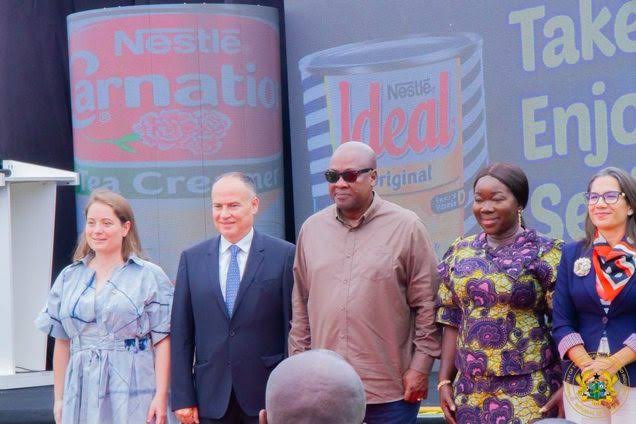
President John Dramani Mahama has commissioned Nestlé Ghana’s expanded evaporated-milk production line in Tema as part of a wider tour of manufacturing businesses, including Three Dreamer Manufacturing and Kasapreko. Mahama presented the expansion as an example of the government’s 24-hour economy in practice and said Tema was regaining its role as Ghana’s industrial center. The new Nestlé line raises capacity to nearly 30,000 tonnes annually, while the government is linking private factory expansion to infrastructure investment, export growth and AfCFTA opportunities
President John Dramani Mahama has commissioned a major expansion of Nestlé Ghana’s evaporated-milk production line in Tema and toured other manufacturing businesses as his administration intensifies efforts to present industrial expansion, round-the-clock production and export-led manufacturing as practical evidence of its 24-hour economy agenda. The new Nestlé line, part of a GH¢59 million modernization project, will raise annual evaporated-milk production capacity from about 12,960 tonnes to nearly 30,000 tonnes, replacing machinery that had been operating for more than three decades and significantly increasing the volume of milk that can be processed and packaged locally.
Mahama commissioned the facility on Thursday, October 8, during a broader working tour that included Three Dreamer Manufacturing Company in Tema and Kasapreko PLC, where he met factory management and workers and used the visits to reinforce his government’s argument that Ghana’s industrial strategy must be measured not simply by policy announcements but by factories expanding production, operating longer hours, hiring workers and selling more goods into domestic and regional markets. At Nestlé, he described the expansion as a tangible example of what his administration means by the 24-hour economy, pointing to a factory already operating around the clock and supporting a substantial workforce.
Nestlé Ghana Managing Director Salomé Azevedo said the upgraded evaporated-milk line can produce as many as 500,000 cans a day and almost doubles the company’s previous capacity in that product category. The Tema factory already produces more than 75,000 tonnes of products annually across brands including Ideal Milk, Milo, Cerelac, Carnation and Nescafé, while the new line will increase the amount of filling, homogenization, sterilization and packaging undertaken locally. Nestlé’s operations in Ghana date back to 1957, while its Tema factory was inaugurated in 1971, making the company one of the longest-standing multinational manufacturers in the country.
Mahama said the significance of the investment goes beyond additional cans of evaporated milk, arguing that Ghana needs a manufacturing model in which local plants increasingly produce goods the country currently imports while using expanded capacity to serve markets elsewhere in Africa. He said the Nestlé investment demonstrates confidence in Ghana’s long-term economy and aligns with his administration’s industrial ambitions, particularly its attempt to link the 24-hour economy to existing manufacturers rather than treating the policy only as a new government program.
The President described the Tema factory as an example of a business that “never sleeps,” noting that Nestlé operates 24 hours a day, seven days a week. According to figures he cited during the commissioning, the company supports approximately 1,200 full-time workers and about 1,300 third-party workers, while more than 94 percent of its employees are Ghanaian. Mahama said the model illustrates the core economic argument behind extended-hour production: when factories operate for longer periods and increase output, the government expects them to create more shifts, expand supply chains and generate additional employment.
The commissioning also gave Mahama an opportunity to make a broader political and economic case about Tema, which was deliberately developed after independence as Ghana’s principal industrial city. He said Tema was beginning to regain some of the industrial importance envisioned under Ghana’s first president, Kwame Nkrumah, citing expansion at the Port of Tema, resumed activity at the Tema Oil Refinery, plans to revive the Volta Aluminium Company and continued development of industrial enclaves around the city.
The President tied those projects to a wider infrastructure strategy, arguing that manufacturing cannot expand sustainably without reliable electricity, efficient roads, port capacity, rail links and predictable logistics. He said the government’s responsibility is to create the conditions in which companies can invest capital with confidence, while businesses are expected to respond by expanding productive capacity and employing more people.
During the visit, Mahama also pointed to Ghana’s recent foreign direct investment numbers as evidence of improving investor sentiment. He said foreign direct investment increased from approximately $624 million in 2024 to $2.62 billion in 2025, while falling inflation, easing interest rates and improved currency stability were helping businesses plan investments with greater confidence. Those figures were presented by the President as part of his argument that macroeconomic stabilization must ultimately translate into physical investments, production capacity and jobs rather than remain a statistical achievement.
The government is also promising reforms intended to reduce some of the obstacles manufacturers face. Mahama said customs procedures are being simplified, tax incentive arrangements are being reviewed and public services are being digitized to make interactions between companies and the state faster and more predictable. He also pledged continued investment in energy and transport infrastructure, telling manufacturers that fiscal stability and reliable electricity would be essential if the country expects companies to invest in plants designed to operate around the clock.
The Nestlé expansion is particularly important to the government’s narrative because it involves an established manufacturer adding capacity rather than a newly announced project that may take years to become operational. The old evaporated-milk line had served the Tema plant for more than 30 years and had reached its capacity limits. Replacing it with machinery capable of lifting production to nearly 30,000 tonnes a year gives the administration an immediate example of industrial expansion it can point to while promoting the 24-hour economy.
Mahama urged Nestlé to deepen its links with Ghanaian farmers, suppliers and smaller businesses so that increased factory production creates benefits beyond the walls of the plant. The larger economic challenge for Ghana is not simply producing finished consumer goods locally but increasing the proportion of inputs, services, packaging, logistics and agricultural products sourced from domestic businesses. Greater local sourcing would allow manufacturing growth to circulate through more parts of the economy rather than relying heavily on imported inputs.
The President also urged the company to use the expanded capacity to target markets outside Ghana. With the African Continental Free Trade Area Secretariat headquartered in Accra, the government has repeatedly argued that Ghana should position itself as a production base for the continent rather than focus almost exclusively on its relatively small domestic market. For businesses such as Nestlé, that means using Ghanaian production facilities to supply consumers across West and Central Africa where commercially viable.
Mahama’s next stops reinforced that theme. At Three Dreamer Manufacturing Company in Tema, he toured a locally operating manufacturer producing and distributing a wide range of fast-moving consumer goods, including diapers, sanitary pads, toilet rolls, non-dairy creamer, biscuits, candies, fish snacks, beef snacks, LED bulbs and canned foods. The company’s diverse product range gave the President another example of the kind of light manufacturing his government says can absorb workers while replacing imports and building export capacity.
He praised employees at Three Dreamer and said their jobs demonstrated one of the practical ways the 24-hour economy could translate into opportunities for ordinary Ghanaians. Mahama told workers that expanding businesses required cooperation between owners, management and employees, arguing that higher productivity and profitability could allow companies to add production lines and employ more people.
The President also encouraged Three Dreamer to look beyond Ghana’s borders. He said companies capable of producing consumer goods locally should use African regional markets to increase scale, because exporting Ghanaian-made products creates jobs domestically while bringing revenue into the economy. The administration’s industrial policy increasingly relies on that connection between local production and continental trade, particularly as Ghana attempts to capitalize on its role as host of the AfCFTA Secretariat.
Mahama’s visit to Kasapreko added a different dimension to the tour because the company represents one of Ghana’s most recognizable indigenous manufacturing success stories. He praised Kasapreko’s expansion and its growing presence outside Ghana, while using the company to raise the issue of succession planning in locally owned businesses. He argued that too many Ghanaian enterprises decline or collapse when founders retire or die because the businesses were built around individuals rather than durable corporate structures.
Kasapreko, he said, offered an example of a Ghanaian company that had managed to transition leadership beyond its founder while continuing to grow. The President encouraged other entrepreneurs to build institutions capable of surviving leadership transitions, saying the long-term strength of Ghana’s private sector depends on businesses that can endure for generations rather than disappearing when their founders step aside.
The manufacturing tour also allowed Mahama to highlight the role of Trade, Agribusiness and Industry Minister Elizabeth Ofosu-Adjare, whom he praised for maintaining close contact with private-sector companies and identifying problems affecting manufacturers. The government renamed the ministry to explicitly include agribusiness and industry, an adjustment intended to signal a stronger emphasis on connecting agricultural production, processing and industrial expansion.
That connection will be critical if Ghana is to extract more value from its agricultural output. While the country exports significant quantities of raw commodities, successive governments have struggled to build enough local processing capacity to capture the higher-value stages of production. The administration is presenting food processing, consumer manufacturing and agribusiness as areas where the 24-hour economy could increase employment relatively quickly if companies have sufficient energy, financing and access to markets.
Mahama’s emphasis on Tema also reflects the city’s strategic advantages. The industrial corridor sits beside Ghana’s largest seaport, contains some of the country’s most important manufacturing and energy infrastructure and has historically served as a center for heavy and light industry. The government has additionally begun work connected to the 120-hectare Tema Integrated Industrial Park near VALCO and the Port of Tema, which is intended to support manufacturing, aluminium processing and export-oriented businesses.
Reviving VALCO remains an important part of that strategy because aluminium offers the potential for a deeper domestic value chain stretching from bauxite extraction to refining, smelting and manufactured aluminium products. Mahama said government work on VALCO, the Tema Oil Refinery and other industrial assets should be seen alongside private expansions such as Nestlé’s rather than as isolated projects.
However, the broader industrial ambitions will depend heavily on whether Ghana can maintain reliable power and predictable production costs. Manufacturing companies have repeatedly identified electricity prices, exchange-rate volatility, imported input costs, financing and taxation as major constraints. A factory designed to operate 24 hours cannot deliver the expected benefits if power interruptions or high energy bills make additional shifts commercially unattractive.
Mahama acknowledged those constraints and said government would continue working to ensure a resilient energy system and more stable economic conditions. His administration is effectively asking manufacturers to increase investment while promising that the state will improve the infrastructure and macroeconomic environment needed to make those investments profitable.
The economic logic of the 24-hour economy also extends beyond factories. The government has described the policy as a wider attempt to create an economy in which selected businesses, ports, public services, logistics networks and commercial activities can operate in multiple shifts, reducing downtime and increasing utilization of existing infrastructure. Manufacturing is one of the sectors where that concept can be demonstrated most clearly because factory output can be directly measured against operating hours, capacity and workforce shifts.
The Nestlé project therefore provides the government with a useful case study, although the expansion itself is a private corporate investment rather than a factory created by the 24-hour economy policy. Nestlé already operates continuously, and Mahama’s argument is that the plant demonstrates the type of production model the government wants more companies to adopt and expand. That distinction is important because the administration is using existing round-the-clock industrial operations as examples of what the broader policy seeks to encourage.
The President’s visit also comes at a time when his government is under pressure to demonstrate that improving macroeconomic indicators are translating into jobs and household income. Falling inflation or increased foreign investment can strengthen confidence, but their political and social impact depends on whether businesses expand payrolls and whether workers experience improvements in real income.
Industrial expansion is therefore becoming one of the administration’s central tests. Investments such as Nestlé’s modernization project offer visible evidence of increased production capacity, but the larger question will be whether similar expansions occur across enough companies and sectors to materially change employment and manufacturing’s contribution to the economy.
For Nestlé, the new evaporated-milk line represents a substantial modernization of a product that has been manufactured in Ghana for decades. For the government, the line has become something larger: an example of the industrial behavior it wants to encourage, with factories operating continuously, producing locally, employing Ghanaian workers and targeting markets beyond the country.
The visits to Three Dreamer and Kasapreko reinforced the same message from different angles. Three Dreamer represents expanding consumer-goods manufacturing and job creation, while Kasapreko illustrates the potential for an indigenous Ghanaian manufacturer to build scale, develop export markets and survive beyond its founding generation.
Mahama’s industrial tour was therefore designed to connect several strands of his economic agenda in one narrative: macroeconomic stability, private investment, local manufacturing, export growth, infrastructure development and the 24-hour economy. The administration’s challenge will be turning that narrative into a broad industrial trend rather than relying on a small number of successful companies as examples.
For now, Nestlé’s Tema investment provides a concrete expansion that can be measured. Annual evaporated-milk capacity is rising from roughly 12,960 tonnes to nearly 30,000 tonnes, the new line can produce as many as 500,000 cans a day, and the factory continues to operate around the clock. Whether Ghana can replicate that scale of investment across more of the Tema industrial corridor and the wider economy will determine how far the government’s 24-hour manufacturing ambitions move from policy language into sustained industrial growth.